
You flip the switch and get a low hum, a loud clunk, or nothing at all. Holiday cooking makes this worse, because peels, bones and the odd spoon all head for the same drain in the same week. Before you assume the unit is dead, it helps to know that most disposal failures are small.
To fix a garbage disposal, match the symptom first: a hum means a jam, silence means the reset button or power, and water underneath means a leak. A jam or a tripped reset is usually fixed in about 10 minutes with a hex key, the small L shaped wrench that fits the bottom of the unit.
How do you fix a garbage disposal that is not working?
Start by listening. The sound the disposal makes when you flip the switch tells you which of four problems you have, and each one has a different fix.
It hums but does not spin. The motor is getting power, but something is stopping the spinning plate inside. That is a jam. It is the most common problem we see, and you can usually clear it yourself.
It makes no sound at all. No power is reaching the motor. The cause is almost always the red reset button on the bottom of the unit, a tripped breaker or outlet, or a plug that has worked loose under the sink.
It runs, but water drips underneath. The motor is fine. Water is getting out at one of three places: the top where the unit meets the sink, the side where the drain pipe connects, or the bottom of the unit itself. Where the drip starts decides whether it is a cheap fix or a replacement.
It runs, but the sink drains slowly or backs up. The disposal is doing its job, and the clog is in the pipe after it. That is a drain problem, not a disposal problem.
Across our own disposal calls, the two complaints we hear most often are "it just hums" and "it is leaking under the sink." Both of those have a clear path to a fix, and the rest of this guide walks through each one in order.
One rule covers every step that follows: never put your hand inside the disposal. Even with the switch off, a family member can flip it on without knowing you are working. Use tongs or pliers to pull anything out, and cut the power before you reach under the sink.
You need only a few tools: a flashlight, a pair of tongs or long pliers, and a hex key. Most disposals ship with the hex key taped to the side or in the box. If yours is gone, a standard 1/4 inch hex key from any hardware store fits most models.
What are the parts of a garbage disposal?
Knowing the parts makes every fix below easier, because you will know what you are turning and why. A household disposal is a small electric motor with a grinding chamber on top. Here is what is inside and around it.
- Mounting ring. The metal ring that clamps the disposal to the bottom of the sink. You twist the whole unit onto it.
- Sink flange. The shiny ring you see in the sink drain opening. It is sealed to the sink with plumber's putty, a soft clay that keeps water from leaking around it.
- Splash guard. The rubber flaps in the drain opening that keep food and spoons from flying out.
- Grinding chamber. The open cup inside the unit where food goes.
- Spinning plate and impellers. The round plate at the bottom of the chamber spins with the motor. Two small swinging lugs, called impellers, sit on top and push food outward.
- Grind ring. A ring of teeth around the wall of the chamber. The impellers fling food against it and it shreds the food into tiny pieces. Disposals do not have sharp blades, which is why a stuck spoon can stop the whole thing.
- Discharge tube. The elbow pipe on the side that carries ground food into the sink drain.
- Dishwasher inlet. A small nozzle on the side of the unit where the dishwasher drain hose connects.
- Hex socket and reset button. Both live on the bottom of the unit. The socket lets you turn the motor by hand. The red button resets the motor after it overheats.
Here is what the inside actually looks like on a disposal one of our technicians pulled apart.
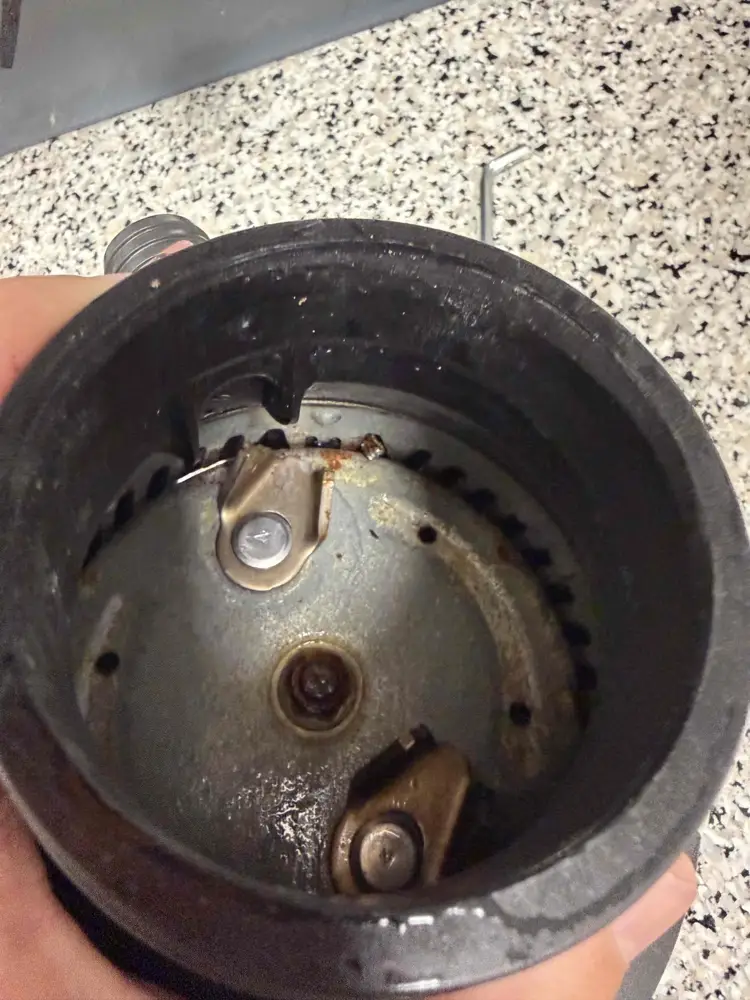
These two swinging lugs are the impellers, and the toothed ring around them is the grind ring: if either is broken or seized with rust, the unit needs to be replaced. When they swing freely and the teeth are intact, a jam is just something wedged between them, and you can clear it.
The top of the unit is where it connects to your sink and dishwasher. This old unit was removed during a replacement, so you can see the parts that are normally hidden.
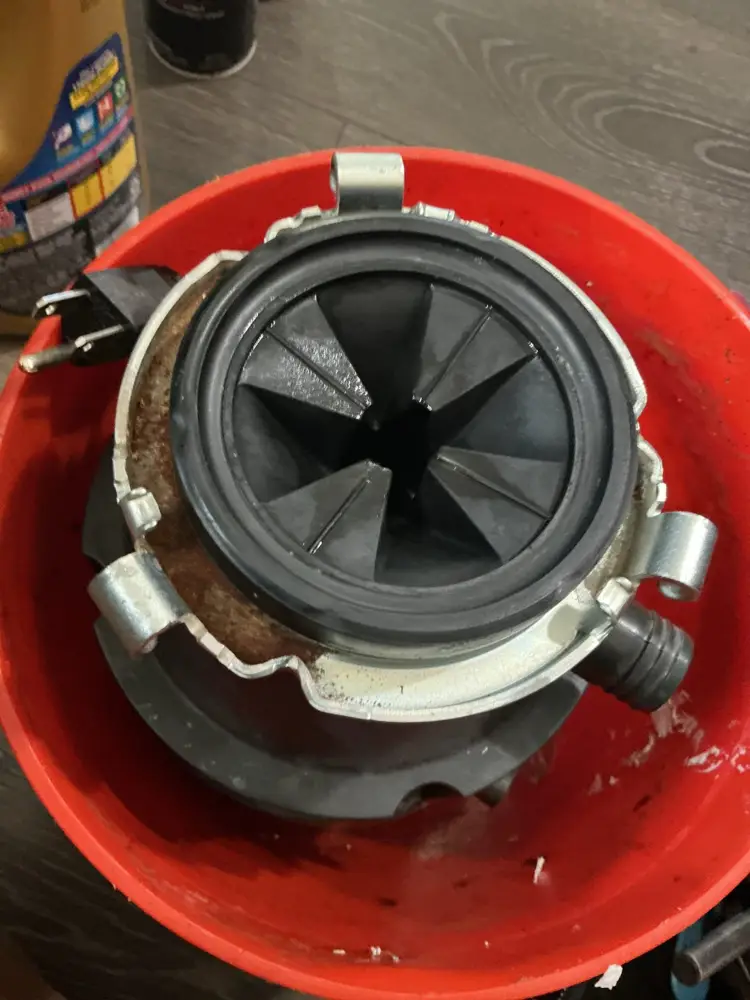
The black rubber is the splash guard, the metal clamp around it is the mounting ring, and the nozzle on the right is the dishwasher inlet. The rust around the top rim of this one is a sign water had been leaking at the sink connection for a long time.
Why does my garbage disposal hum but not spin?
A hum with no grinding sound means the motor is trying to turn and cannot. Something is wedged between the impellers and the grind ring, or the plate has rusted in place after sitting unused for a while. If you leave it humming, the motor overheats and the reset button trips, so turn it off right away.
The fix is to turn the motor by hand from underneath until the jam breaks loose. This works on the large majority of jammed units.
Step 1: Cut the power. Turn off the wall switch. Then unplug the disposal from the outlet under the sink, or turn off its breaker if it is wired straight into the wall. A disposal can restart the moment a jam clears, so do not skip this.
Step 2: Find the hex socket. Look at the very center of the bottom of the unit with a flashlight. You will see a small six sided hole. That is where the hex key goes.
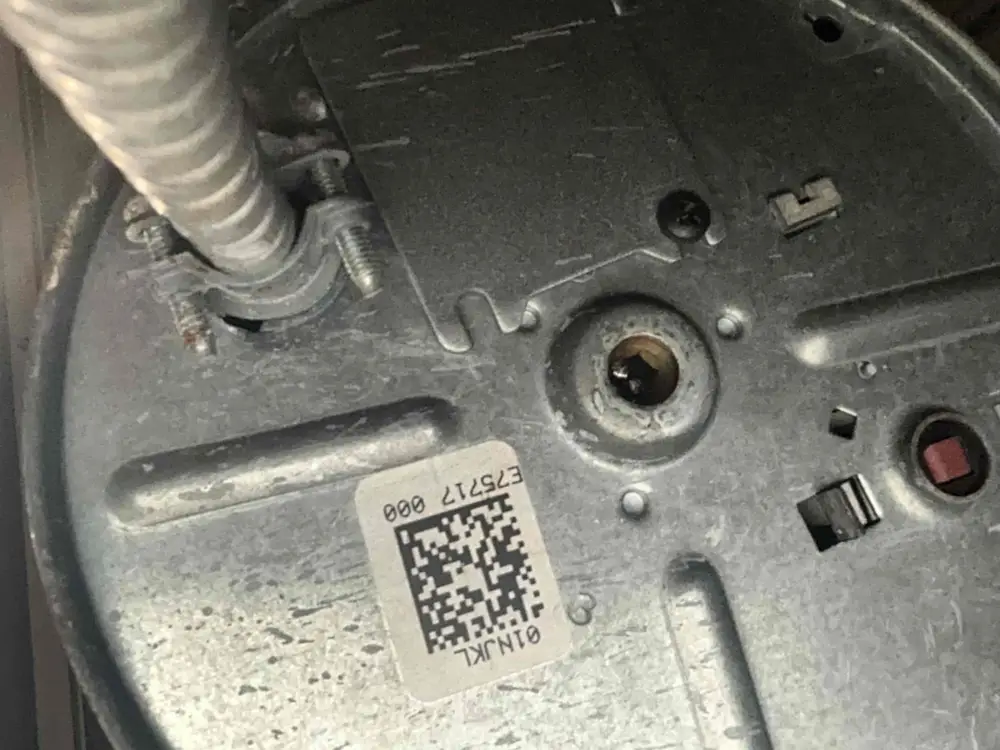
The hole in the center is the hex socket, and the red square to the right is the reset button: these two parts fix most humming disposals. This unit is wired straight into the wall through the metal cable on the left, so the power for it is cut at the breaker, not by unplugging.
Step 3: Work the hex key back and forth. Push the key into the socket and turn it in both directions. It will feel stuck at first. Keep rocking it with steady pressure until it breaks free and turns a full circle easily. That means the plate is spinning again.
Step 4: Pull out what caused it. With the power still off, shine a light down the drain and remove the loose object with tongs or pliers. Common culprits on our calls include silverware, bottle caps, a soup can lid, bits of glass, fruit pits and bones.
On one call last fall, a homeowner had already tried the reset button and the disposal still hummed. Our technician freed the plate from underneath and pulled this out of the chamber.
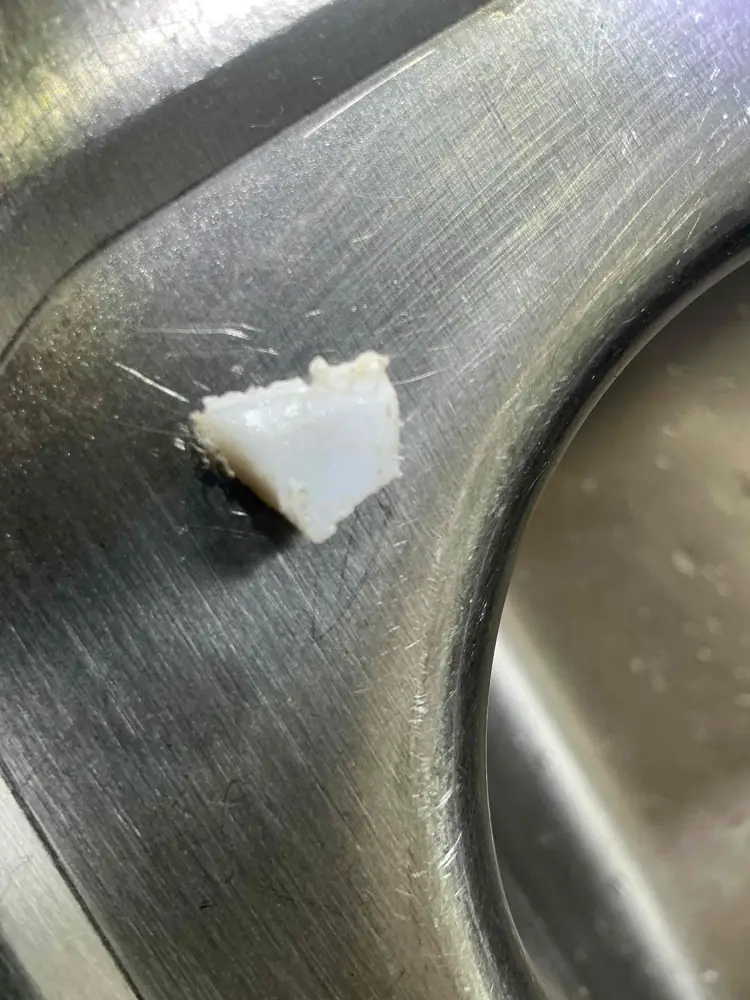
This piece of hard plastic was the whole problem: once it was out, the disposal spun freely and did not need to be replaced. A small object like this can lock the plate completely, so a hum almost never means the motor is dead.
Step 5: Press the reset button and test. Push the red reset button on the bottom until it clicks and stays in. Restore power, run cold water, and turn the disposal on. It should spin with a smooth whir.
If the hex key will not move at all, even with firm pressure, or the unit hums again right after you clear it, stop. The motor bearings may be seized or the plate may be rusted solid, and forcing it can crack the housing.
What should I do if my garbage disposal will not turn on at all?
Silence means power is not reaching the motor. Work through these checks in order, because each one takes under a minute and the first one fixes it most of the time.
Step 1: Press the reset button. Every disposal has an overload switch that cuts the motor when it gets too hot, usually after a long jam or grinding a big load. Wait several minutes for the motor to cool, then press the red button on the bottom firmly. If it was tripped, it will click and stay in.
Step 2: Check the outlet and the breaker. Many kitchens put the disposal outlet on a GFCI, a safety outlet with test and reset buttons that cuts power when it senses a fault. Look for a GFCI under the sink or on the counter nearby and press its reset button.
Then check your electrical panel for a tripped breaker, which sits in the middle position instead of fully on.
Step 3: Check the plug. If the unit plugs in, make sure the cord has not worked loose. Dishes and cleaning bottles under the sink knock plugs halfway out more often than you would think.
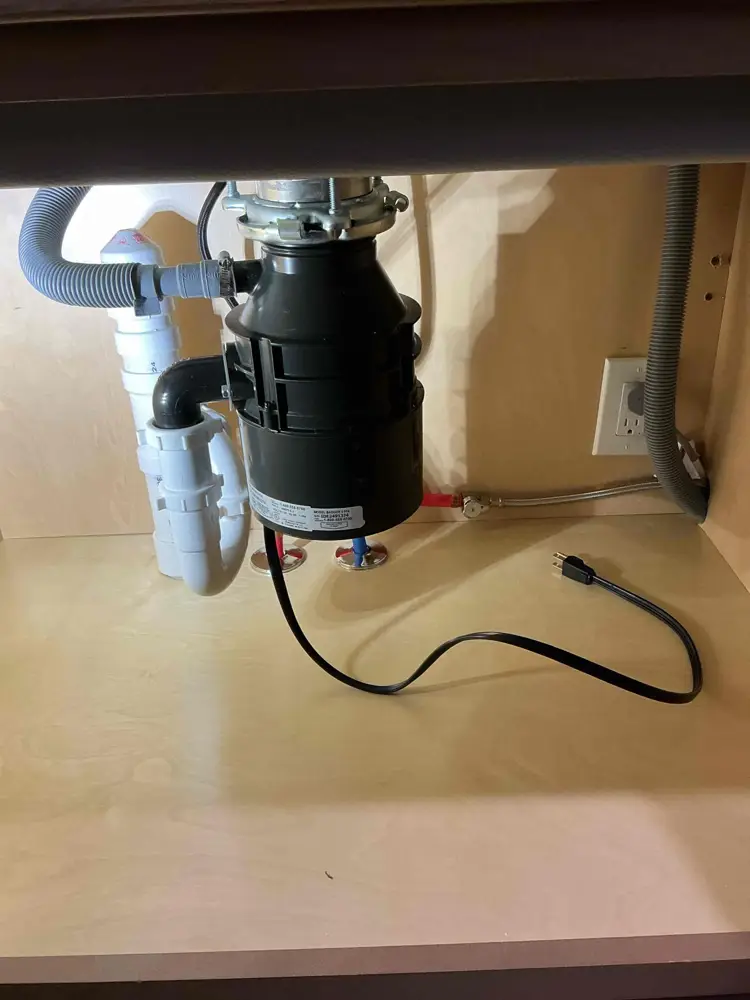
This disposal plugs into the outlet on the cabinet wall, so a loose plug is the first thing to check when it goes silent. On plug in units, you can test the outlet itself by plugging in a lamp or phone charger.
Step 4: Check the wall switch. If the outlet has power and the reset button is in, the switch itself may have failed. Switches wear out on disposals because they get flipped thousands of times. This is a job for an electrician if you are not comfortable working with wiring.
Step 5: Test once more. Run cold water and flip the switch. If you hear a hum now, the unit has power but is jammed, so go back to the hex key steps above.
If every check passes and the unit is still completely silent, the motor has likely failed. On most household disposals, a dead motor means a new unit, because the motor is not sold as a separate part.
Why is my garbage disposal leaking underneath?
A leak under the sink is the second most common disposal complaint we see, and the fix depends entirely on where the water starts. Dry everything off with a towel, put a dry paper towel under each connection, run water with the disposal on, and watch which towel gets wet first.
Leak from the top, at the sink. Water is getting past the sink flange or the mounting ring. The plumber's putty under the flange may have dried out, or the mounting ring may have loosened from vibration. Tightening the mounting ring fixes some of these.
Others need the flange pulled and resealed with fresh putty, which means taking the disposal off the sink.
Leak from the side. Water is coming from the discharge tube or the dishwasher hose. Both are held with a gasket, a rubber seal, and a clamp or a pair of bolts. Tightening the bolts or replacing the gasket usually stops it.
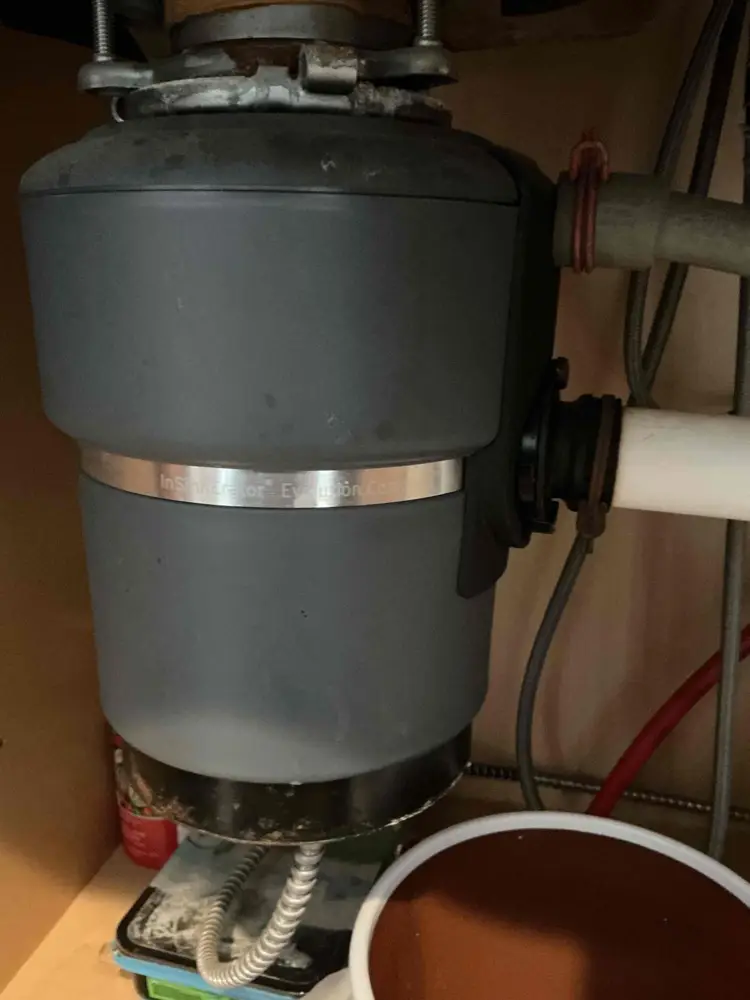
This side connection is where the drain pipe meets the disposal, and a drip here is usually a worn gasket, which is a small repair. On this job the homeowner reported water coming out of the side, so this is the first place our technician checked.
Below the side outlet, the discharge tube runs into the trap, the curved pipe that holds water to block sewer gas. Slip nuts on the trap can loosen too.
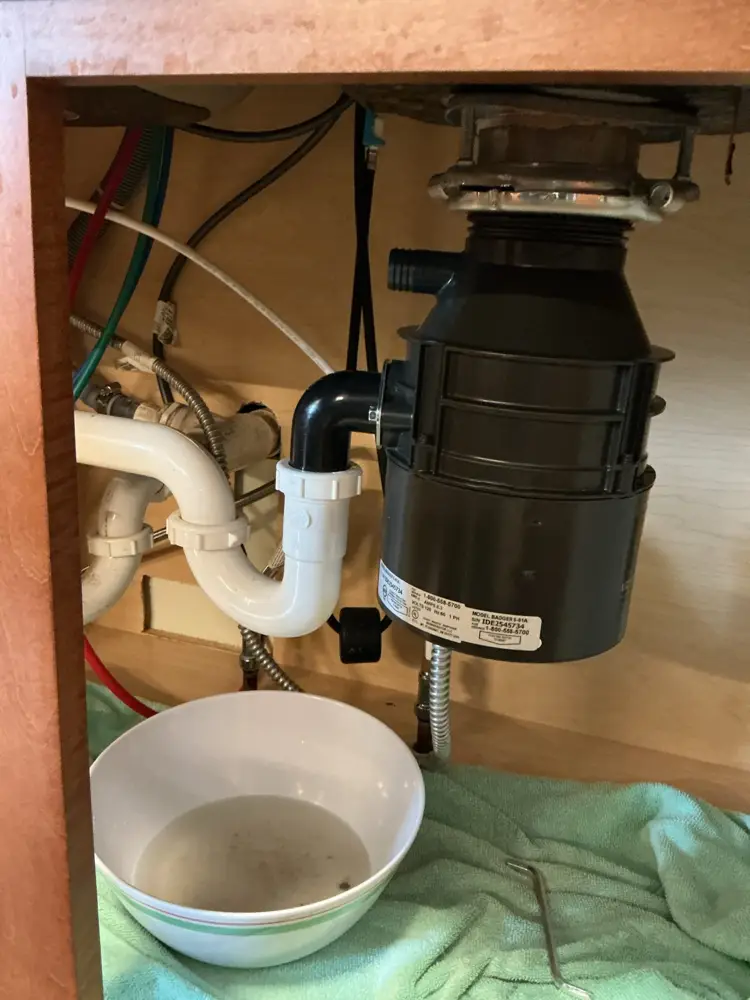
The bowl under this sink was catching a slow drip: when the leak is at the pipe joints like these and not the disposal body, the disposal itself can stay. Hand tighten each slip nut a quarter turn and check again before you buy anything.
Leak from the bottom of the unit. This is the one that is not worth fixing. Water coming out of the bottom means an internal seal has failed and water is reaching the motor. There is no practical repair.
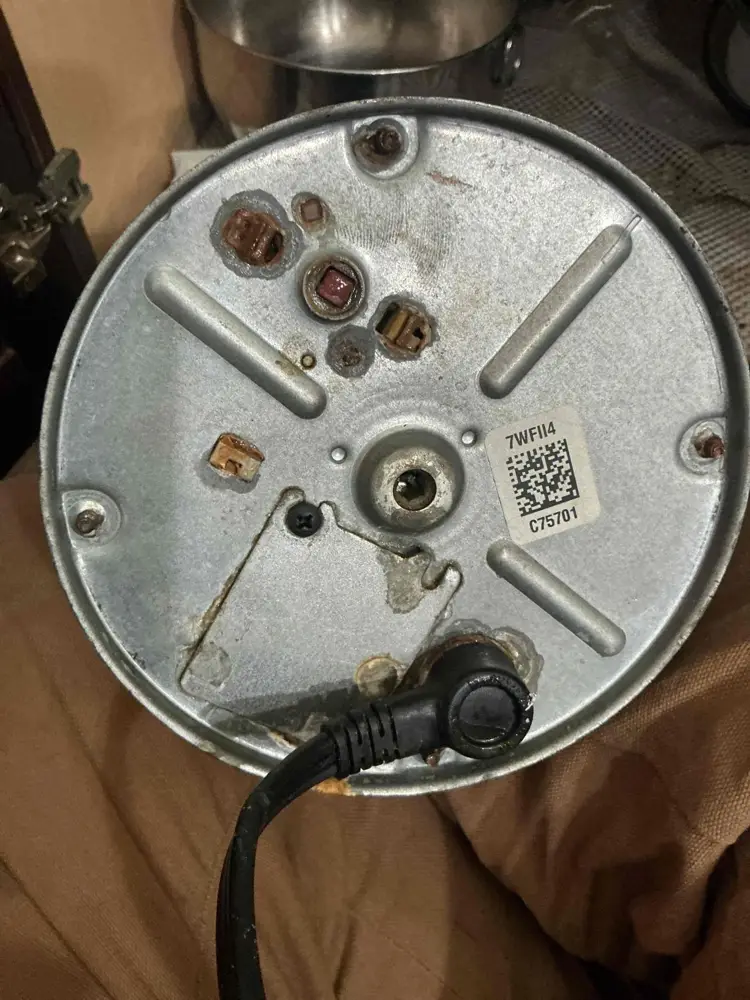
Rust streaks like these on the bottom of a disposal mean water has been getting inside the motor housing: this unit was past saving and was replaced. Compare it with the clean bottom plate earlier in this guide. If yours looks like this, skip the repairs and plan for a new unit.
Leaks also damage the cabinet. Particleboard swells and stains quickly, so do not let a slow drip go for weeks.
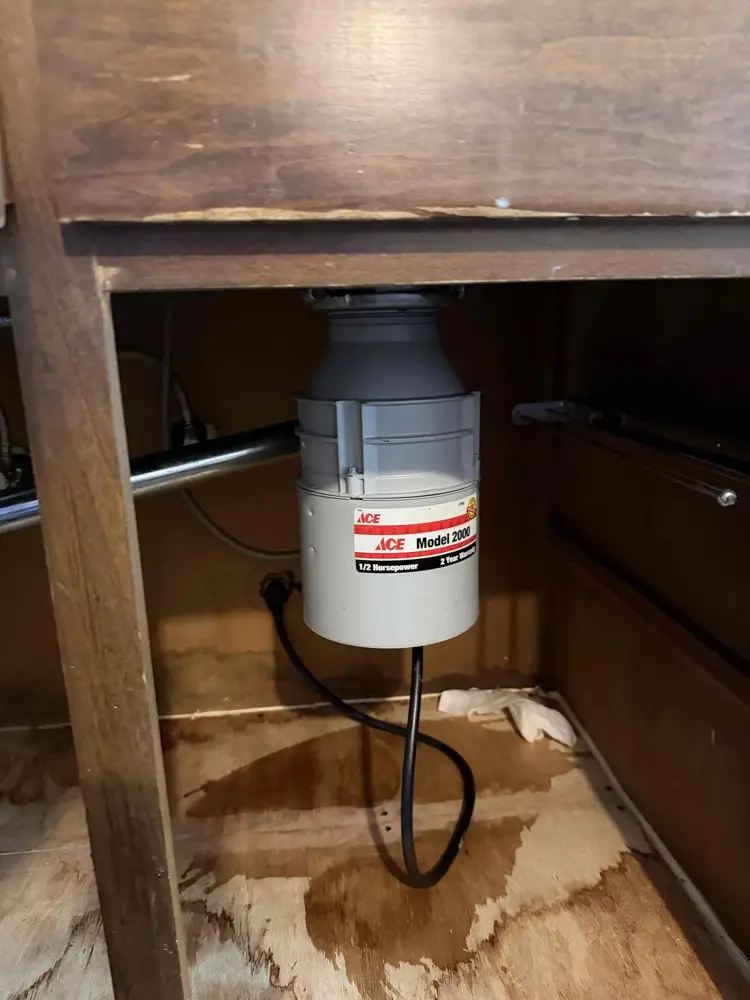
These dark rings on the cabinet floor came from a disposal that leaked every time the sink was used: catch it early and the fix is a seal, wait and the cabinet floor needs replacing too. If you cannot tell where the water is coming from, a leak detection visit finds it without guesswork.
Why does my garbage disposal make a loud grinding or rattling noise?
A disposal should make a steady whir. A metallic clatter, a rattle or a banging sound usually means something hard is bouncing around the chamber. Turn it off right away, because hard objects chip the grind ring and bend the impellers.
Step 1: Cut the power at the switch and the plug or breaker, exactly as you would for a jam.
Step 2: Look and fish it out. Shine a flashlight into the chamber and remove anything you see with tongs. Small pieces often hide under the edge of the splash guard, so push the flaps aside to look.
On a call for a disposal making a loud metallic noise, our technician found this fragment inside the unit.
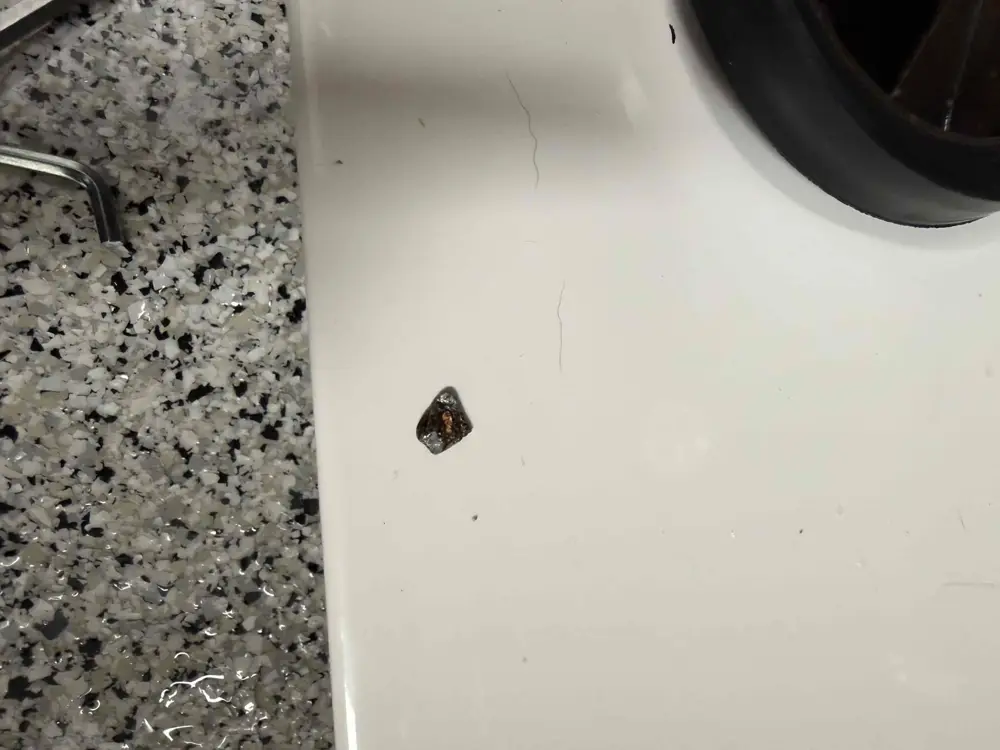
This small metal piece was enough to make the whole unit sound like it was breaking: removing it brought the noise back to normal. Even something this size can bend an impeller if the disposal keeps running on it.
Step 3: Turn it by hand. Use the hex key from below to rotate the plate a full turn or two. If it moves smoothly, restore power and test with cold water.
If the noise continues after the chamber is clear, the problem is likely a loose or broken impeller or worn motor bearings. Both are signs the unit is near the end of its life.
Why does my sink back up when the disposal runs?
If the disposal spins fine but water rises in the sink, or comes up in the other bowl of a double sink, the clog is past the disposal. Ground food, grease and starch build up in the trap and the drain line behind the wall.
First, check the obvious one. If a dishwasher was just installed, the knockout plug inside the dishwasher inlet may never have been removed. That small plastic disk blocks the dishwasher hose and causes water to back up into the sink when the dishwasher drains. It has to be punched out before the hose is connected.
For a clog in the pipe, our guide to how to unclog a kitchen sink walks through plunging and clearing the trap safely. Skip chemical drain cleaners, which can sit in the disposal and damage the seals; we cover why in is Drano bad for pipes.
Your disposal is also bound by the plumbing code. The Michigan plumbing code requires a household disposal to connect to a drain at least 1 1/2 inches wide (Section 416), and spells out how dishwasher drains must connect (Section 802.1.6).
A drain that was rebuilt too narrow during a remodel will keep backing up no matter how often it is cleared.
Food that does not grind well makes backups more likely. Grease, coffee grounds, pasta, rice, eggshells and fibrous peels like celery and onion skins all pile up in the pipe. The EPA has practical ideas for cutting kitchen food waste at the source, which also means less going down the drain.
If you clear the trap and it still backs up, or several drains in the house are slow, the clog is deeper. That is when professional drain cleaning makes sense.
Should I repair or replace my garbage disposal?
Most disposals that hum, trip, or leak at a connection can be fixed in place. Replacement makes sense when the problem is inside the unit. Here is how to tell.
| What you see | What it usually means | Repair or replace |
|---|---|---|
| Hums, hex key frees it | Object jammed the plate | Repair it yourself |
| Silent, reset button clicks in | Motor overheated | Repair it yourself |
| Drip at side connection or trap | Worn gasket or loose nut | Repair |
| Drip at the sink flange | Dried out putty or loose ring | Repair |
| Water from the bottom of the unit | Failed internal seal | Replace |
| Hex key will not move at all | Seized bearings or rusted plate | Replace |
| Silent after every check | Burned out motor | Replace |
| Keeps tripping the reset button | Motor wearing out | Replace soon |
Age matters too. Manufacturers like InSinkerator publish troubleshooting and support guides for their units, which are worth reading before you buy parts. In our experience, an older unit that develops a second problem within a year is rarely worth another repair, and a new unit is the better spend.
When you replace, a licensed plumber should handle the drain and dishwasher connections so they meet code and do not leak into the cabinet.
Our garbage disposal installation team swaps the unit, reseals the sink, and tests the dishwasher drain before leaving. For cleaning and odor problems, which are separate from the fixes here, see how to clean a garbage disposal.
Where is the reset button on a garbage disposal?
The reset button is on the bottom of the unit, usually a small red or black button near the center or the edge. Press it firmly after letting the motor cool for several minutes. If it clicks and stays in, it had tripped.
What size hex key fits a garbage disposal?
Most household disposals take a 1/4 inch hex key in the socket at the center of the bottom. Many units ship with one taped to the side or in the box. Any hardware store sells them.
Is it safe to put my hand in a garbage disposal?
No. Even with the switch off, someone can turn it on without knowing you are working. Cut the power at the plug or breaker and use tongs or pliers to remove objects from the chamber.
Why does my garbage disposal keep tripping the reset button?
Repeated tripping means the motor is overheating. A partial jam, grinding large loads without enough cold water, or a worn motor can cause it. Clear any jam first. If it keeps tripping, the motor is near the end of its life.
Can a leaking garbage disposal be fixed?
It depends on where it leaks. Leaks at the sink connection, the side drain pipe or the dishwasher hose can usually be fixed with new putty, a gasket or tightening. Water coming from the bottom of the unit means an internal seal failed, and the unit should be replaced.
Why does my garbage disposal hum after I reset it?
A hum after a reset means power is back but the plate still cannot spin. Something is jammed inside. Cut the power, turn the hex key on the bottom back and forth until it spins freely, remove the object, then test again.
How long does a garbage disposal last?
It depends on how heavily it is used and what goes down it. Rust on the bottom, repeated tripping and frequent jams are signs a unit is wearing out.
Who can fix my garbage disposal in Grand Rapids?
If you have tried the reset button and the hex key and the disposal still will not cooperate, or water is coming from the bottom of the unit, NSP Plumbing can help. We are a licensed Michigan plumbing contractor (license #8004990) based in Wyoming, MI.
We repair and replace garbage disposals across Grand Rapids, Wyoming, Kentwood, Grandville, Jenison and Walker. Our technicians tell you whether the unit can be saved before recommending a new one, and if a reset is all it needed, we will say so.
For other kitchen and fixture problems, see our plumbing repair services or contact us with a question.
Disposal still humming or leaking?
Tell us what the disposal is doing and when it started. A licensed NSP Plumbing technician will come out, find the cause, and explain whether it can be repaired or needs replacing before any work begins.