
Most people never look inside a toilet tank until something goes wrong. The handle feels loose, the water keeps hissing, or the flush suddenly needs two tries.
Once you know the handful of parts in there, most toilet problems stop being a mystery.
A toilet works by gravity and a siphon: the tank dumps its water into the bowl, that rush starts a siphon that pulls the bowl empty, and the fill valve refills both. Every repair comes back to one of those three jobs.
How does a toilet work?
A standard toilet is two connected containers. The tank on the back holds clean water, usually somewhere around a gallon and a half. The bowl in front holds a smaller pool of water that seals the drain and keeps sewer gas out of your bathroom.
When you push the handle, three things happen in order:
- The tank empties. The handle lifts a rubber seal at the bottom of the tank, and the stored water drops into the bowl in a few seconds.
- The bowl siphons. That sudden rush fills the curved passage built into the bowl faster than it can drain. The passage runs full, and once it does, it acts like a siphon hose and pulls everything in the bowl down the drain.
- The tank refills. As the tank empties, a valve opens and lets fresh water back in. A small tube sends some of that water into the bowl so the seal of water is back in place when the flush is done.
That is the whole machine. No motor, no electricity, no pump in a regular toilet. It is gravity doing the pushing and a siphon doing the pulling.
The siphon is the clever part, and it is why a toilet can clear the bowl with so little water. It is also why a weak flush usually means the siphon never fully started, not that the drain is broken. We explain that in detail further down.
If your toilet is acting up right now and you just want to know which part to blame, skip to the section on what each problem means. If you want to understand the machine first, keep reading. It takes about five minutes and it will save you a lot of guessing at the hardware store.
What are the parts inside a toilet tank?
Lift the tank lid (set it down on a towel, it is heavy and breaks easily) and you will see six parts. Here is a real tank from an apartment toilet NSP serviced in March 2026, with each part labeled.
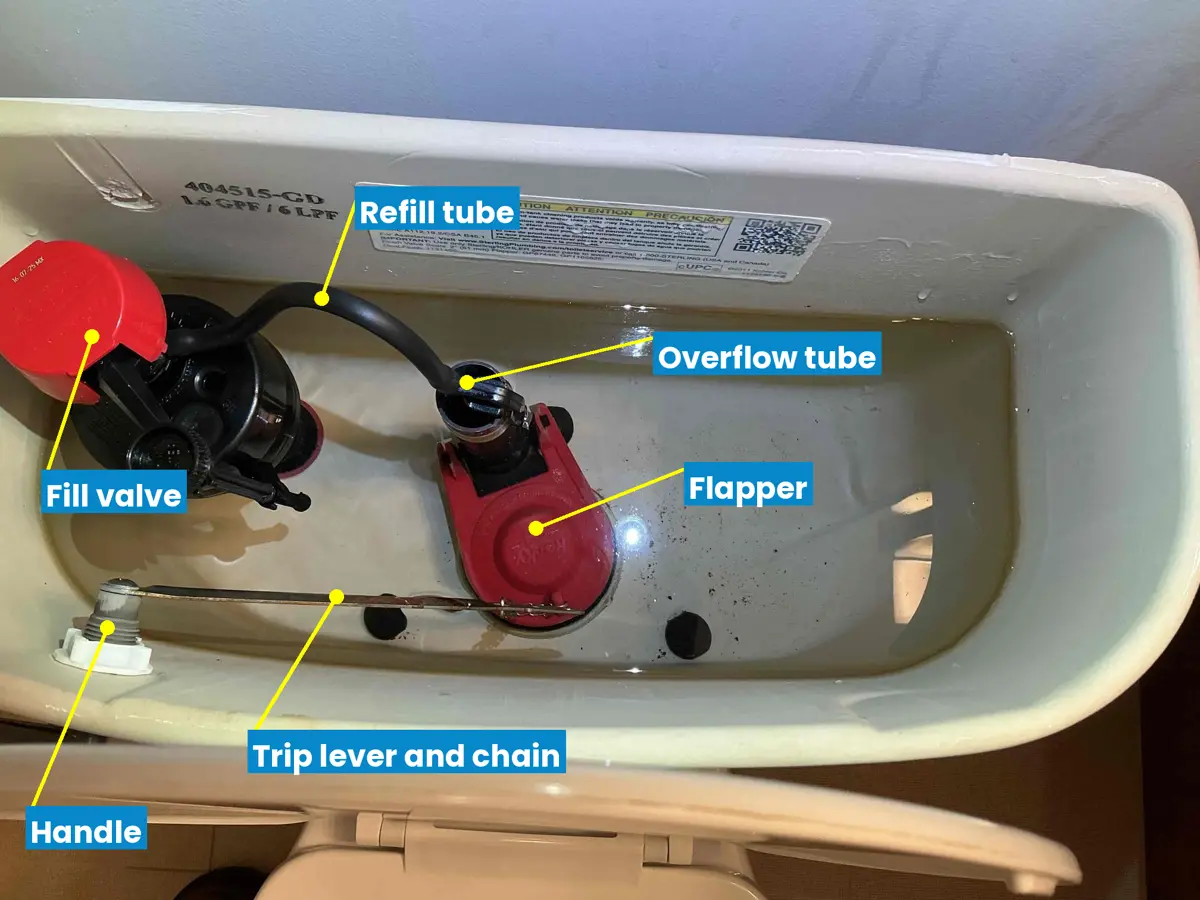
This is what a healthy modern tank looks like: a tall fill valve on the left, the flapper and overflow tube in the middle, and the handle arm reaching across. The molded label on the back wall says 1.6 GPF, which means 1.6 gallons per flush.
Here is what each part does, in plain words:
Handle and trip lever. The handle on the outside turns a metal or plastic arm inside the tank, called the trip lever. The lever is attached to a small chain.
Chain. The chain connects the trip lever to the flapper. When the lever rises, the chain pulls the flapper up. It needs a little slack, about half an inch. Too tight and the flapper cannot close. Too loose and the flapper barely lifts.
Flapper. A rubber or silicone cap that sits over the big hole in the bottom of the tank. It is the door between the tank and the bowl. When it lifts, the tank empties. When it drops back down, it seals so the tank can fill again.
Flush valve. The opening the flapper sits on, plus the ring it seals against (called the seat). If the seat is rough or scaled with minerals, even a new flapper can leak.
Overflow tube. The open pipe standing up next to the flapper. If the water ever rises too high, it spills into this tube and goes down to the bowl instead of over the top of the tank onto your floor.
The Michigan plumbing code requires every flush tank to have one, and it has to drain into the toilet it serves.
Fill valve. The tall valve, usually on the left side, connected underneath to your water supply. It opens when the water level drops and shuts off when the tank is full. Older toilets call it a ballcock.
Float. The part that tells the fill valve when to stop. On newer valves it is a small cup that slides up and down the valve body. On older toilets it is a ball on the end of a long arm.
Refill tube. The thin flexible hose running from the fill valve to the top of the overflow tube. While the tank fills, it sends a stream of water into the overflow tube, which drains to the bowl and puts the water seal back.
What are the parts of the bowl?
The bowl looks like one solid piece of porcelain, and it mostly is. The working parts are molded into it, plus two hidden parts underneath that hold it to the floor and the drain.
Rim holes. Look under the rim of the bowl with a hand mirror and you will see a ring of small holes. Part of the flush water comes out here and washes down the sides of the bowl.
Siphon jet. Many toilets have one larger hole at the bottom of the bowl, aimed at the drain. It shoots a strong stream straight into the trapway to kick the siphon off faster.
Trapway. The curved passage cast inside the bowl that leads to the drain. It rises up and then drops down, like a sideways S. The water sitting in the bowl is the part of the trapway that stays full between flushes. That standing water is your seal against sewer gas, the same job the curved pipe under your sink does.
Wax ring. A thick ring of wax (or a foam or rubber gasket on some newer toilets) that seals the bottom of the toilet to the drain pipe. You never see it unless the toilet is pulled up.
Toilet flange. A round fitting set into the floor that the drain pipe connects to. The two bolts that hold the toilet down hook into slots on the flange. The flange is what actually anchors the toilet, and the wax ring seals between the flange and the porcelain.
Here is what the wax ring looks like when it has failed. This toilet had a leak at the base, and once we pulled it up the old wax was squashed out of shape around the flange.
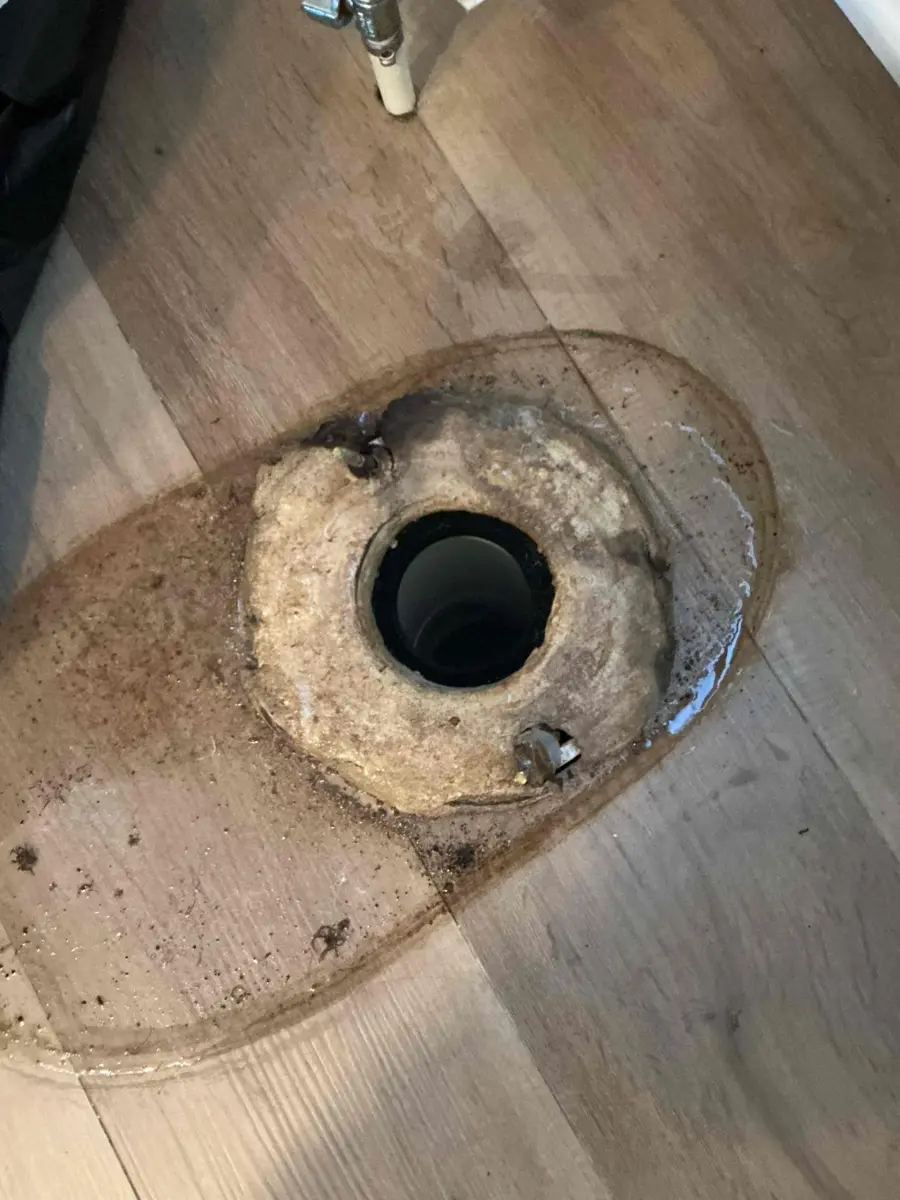
Squashed, uneven wax like this means the seal is gone: the toilet needs a new wax ring, and the flange should be checked before it goes back down. Water and waste were getting out under the porcelain every time it flushed.
When the flange itself is fine, a new wax ring and fresh bolts fix it. When the flange is cracked or the floor around it has gone soft, that has to be fixed first or the new ring will fail too. We show both outcomes in the section on a rocking toilet below.
What happens during a flush, second by second?
This is where the siphon earns its keep. Here is one full flush, slowed down.
Second zero. You push the handle. The trip lever rises, the chain goes tight, and the flapper swings open. On many flappers, a small air pocket inside keeps it floating open until the tank is nearly empty.
Seconds one to three. About a gallon and a half of water drops out of the tank. Some of it shoots through the rim holes and washes the bowl. The rest goes through the siphon jet straight into the trapway.
Seconds two to four. The trapway fills completely. This is the moment that matters. Once the curved passage runs full of water with no air gap, the weight of water falling down the drain side pulls the water behind it along. That is a siphon. It sucks the bowl empty much faster than water could simply pour out.
Second four or five. The bowl is nearly empty and air rushes into the trapway. You hear the familiar gurgle. The siphon breaks and flow stops.
Seconds three to five, inside the tank. As the tank empties, the flapper drops back onto its seat and seals. The float has fallen with the water level, which opened the fill valve. Fresh water starts flowing in.
The next 30 to 60 seconds. The fill valve keeps filling the tank. The refill tube sends a smaller stream into the overflow tube to top up the bowl. When the float rises to its set height, the fill valve shuts off. The tank is quiet and ready.
Why this matters to you: if the tank does not dump its water fast enough, the trapway never fills completely, the siphon never starts, and the water just swirls and slowly drains.
That is the classic weak flush. The usual causes are a tank water level set too low, a chain with too much slack, or rim holes and the siphon jet clogged with hard water minerals.
That last one is common around Grand Rapids. Our water is hard (the city's 2025 water analysis averages about 8 grains per gallon), and over years the minerals narrow those little rim holes. A toilet that used to flush with authority gets lazier and lazier.
What is the difference between gravity, pressure assisted and dual flush toilets?
Almost every toilet in a West Michigan house is one of these three types. They all use a siphon in the bowl. What changes is how the water gets from the tank into the bowl.
| Type | How the flush works | What you notice | Good to know |
|---|---|---|---|
| Gravity | Tank water falls into the bowl when the flapper lifts | Quiet, familiar, parts at every hardware store | By far the most common in homes |
| Pressure assisted | A sealed tank inside the tank uses your water pressure to squeeze air and push the flush | Loud whoosh, very strong flush | Parts are brand specific and cost more |
| Dual flush | Two buttons, a short flush for liquid and a full flush for solids | Buttons on top instead of a handle | Uses a tall seal instead of a flapper on many models |
Gravity toilets are what this guide mostly describes. They are simple, cheap to repair, and any plumber can get parts the same day.
Pressure assisted toilets have a plastic pressure vessel inside the ceramic tank. Your incoming water pressure compresses the air in that vessel, and the flush releases it with a bang.
They are great at clearing the bowl in one go. They are also noisy, and when the internal cartridge fails you usually need the exact brand replacement. If your home water pressure is low, they can underperform. Our guide on how to increase water pressure in your house covers that side.
Dual flush toilets let you pick the amount of water. Instead of a flapper on a chain, many use a tall cylinder that lifts straight up. The seal at the bottom of that cylinder wears out just like a flapper does, and the symptom is the same: water trickling into the bowl.
How much water a flush uses depends mostly on age. Federal law has capped new toilets at 1.6 gallons per flush since the 1990s, which you can read in the federal water closet standard.
The EPA WaterSense program labels toilets that use 1.28 gallons or less and still pass a flush performance test. EPA notes that older toilets can use as much as 6 gallons per flush, and that toilets account for nearly 30 percent of indoor water use in an average home.
If your toilet has no gallons per flush number stamped behind the tank or on the bowl near the hinge, it is probably old enough that a replacement would pay you back in water.
What do common toilet problems tell you about which part failed?
Once you know the parts, the symptoms point right at the culprit. Here is the quick map we use on service calls.
| What you notice | Part most likely at fault |
|---|---|
| Water keeps running, or a hiss you hear at night | Flapper not sealing, or fill valve not shutting off |
| Toilet refills by itself every so often with nobody using it | Flapper leaking slowly (a "phantom flush") |
| Tank takes minutes to refill | Fill valve clogged with debris, or a partly closed shutoff valve |
| Weak flush that swirls but does not empty | Low tank water level, slack chain, or mineral clogged rim holes |
| Handle feels loose or does nothing | Broken trip lever or a chain that came off |
| Water on the floor at the base, or the toilet rocks | Failed wax ring, loose bolts, or a broken flange |
| Bowl water level keeps dropping between flushes | Refill tube popped off, or a partial clog in the trapway |
Running toilets are one of the most common toilet calls we get, and the flapper and fill valve cause nearly all of them. Our full guide on why your toilet keeps running walks through testing each part.
Here is what an older fill valve looks like. This homeowner's toilet was running constantly. He had already bought a replacement fill valve, but the connection on the new part did not match his supply line.
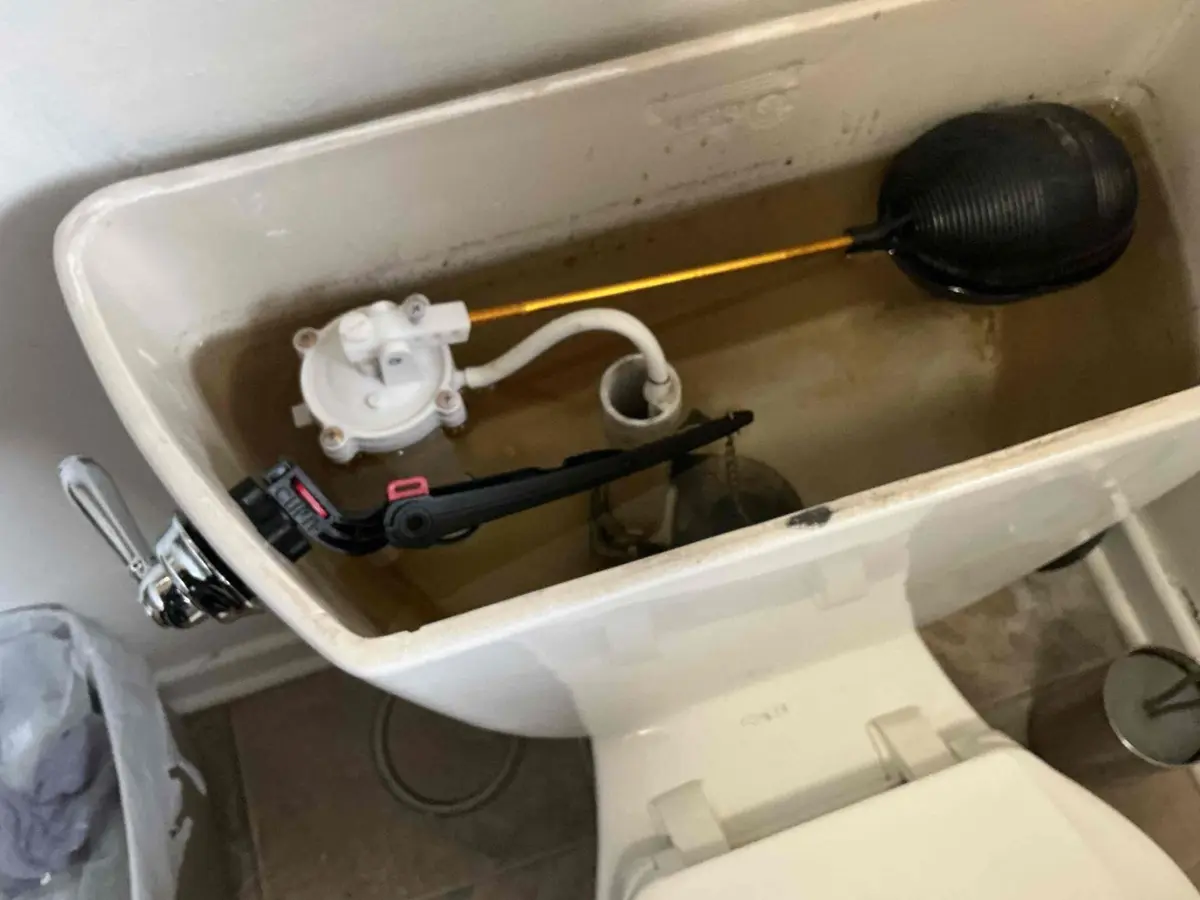
A ball on a long arm means the fill valve is an old design: when it starts running constantly, replace the whole valve instead of bending the arm. Bending the float arm down can quiet it for a while, but the worn seal inside keeps getting worse.
The mismatched connection is worth remembering. Supply lines and fill valve threads come in a few sizes, and older homes around Grand Rapids sometimes have an unusual mix. Take the old part with you to the store, or take a clear photo of where the supply line meets the tank.
The flapper is the other usual suspect. Rubber flappers get stiff and warped with age, especially in hard water and if anyone uses bleach tablets in the tank. Here is a flapper and fill valve we pulled out together on a commercial property where the owner wanted all the tank parts replaced at once.
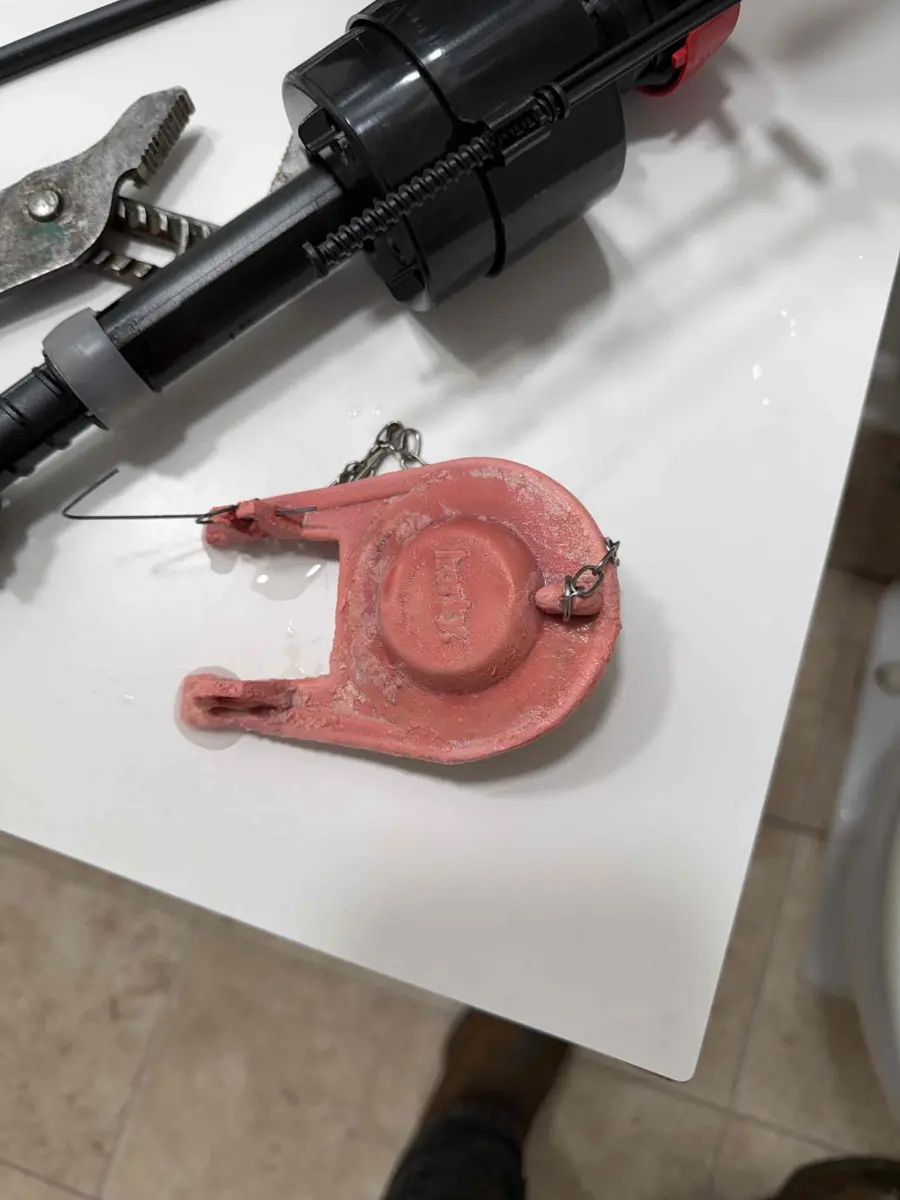
A flapper that is warped, slimy or stiff will not seal: replace it, and if the fill valve is the same age, replacing both in one visit is often the smarter call. It saves a second trip when the other part fails a few months later.
Slow refills are their own story. On this toilet the tank took about an hour to refill. You can see the rust staining around the waterline, a sign of years of minerals and sediment in the tank.
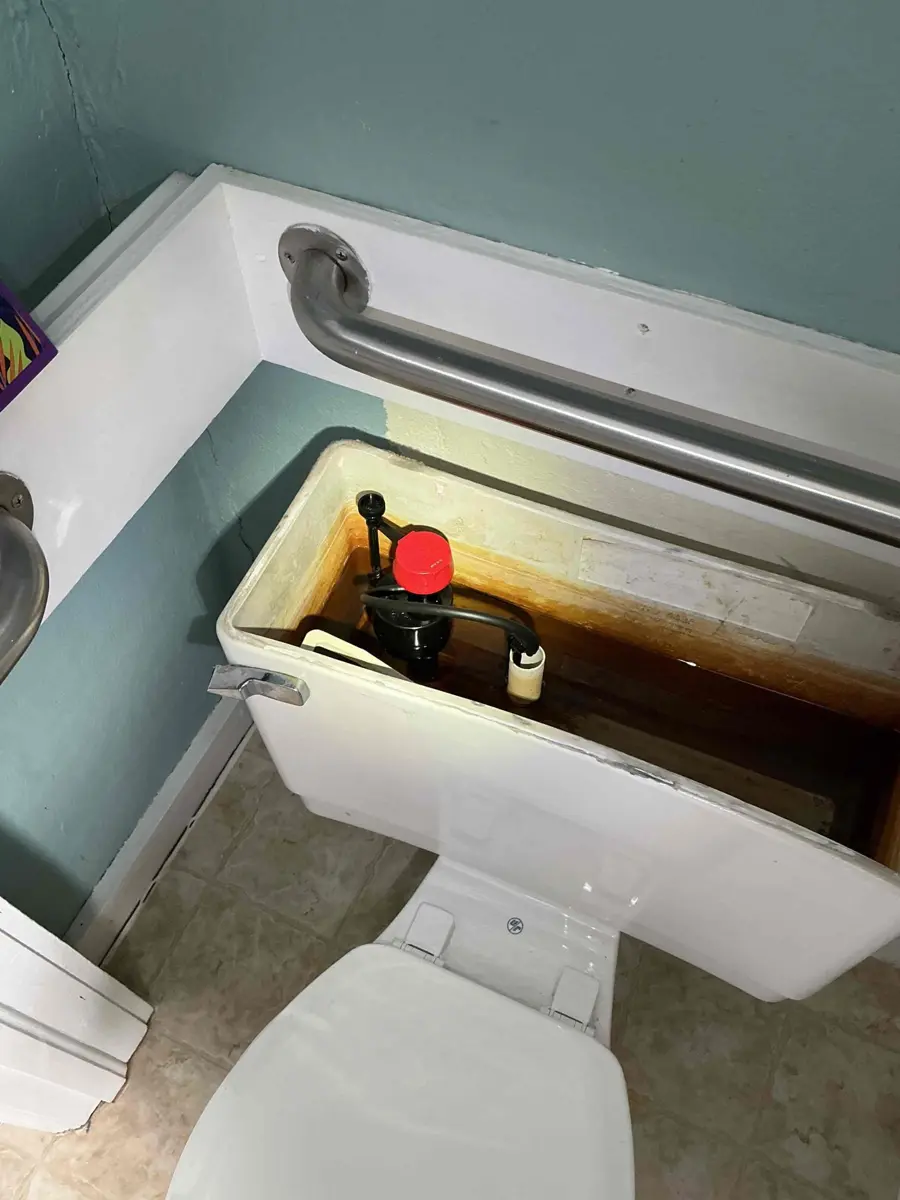
Staining like this plus a painfully slow refill means sediment is choking the fill valve: it needs cleaning or replacing, and you should make sure the shutoff valve behind the toilet is fully open. The tank itself was fine.
Why does my toilet rock, and what is under it?
A toilet should not move at all when you sit on it. If it rocks, the seal underneath is being flexed every time someone uses it, and that eventually lets water and sewer gas out. A sewer smell around the base is a common sign, which our post on why your bathroom smells like sewage explains.
Sometimes the fix is as simple as tightening the two bolts at the base a little (gently, porcelain cracks if you crank on it). If that does not stop the rocking, or the floor feels soft, the problem is the flange or the floor under it.
This second floor toilet had a broken flange. The flange the toilet bolts to had snapped off an old copper drain pipe, and you can see the soft, water damaged wood around the hole.
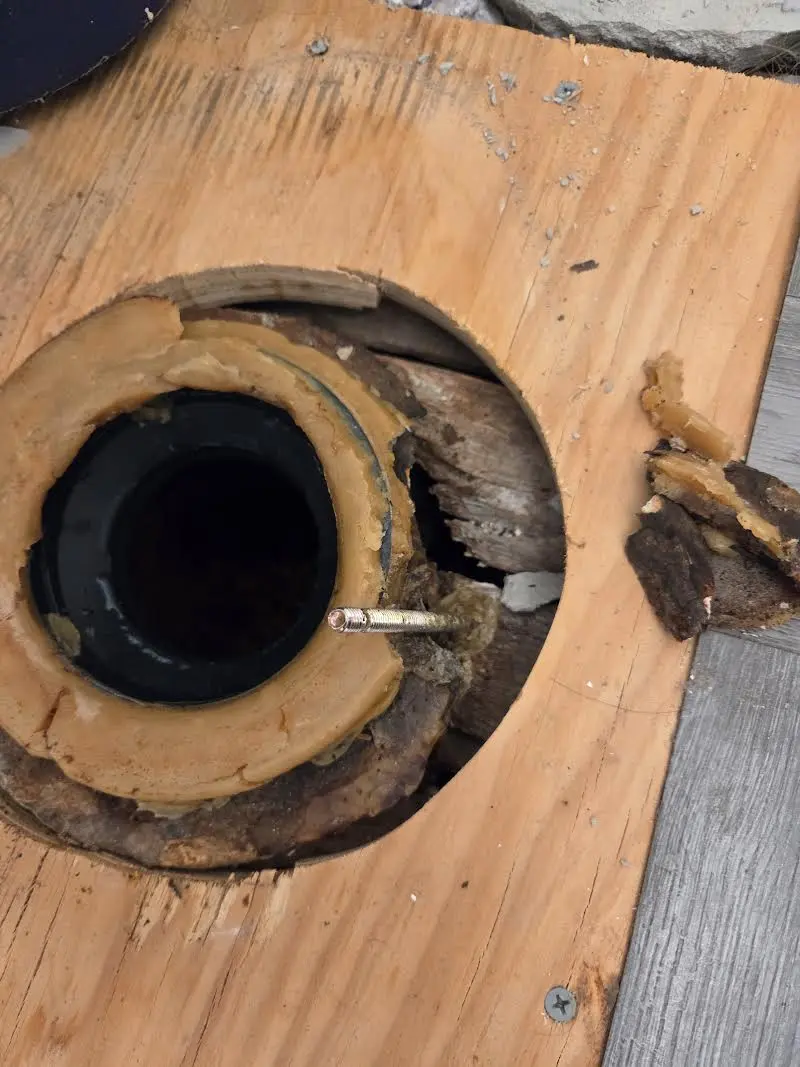
A broken flange and soft wood mean the toilet cannot be held down: the flange has to be replaced and the floor repaired before a new wax ring will last. Resetting the toilet on this would have leaked again within weeks.
Compare that with a new flange set properly into the floor. This one went in after we rebuilt the drain line below a bathroom.
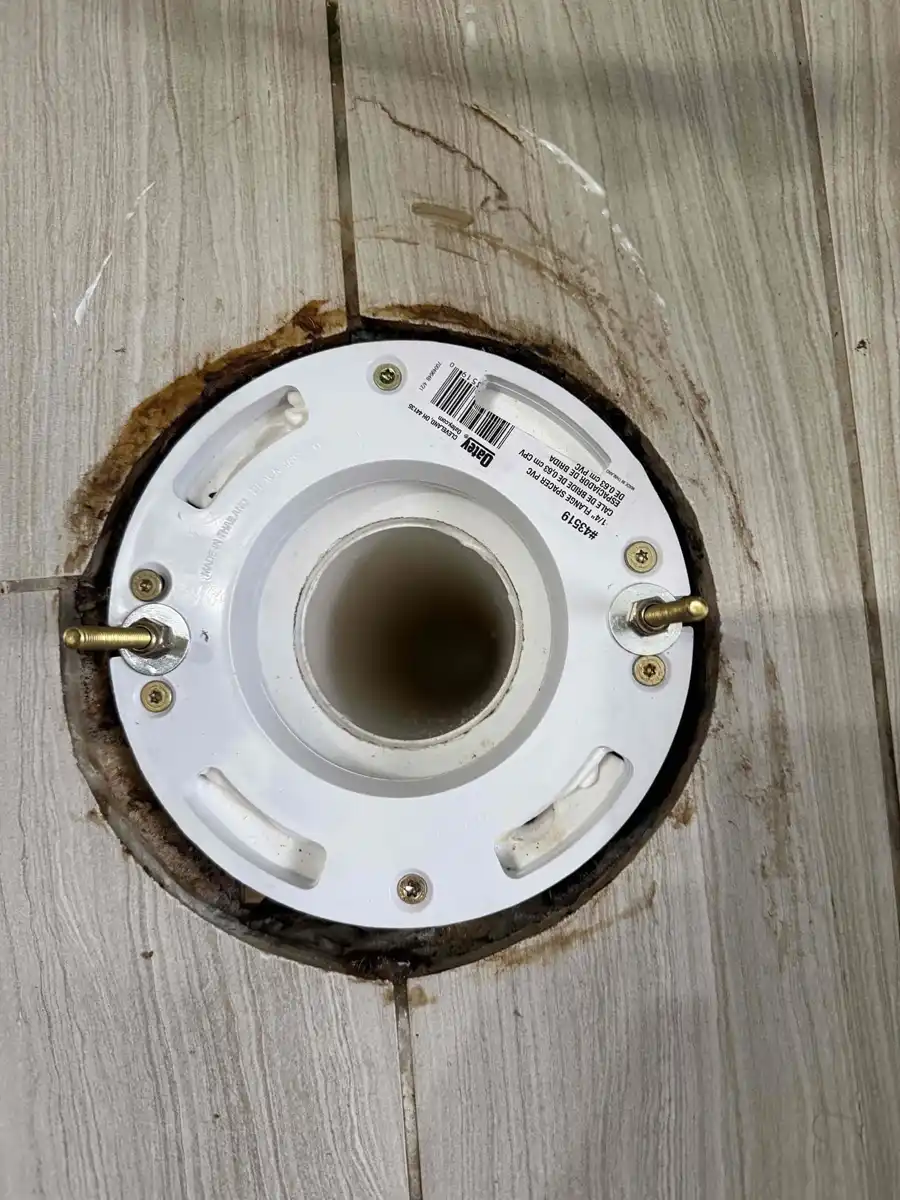
This is what a solid base looks like: a new flange screwed tight to sound floor, with both bolts upright and ready for the toilet. A toilet set on this will not rock.
If you have water at the base, shut off the water at the valve behind the toilet and stop using it until it is checked. A small leak at a wax ring soaks into the floor long before it shows on the ceiling below.
Can I fix a toilet myself or should I call a plumber?
A lot of toilet repairs are fair game for a handy homeowner, and knowing the parts is most of the battle.
Good do it yourself jobs:
- Adjusting the chain length.
- Raising or lowering the tank water level with the adjustment on the fill valve (aim for about an inch below the top of the overflow tube, or the line marked inside the tank).
- Replacing a flapper. Turn off the water, flush to drain the tank, unhook the old one and clip on a match.
- Cleaning mineral buildup out of the rim holes with a small brush.
- Reattaching a refill tube that popped off.
Jobs where a plumber usually saves you time and a mess:
- A fill valve that will not match your supply connection, like the homeowner above.
- A shutoff valve behind the toilet that is stuck, leaking or will not close all the way. Forcing an old valve is how a small job turns into a flooded bathroom.
- Anything under the toilet: the wax ring, the flange, soft floor, or a toilet that rocks.
- Pressure assisted toilet cartridges.
- Repeated clogs, which usually mean a problem in the drain line rather than the toilet. Our drain cleaning team handles those, and please do not pour chemical drain cleaner into a toilet first (here is why Drano is hard on pipes).
One rule of thumb: if you have replaced the flapper and the toilet still runs, or you have replaced the wax ring and the base still leaks, stop. The real cause is somewhere else, and buying more parts just adds to the pile.
If water is showing up somewhere you cannot trace, our leak detection service can find it without tearing open walls.
How does a toilet flush without electricity?
A regular toilet uses gravity and a siphon. Water falls from the tank into the bowl, fills the curved passage inside the bowl, and once that passage runs full it siphons the bowl empty. The fill valve then uses your home water pressure to refill the tank. No power is involved.
What are the main parts of a toilet tank?
The handle and trip lever, the chain, the flapper, the flush valve seat, the overflow tube, the fill valve with its float, and the refill tube. The flapper lets water out, the fill valve lets water in, and the overflow tube keeps the tank from spilling over.
Why does my toilet flush weakly?
Usually the siphon is not starting. The common causes are a tank water level set too low, a chain with too much slack so the flapper closes early, or mineral buildup clogging the small holes under the rim and the jet at the bottom of the bowl.
Why does my toilet refill by itself when nobody used it?
That is called a phantom flush. Water is slowly leaking from the tank into the bowl past a worn flapper or a rough flush valve seat. When the tank level drops far enough, the fill valve turns on to top it up. A new flapper fixes most of them.
How long should a toilet take to refill?
Most toilets refill in under a minute. If yours takes several minutes, the fill valve is probably clogged with sediment or the shutoff valve behind the toilet is not fully open. Check the valve first, then clean or replace the fill valve.
How much water does a toilet use per flush?
New toilets sold in the United States use 1.6 gallons per flush or less, and EPA WaterSense labeled models use 1.28 gallons or less. Older toilets can use as much as 6 gallons. Look for a number stamped behind the tank or near the seat hinge.
What holds a toilet to the floor?
A round fitting in the floor called a flange, which connects to the drain pipe. Two bolts hook into the flange and hold the toilet down, and a wax ring seals the gap between the toilet and the drain. A broken flange or soft floor makes the toilet rock.
Toilet repair from NSP Plumbing
NSP Plumbing is a licensed Michigan plumbing contractor (license #8004990) based in Wyoming, Michigan. Our technicians fix running toilets, weak flushes, slow tanks and leaks at the base every week across Grand Rapids, Wyoming, Kentwood, Grandville, Jenison, Byron Center, Hudsonville, Caledonia and the rest of West Michigan.
If your toilet will not stop running, rocks on the floor, or you just do not want to wrestle with a stuck shutoff valve, our toilet repair and installation team can diagnose it and fix it in one visit.
For anything else in the bathroom, see our plumbing repair service. You can read what customers say about us on our reviews page.
Toilet acting up?
A licensed NSP plumber will find which part failed, explain it in plain words, and fix it with the right part for your toilet. Pick a time that works for you and we will confirm by text.