Weak showers, a washing machine that takes forever to fill, a kitchen faucet that dribbles. Most homeowners assume the fix is a pump or new pipes. Usually it is not. Start by finding out whether one fixture or the whole house is weak, then check the cheap causes first. In our records, the typical fix on a low pressure call runs about $490 at the median.
How can I increase my water pressure in my house?
You increase water pressure by removing whatever is choking it. Water arrives at your home with a certain amount of push from the city main or your well. Somewhere between the street and your faucet, something is eating part of that push. Your job is to find that something.
Here is the order we work in, cheapest and most common first:
- Clean or replace the aerator (the little screen at the tip of the faucet) or the showerhead. Mineral scale clogs these fast in West Michigan.
- Make sure the main shutoff valve is fully open. A valve left half closed after a repair is one of the most common causes we find.
- Check the water softener or filter. A clogged filter cartridge or a softener stuck in its cleaning cycle can cut flow to the whole house.
- Read the pressure with a gauge. A $10 to $15 gauge on an outdoor spigot tells you if the problem is the supply or the plumbing.
- Check the pressure reducing valve if you have one. This is a bell shaped brass valve near the water meter that lowers incoming pressure. It can be adjusted, and it can fail.
- Look at the pipes themselves. Old galvanized steel pipe (gray, threaded iron pipe common in homes built before the 1960s) rusts shut from the inside over decades.
- If you are on a well, check the pressure tank and pressure switch.
Most homes never get past step 3. When they do, the answer is almost always a valve, a regulator, or old pipe, and every one of those is a known, fixable thing. You rarely need to guess.
A booster pump is the last resort, not the first. It only makes sense when the supply coming in is truly low, which a gauge will prove in two minutes. Buying a pump to push water through a clogged pipe just makes a louder clogged pipe.
Is it one fixture or the whole house?
This one question cuts your troubleshooting in half. Walk the house and run the cold water at every sink, the tub, and an outdoor spigot. Then do the same with hot water.
Only one fixture is weak. The problem lives at that fixture. Think aerator, showerhead, the cartridge inside the faucet (the part that moves when you turn the handle), or the small shutoff valve under the sink. These are the cheapest fixes on this page.
Only the hot water is weak, everywhere. Look at the water heater. The shutoff valve on top of the tank may be partly closed, or sediment (sand like mineral buildup) may be clogging the tank outlet. Our guide on what to check when you have no hot water walks through the heater side.
Everything is weak, hot and cold. The problem is upstream of where the lines split. That means the main shutoff, the pressure reducing valve, a softener or whole house filter, the water service line from the street, or the city or well supply itself.
Pressure used to be fine and dropped suddenly. Something changed. A valve got bumped, a filter clogged, a neighbor's main break is being repaired, or you have a leak. A sudden drop with no obvious cause is worth checking your water meter: shut every fixture off and watch the meter dial. If it moves, water is going somewhere. That calls for leak detection, not a pump.
One more pattern to know. Pressure that is fine at 2 PM and weak at 7 AM is often just peak demand on the city system, when every household on the street showers at once. Michigan code actually tells plumbers to design for this. Section 604.6 of the Michigan Plumbing Code on UpCodes says that where street pressure fluctuates, the house system has to be designed for the minimum pressure available.
What can I fix myself in ten minutes?
Plenty. These are the fixes worth trying before you call anyone, and they cost little or nothing.
Clean the aerator. Unscrew the tip of the faucet (a rag and pliers help). Rinse the screen, soak it in white vinegar for an hour if it is crusted white, and screw it back on. If the flow jumps, you found it.
Clean or swap the showerhead. Same idea. Soak it in a bag of vinegar overnight. Many modern heads also have a flow restrictor, a small plastic disc inside that limits gallons per minute. Federal rules cap showerheads at 2.5 gallons per minute, and EPA WaterSense labeled heads use 2.0 or less. A low flow head is designed to feel like less water. That is not a plumbing problem.
To see what a scaled up head looks like versus a working one, look at the spray pattern first.
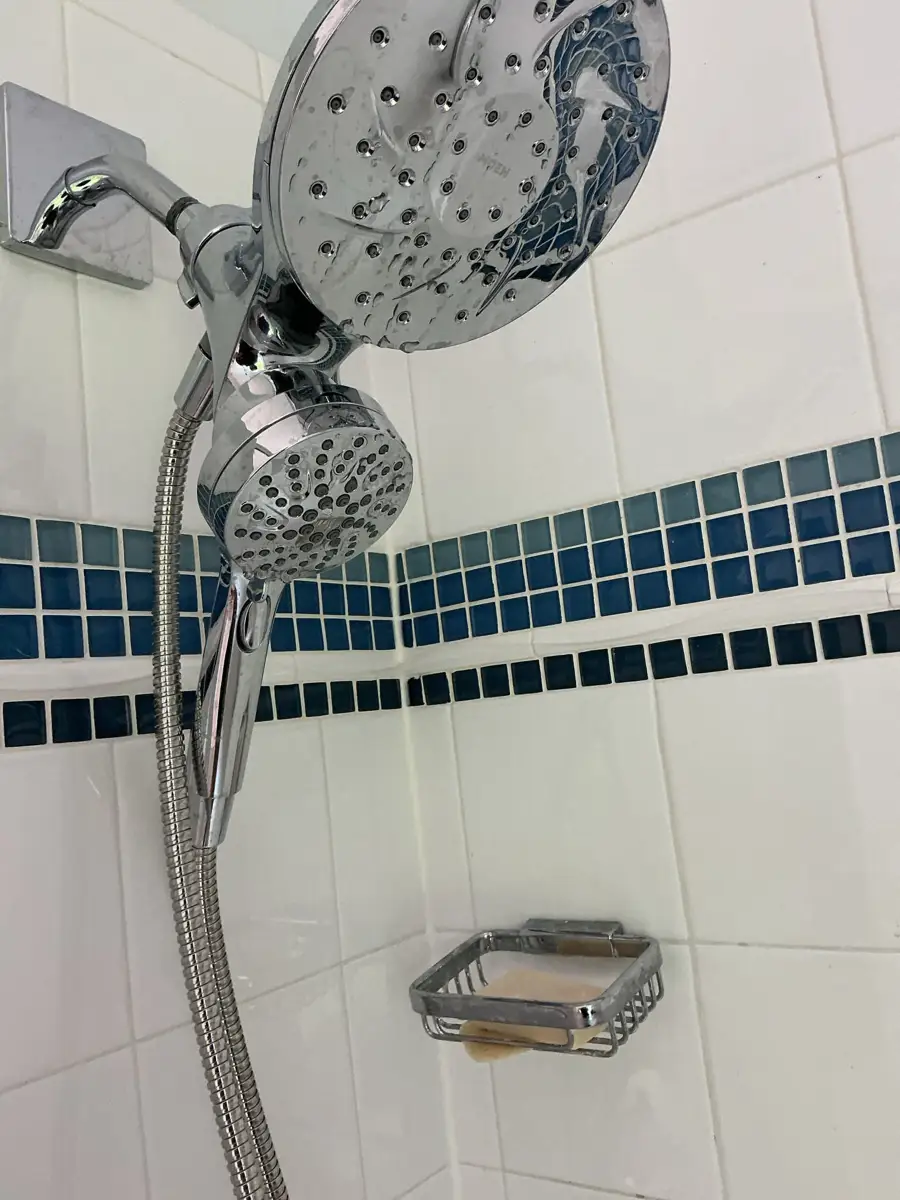
If only the shower is weak, start here: this head and its restrictor are a $0 to $50 fix, not a plumbing repair. Clean it or swap it before you pay anyone to look at pipes.
Open the main shutoff all the way. Find the valve where water enters the house (our guide on how to find your main water shutoff valve shows where to look). A round handle turns counterclockwise until it stops. A lever handle should run parallel with the pipe. Old round handle valves can break inside, so turn gently.
Check the valves under the sink. The small oval handles under a sink or toilet sometimes get turned partway during a cleaning. Open them fully.
Bypass the softener to test it. Most softeners have a bypass valve on the back. Put it in bypass and run the water. If pressure comes back, the softener or its filter is the choke point. Our water softener team can service or replace it.
Replace the filter cartridge. Whole house sediment filters clog quietly. If the cartridge is brown, change it.
How do I test my water pressure?
Buy a pressure gauge that threads onto a garden hose spigot. They are sold at every hardware store for about $10 to $15. This is the single most useful tool in this whole guide, because it turns a guess into a number.
Screw it onto an outdoor spigot or the laundry faucet, make sure nothing else in the house is running, and open the spigot fully. Read the needle.
Here is how to read the result:
| Gauge reading | What it means | What to do |
|---|---|---|
| Under 40 psi | Low supply | Check the regulator, main valve, well tank, or call the water utility |
| 40 to 60 psi | Normal for most homes | Problem is inside the plumbing, not the supply |
| 60 to 80 psi | Strong, still acceptable | Look at fixtures and pipes |
| Over 80 psi | Too high | Michigan code requires a pressure reducing valve |
That last row is real code, not our opinion. Section 604.8 of the Michigan Plumbing Code requires a pressure reducing valve where static pressure inside a building exceeds 80 psi, set to bring it down to 80 or less.
A gauge also clears up a common mix up. Pressure and flow are not the same thing. Your gauge can read a healthy 60 psi with every faucet off, and the shower can still feel weak. That means pressure is fine and flow is being restricted somewhere. The fix for that is almost never a pump. It is a clog, a valve, or a pipe that has narrowed inside.
For the best picture, take two readings: one with everything off, and one while the kitchen faucet runs full. A big drop between the two points to a restriction in the piping.
Why is my water pressure low in the whole house?
When the gauge reads low with everything off, the problem is at or before the point where water enters your home. These are the causes we find most often.
The pressure reducing valve. Many homes have one right after the water meter. It is adjustable with a screw on top, and it wears out. We had a call in July 2026 on the southeast side of the metro where the home had switched from Caledonia water to Grand Rapids water and pressure dropped below 50 psi. The tech found a pressure reducing valve after the meter, adjusted it up, and the house had normal pressure again. The visit was about $50. That is the best case, and it happens.
A partly closed or failing main valve. Old gate valves (valves with a round wheel handle) can have the internal gate drop and stick partway closed. The handle turns, but nothing changes. Replacing the main shutoff is a common, modest repair.
Backflow devices. Homes with lawn irrigation have a backflow assembly (a brass valve that keeps sprinkler water from flowing back into your drinking water). Every one of them costs a little pressure by design. A failing one costs more.
Before you blame the city, look at what is mounted on your own supply line.
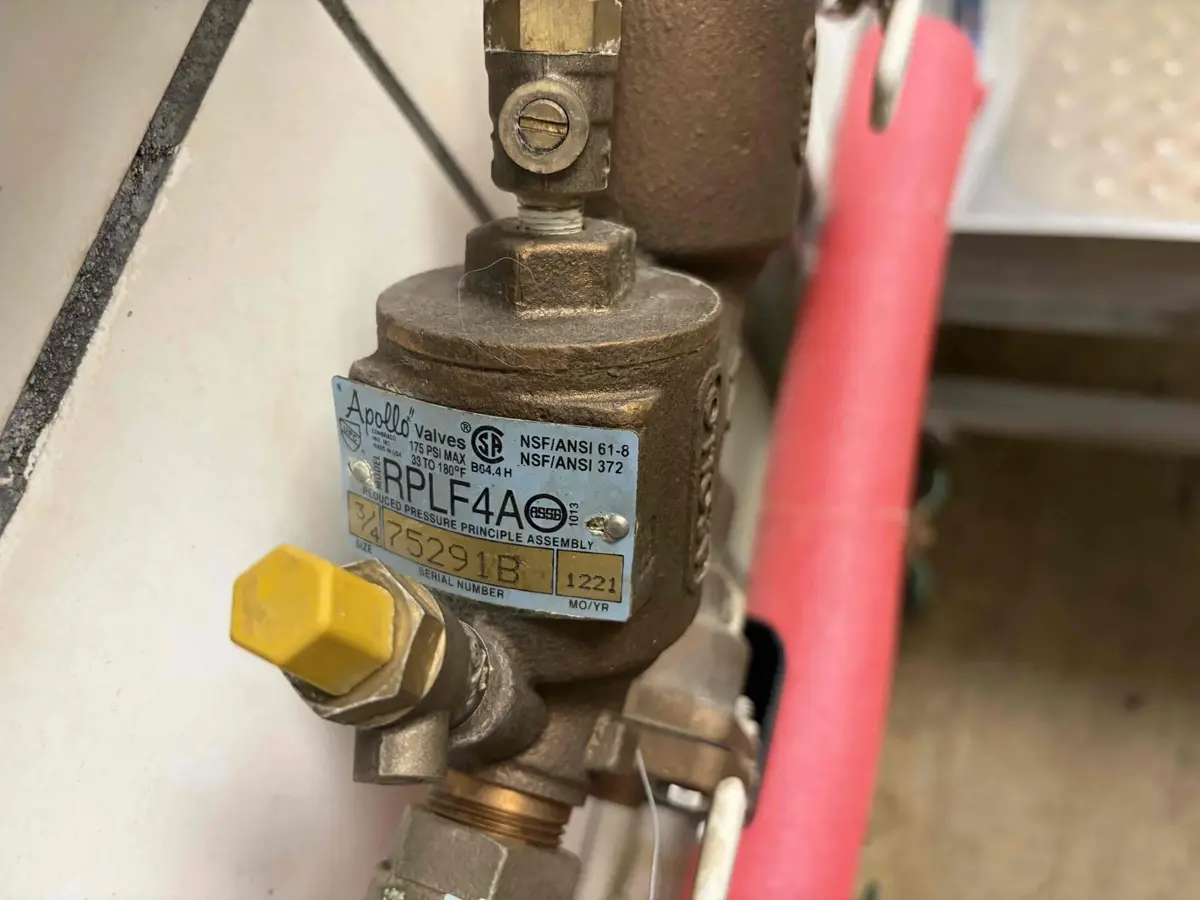
A backflow assembly like this one always takes a little pressure, and a bad one takes a lot: have it tested before you replace anything bigger. Our backflow testing visit runs $150 in our records.
The water service line. The pipe from the street to your house can be undersized, crushed, or corroded. A small repair on that line ran $175 to $325 on our invoices. A full replacement is a much larger job, covered below.
The supply itself. If your neighbors have the same problem, call the utility. The Grand Rapids Water System serves the city and several surrounding communities and posts main breaks and service notices. Section 604.7 of the Michigan code covers the case where the supply really is too weak for the house: that is when a booster pump is the right answer.
Can old pipes cause low water pressure?
Yes, and in older Grand Rapids neighborhoods this is the big one. Galvanized steel pipe was standard in homes built before the 1960s. The zinc coating wears away, the steel rusts from the inside, and the opening slowly closes. A pipe that started at three quarters of an inch across can end up with a pencil sized hole through the middle.
The signs are consistent. Pressure gets worse over years, not days. It is worse on upper floors and at the far end of the house. Water can run brownish after sitting. And cleaning aerators helps for a week, because rust flakes keep coming.
Here is what that pipe looks like where it enters a basement wall.
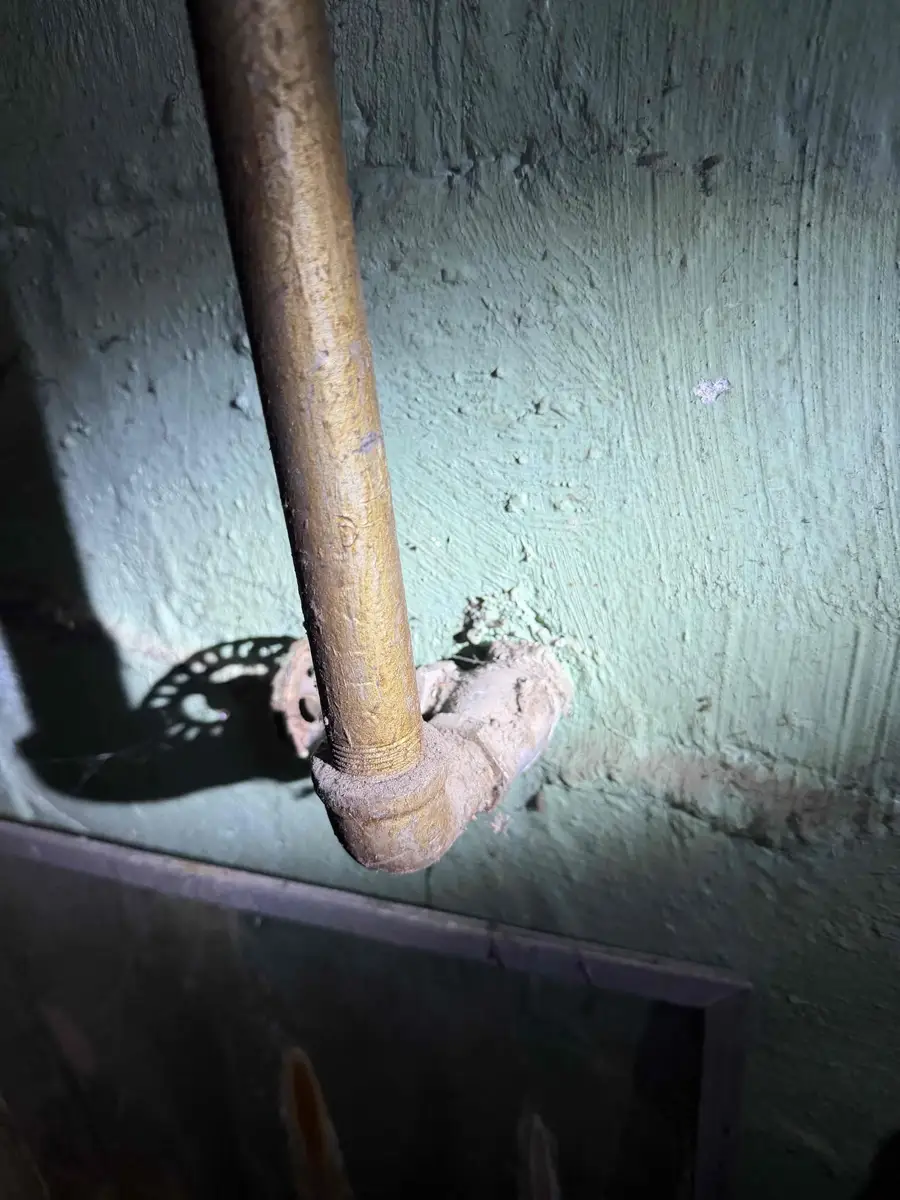
Rust at the threads like this means the inside is worse: this pipe is past cleaning and has to be replaced. Nothing you pour into it or bolt onto it will open it back up.
You do not always need to replace everything. Often the worst section is the main trunk line (the larger pipe that runs the length of the basement and feeds the branches). Replacing that trunk and the first few feet of each branch can bring back most of the flow for a fraction of a whole house job.
When we replace it, this is what goes in.
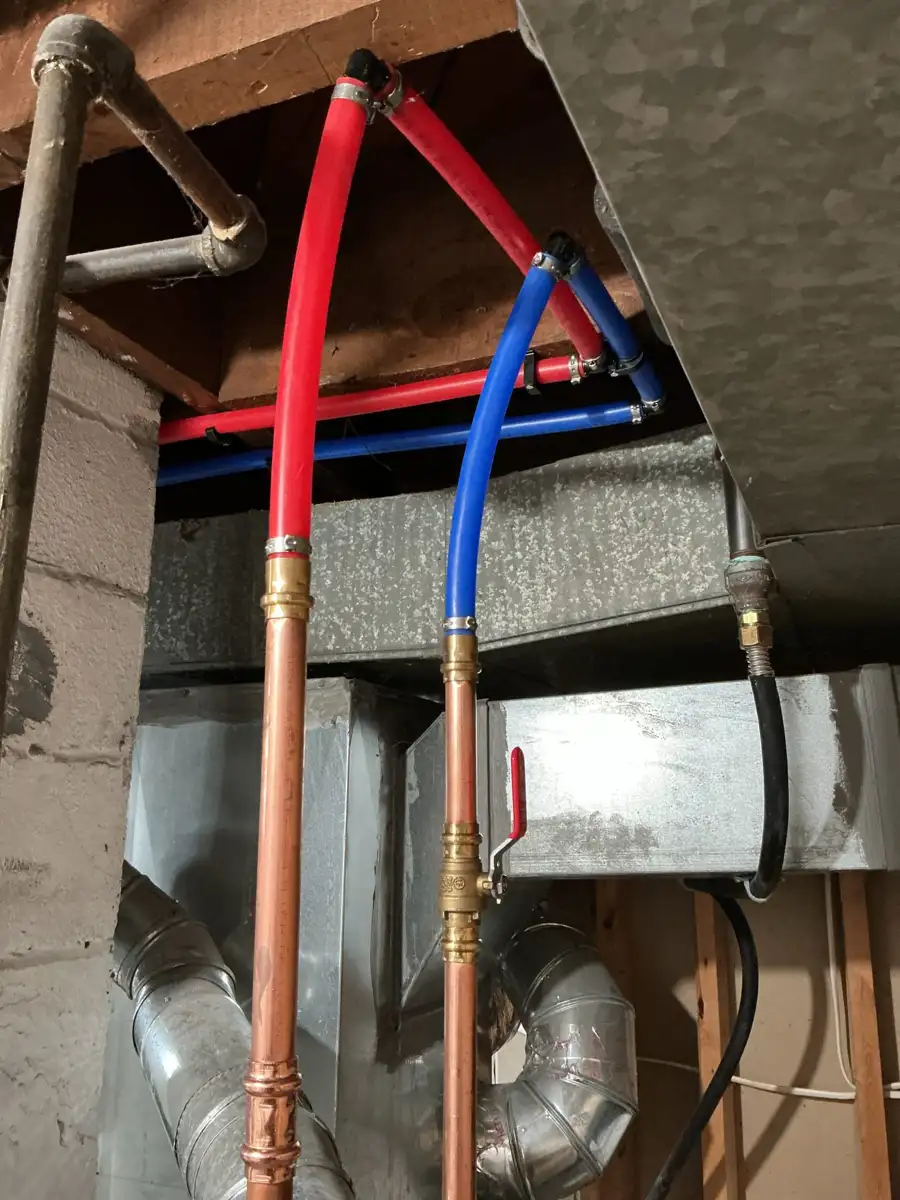
New PEX lines like these fix the flow problem for good: red is hot, blue is cold, and nothing inside them rusts. PEX (flexible plastic water pipe) is what we use on most repipe jobs.
In March 2026 we did a full day job with two techs that replaced all the galvanized piping in a basement with PEX, added a new main shutoff, and redid the laundry supply lines. That invoice was $4,520. The largest complete water line replacement in our records this year was $8,898, on a home with a full reroute. Most partial replacements land far below that.
Why is my well water pressure low?
If you are on a well, you do not have a city main or a regulator. You have a pump, a pressure tank, and a pressure switch. The switch tells the pump to turn on when pressure drops to a set point (often 40 psi) and off when it reaches a higher one (often 60).
Low or surging pressure on a well usually comes from one of three things:
- A waterlogged pressure tank. The tank has an air cushion inside. When that cushion is lost, the pump clicks on and off constantly and pressure swings. Tap the tank: a hollow sound on top and a solid sound on the bottom is normal.
- A worn pressure switch. The contacts burn or the small tube feeding it clogs. Replacement ran $400 to $550 on our invoices, a small sample.
- A clogged filter or softener between the tank and the house. Same test as city water: bypass it and see.
The gauge on the tank tells you most of the story.
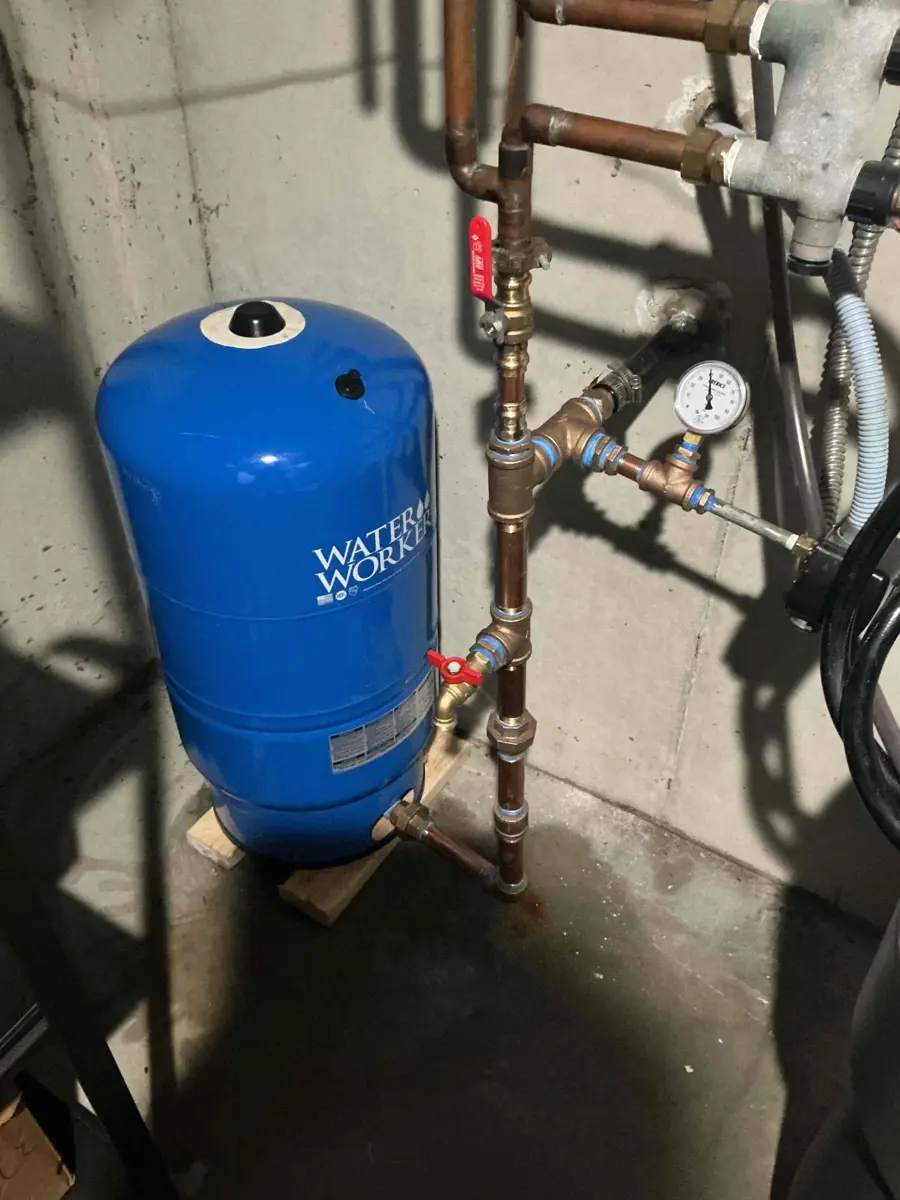
If this gauge swings fast between low and high, the tank has lost its air and needs service or replacement. Tank replacement ran $680 to $1,200 in our records, again a small sample.
The EPA's private well guidance is a good neutral resource on well basics and testing. For anything electrical at the pump, call a pro. The pump circuit is 240 volts.
What does it cost to fix low water pressure?
Across all residential calls where low pressure was part of the problem, the median invoice was about $490. The middle half of jobs fell between $150 and $1,050. The low end is a visit, an adjustment, and a cleaned fixture. The high end is pipe replacement.
Here is how the individual repairs priced out on our invoices:
| Repair | Typical price (NSP invoices) | Notes |
|---|---|---|
| Service visit / dispatch | $49 | Standard residential dispatch |
| Pressure reducing valve adjustment | About $50 | One job, no parts needed |
| Faucet cartridge replacement | $250 median ($75 to $488) | One fixture weak |
| Shower cartridge replacement | $350 to $488 | Small sample |
| Water line repair | $175 to $325 | Small section, small sample |
| Well pressure switch | $400 to $550 | Small sample |
| Well pressure tank | $680 to $1,200 | Small sample |
| Galvanized repipe, full basement | $4,520 | One job, full day, two techs |
A single weak shower is usually a cartridge problem. The cartridge is the part inside the valve that mixes hot and cold. When it scales up, flow drops even though the pipes are fine.
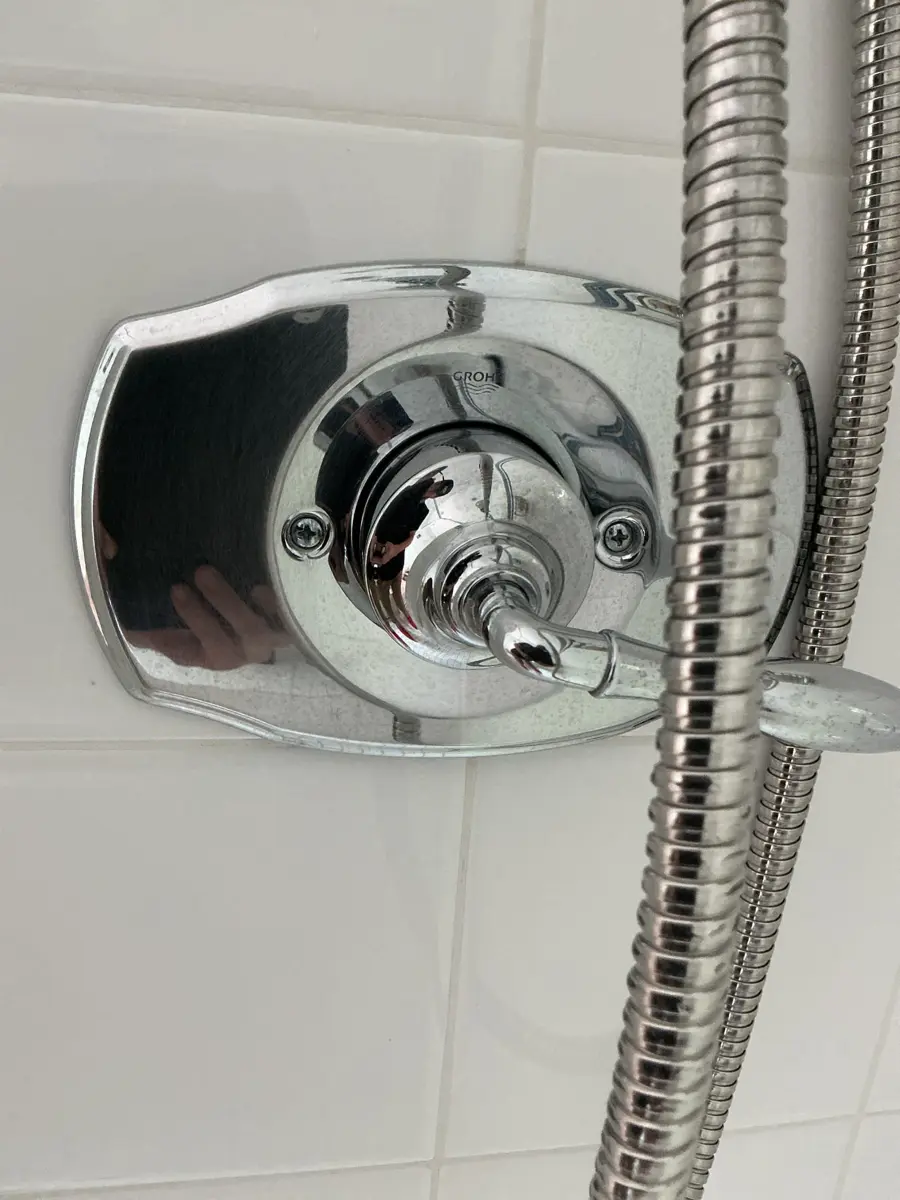
Low flow at one shower with good pressure everywhere else points behind this plate: a cartridge swap, not new pipes. That is a $350 to $488 repair on our invoices, not a repipe.
Two ways to not overpay. First, get a gauge reading before anyone quotes a pump or a repipe. Second, ask what the plumber measured and where. A good quote names the choke point.
How can I increase my water pressure in my house without a pump?
Clean aerators and showerheads, make sure the main shutoff and fixture valves are fully open, bypass the softener to test it, and replace clogged filters. If you have a pressure reducing valve near the meter, it can be adjusted. Most low pressure problems are fixed by one of these, and a pump is only needed when the incoming supply is truly low.
What is normal water pressure for a house?
Most homes run between 40 and 60 psi. Up to 80 psi is acceptable. Above 80 psi, the Michigan Plumbing Code requires a pressure reducing valve, because high pressure wears out fixtures, water heaters and supply hoses faster. Under 40 psi usually feels weak at the shower.
Can I adjust my water pressure regulator myself?
You can, carefully. The regulator is the bell shaped brass valve after the water meter. Loosen the lock nut and turn the top screw clockwise to raise pressure, a quarter turn at a time, checking a gauge as you go. Stay at or below 80 psi. If turning it changes nothing, the valve has likely failed and needs replacing.
Why is my water pressure low in only one faucet?
The problem is at that faucet. The aerator screen may be clogged with scale, the cartridge inside the faucet may be worn, or the small shutoff valve under the sink may be partly closed. Faucet cartridge replacement ran $250 at the median on NSP invoices, with a range of $75 to $488.
Does a water softener lower water pressure?
A healthy softener costs a little pressure. A clogged one, or one stuck in its regeneration cycle, can cut flow to the whole house. Put it in bypass mode using the valve on the back and run a faucet. If pressure jumps, the softener or its pre filter needs service.
How much does it cost to fix low water pressure?
On residential calls NSP Plumbing invoiced from September 2025 to September 2026 where low pressure was part of the problem, the median was about $490 and the middle half ran $150 to $1,050. Simple adjustments cost far less. Replacing old galvanized pipe costs more, typically several thousand dollars.
Will replacing old pipes fix low water pressure?
If the pipes are galvanized steel and have rusted shut inside, yes. Replacing the main trunk line and the first few feet of each branch often brings back most of the flow without redoing the whole house. A pressure gauge and a look at the pipe tell you whether pipe is the real problem first.
Need help with low water pressure in West Michigan?
NSP Plumbing is a licensed Michigan plumbing contractor, license #8004990, based in Wyoming, MI. We diagnose low pressure with a gauge reading and a straight answer on what is choking your water, whether that is a $50 regulator adjustment or a pipe that needs replacing. See our water pressure repair service, water line repair, and fixture installation pages.
We serve Grand Rapids, Wyoming, Kentwood, Grandville, Jenison, Byron Center, Caledonia, Walker, Rockford and the rest of the metro. If your water smells as well as runs weak, read why your water smells like rotten eggs. Or contact us to talk to a person.
Weak water pressure? Get a real answer.
A licensed NSP plumber tests your pressure, finds what is choking it, and gives you a written price before any work starts. Small fixes are often done the same visit.