You turn on the shower and get a limp drizzle, while the kitchen sink down the hall runs just fine. That pattern is good news. When only the shower is weak, the problem almost always lives in the showerhead or the valve behind the handle, not in your pipes. Most weak showers are fixed with a cleaning or a part swap, and when a plumber is needed, a shower cartridge replacement on our invoices lands around $445 in labor at the median.
How do I increase water pressure in my shower?
Work from the cheapest fix to the most expensive one, and test after each step. Here is the order we would follow in your bathroom:
- Check whether it is only the shower. Run the bathroom sink and the tub spout at full blast. If they are strong and the shower is weak, the problem is in the showerhead or the shower valve.
- Clean the showerhead. Mineral scale from hard water blocks the tiny spray holes. A vinegar soak fixes this more often than anything else on this list.
- Check the flow restrictor. Most heads have a small plastic disc inside that limits water flow. A clogged or very low flow restrictor feels like bad pressure.
- Look at the tub diverter. If water still leaks out of the tub spout while the shower runs, the diverter is stealing flow from the head.
- Replace the cartridge. The cartridge is the part inside the wall valve that mixes hot and cold water. When it scales up or wears out, flow drops.
- Look at the valve and the supply pipes. This is the rare case, usually in older homes, and it is the only one that means opening a wall.
Steps one through four cost you almost nothing. Steps five and six are where a plumber usually earns the money, and we cover what each costs below.
If you run through this list and every fixture in the house is weak, not just the shower, stop here. That is a whole house problem, and our guide on how to increase water pressure in your house walks through the main shutoff, the pressure regulator near your meter and the softener instead.
Is it the shower or the whole house?
This two minute test saves people from paying for the wrong repair. Turn on the bathroom sink cold and hot, then the tub spout, then the shower. Compare what you see.
Only the shower is weak, hot and cold both. The showerhead or the cartridge is the problem. This is the most common result we see.
Only the hot side is weak at the shower. Look at the cartridge first, since a worn cartridge often starves one side. If hot water is weak at every faucet in the house, the water heater or its shutoff valve is the suspect, and our guide on no hot water covers that.
Pressure comes and goes during the shower. That is often the pressure balancing part of the valve reacting when someone flushes a toilet or runs a dishwasher. We cover that section by section below.
Everything in the house is weak. Skip the rest of this page and read the whole house guide linked above.
Here is the simple test we do first on a service call. We pull the showerhead off and run the water through the bare arm (the pipe sticking out of the wall).
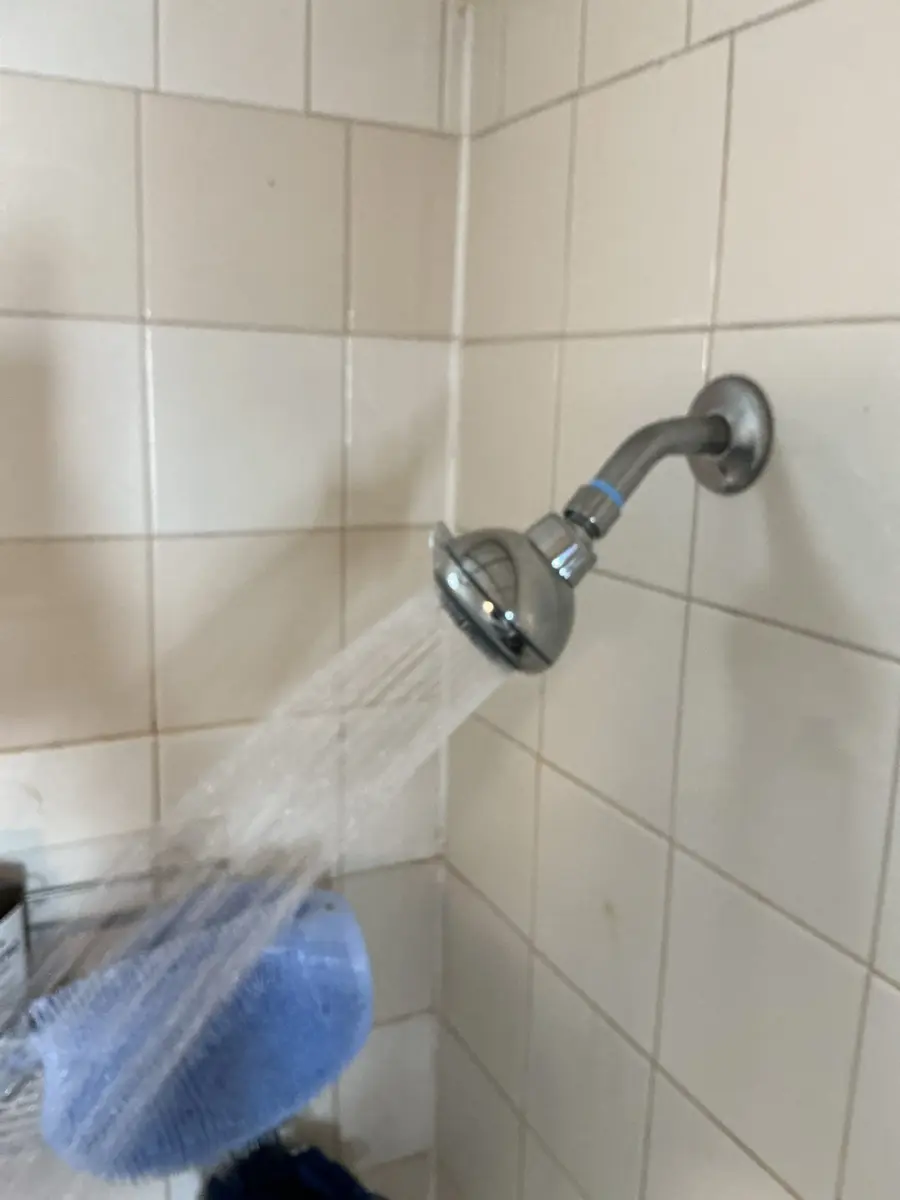
A thin, uneven spray like this with strong flow from the bare arm means the head is the problem, not the plumbing. Clean it or replace it, and you are done for under $50.
If the bare arm is also weak, the restriction is behind the wall, in the valve or the supply pipes. That is the point where calling a plumber makes sense.
Why is my shower pressure weak in Grand Rapids?
Hard water is the local answer. The minerals in West Michigan water, mostly calcium and magnesium, leave white scale on anything water sits in. The USGS explains water hardness as the amount of these dissolved minerals, and water above about 120 milligrams per liter counts as hard.
That scale builds up in three places in a shower:
- The spray holes of the showerhead. The holes shrink until the spray gets narrow and weak.
- The screen or flow restrictor inside the head. Small flakes of scale break loose from the pipes and catch here.
- The cartridge inside the valve. Scale on the moving parts makes the handle stiff and chokes the flow.
The first two are cheap fixes you can do yourself. The third is the most common reason we get called out for a weak shower. If your house does not have a softener, expect to deal with this every few years. A water softener slows the buildup a lot, and our water treatment page covers the other options for your home.
There is one more common cause that is not a problem at all. Newer showerheads are designed to use less water. Federal rules cap showerheads at 2.5 gallons per minute, and heads carrying the EPA WaterSense label use no more than 2.0 gallons per minute. If you replaced an older head recently, you may simply be feeling a lower flow design, not a failing part.
How do I clean a clogged shower head?
Soaking works better than scrubbing. Here is the method:
- Fill a plastic bag with white vinegar.
- Pull the bag up over the showerhead so the face is fully under the vinegar.
- Secure the bag with a rubber band or a twist tie.
- Leave it for a few hours, or overnight for heavy buildup.
- Take the bag off and run hot water through the head for a minute.
- Rub the rubber spray nozzles with your thumb to break off loosened scale.
If the head unscrews easily, take it off and soak it in a bowl instead. That lets you clear the small screen where the head threads onto the arm, which is where scale flakes tend to collect.
Replace the head if cleaning does not help. A standard showerhead from a hardware store costs about $20 to $60 and threads on by hand, with a wrap of thread tape (the thin white tape that seals the threads). If you would rather have us do it while we are there for another job, the labor line for a showerhead swap on our invoices was about $100 to $150. That comes from a very small sample, so treat it as rough.
When you shop, look at the gallons per minute rating printed on the box. A head rated 1.5 gallons per minute will always feel lighter than one rated 2.5, no matter how good your plumbing is.
What does a flow restrictor do, and can I remove it?
A flow restrictor is a small plastic disc, usually colored, that sits inside the showerhead where it screws onto the arm. It has a small hole that limits how much water passes through. It is there to meet the water use rules for showerheads.
The Michigan Plumbing Code, Table 604.4 on UpCodes, sets the maximum flow for a showerhead at 2.5 gallons per minute at 80 pounds per square inch. The federal standard in 10 CFR 430.32 says the same. So manufacturers build the limit in.
Here is our honest advice on restrictors:
- Check it for debris first. A restrictor clogged with scale can cut flow in half. Pull it out with a small screwdriver, rinse it and put it back. That often fixes the problem on its own.
- Removing it is not our recommendation. It raises flow, but it also uses more hot water, can drain your water heater faster during a long shower, and puts the head outside what it was rated for.
- A better head beats a gutted one. Heads designed for low flow homes put the same water through fewer, larger holes, so the spray feels stronger at the same gallons per minute.
If you have cleaned the restrictor and the head and the flow is still weak with the head off, the issue is behind the wall. Keep reading.
Why is water coming out of the tub spout while the shower runs?
If you have a tub and shower combo, the diverter is the part that sends water up to the showerhead instead of out of the tub spout. On most homes it is the little pull up knob on top of the spout.
When the diverter wears out, part of the water keeps flowing out of the spout while you shower. That water never makes it to the head, so the shower feels weak. We see this often in older bathrooms and rental units.
How to tell: turn on the shower and look at the tub spout. A drip is normal. A steady stream is not.
The fix is usually cheap. On most tubs the diverter is built into the spout itself, so the fix is a new spout, a part that costs about $15 to $40. Some spouts slide on with a small set screw underneath, others thread on. If you are not sure which you have, look for a small screw on the underside of the spout before you start twisting.
On two and three handle valves, the diverter is the middle handle, and it has its own stem and washer inside the wall. That repair is a bit more work.
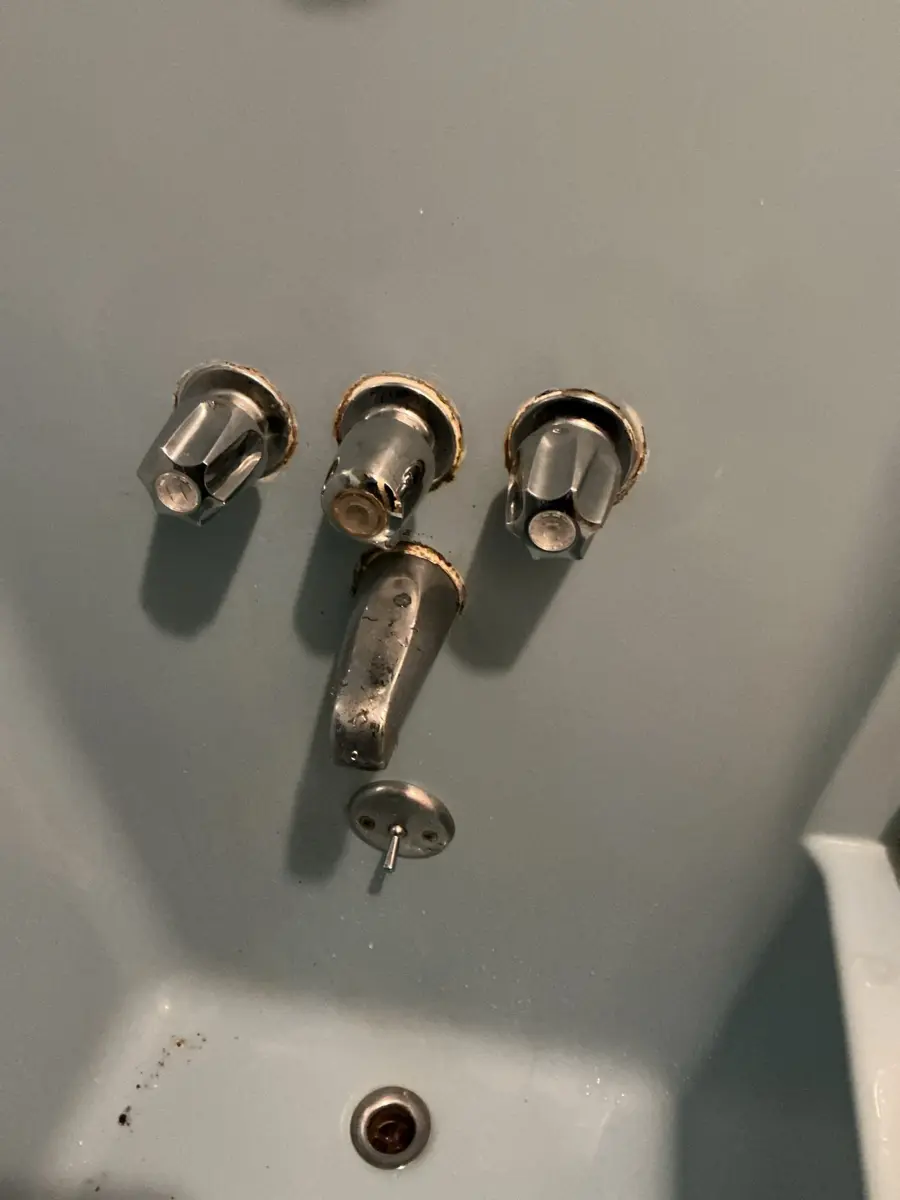
On an older three handle valve like this, the middle stem is the diverter: replacing its stem and washer fixes the weak shower without opening the wall. On our invoices, stem repair on these valves ran about $390 to $610 in labor, from a small sample.
When does a weak shower mean a bad cartridge?
The cartridge is the part inside the wall valve that moves when you turn the handle. It controls how much water flows and how much hot mixes with cold. In single handle showers, it is the heart of the whole system.
A worn or scaled cartridge usually shows one or more of these signs:
- Weak flow at the shower even with the head removed.
- A handle that is stiff or grinds when you turn it.
- A shower that drips after you turn it off.
- Hot water that is weak or runs out fast only at that shower.
- Temperature that swings when you barely move the handle.
Here is what a cartridge looks like once the handle and trim plate come off.
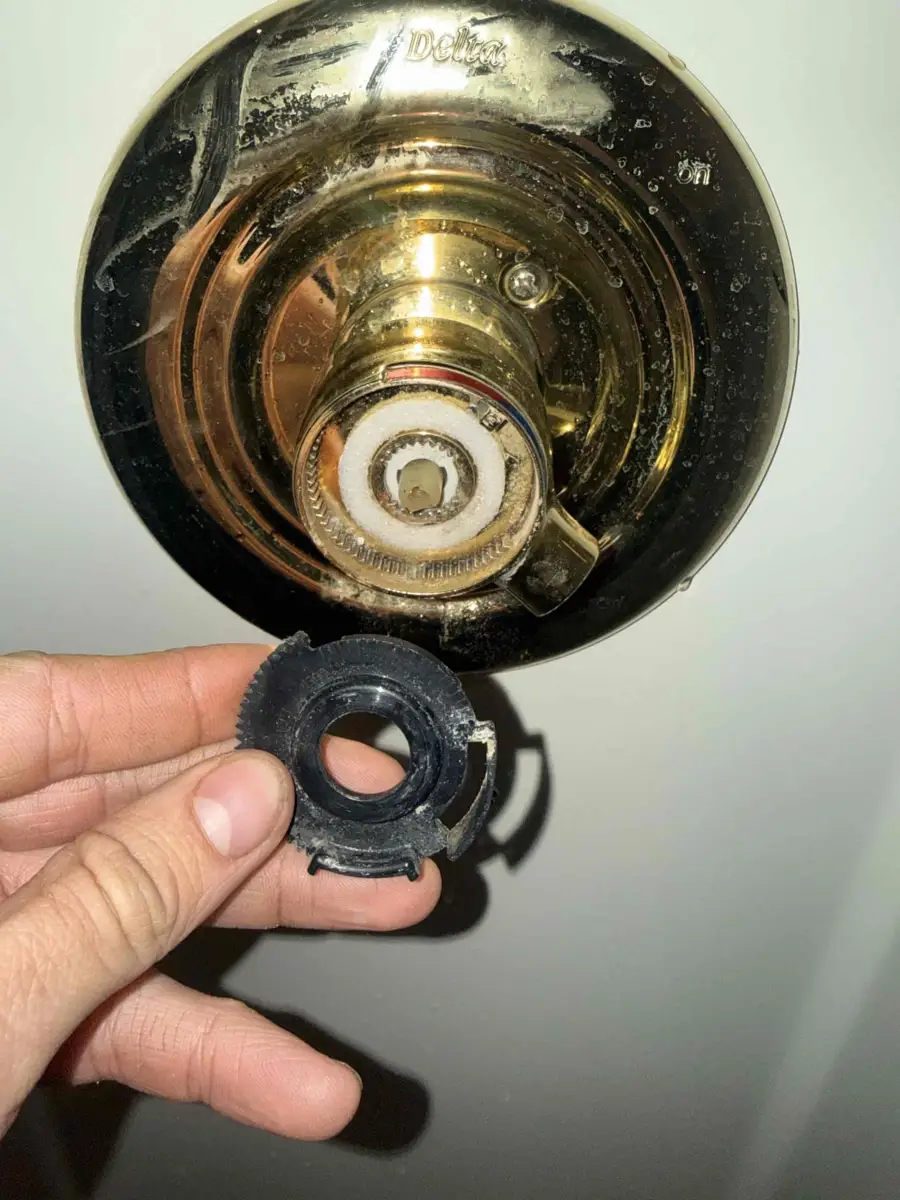
When the brass body behind the handle is crusted with scale like this, the cartridge inside is almost always what is choking your shower. A new cartridge restores full flow without touching the pipes.
Cartridges are specific to the brand of the valve. Moen, Delta, Kohler and others each use their own, and even within one brand there are several types. That is why a hardware store trip without the old part in hand often ends in a second trip.
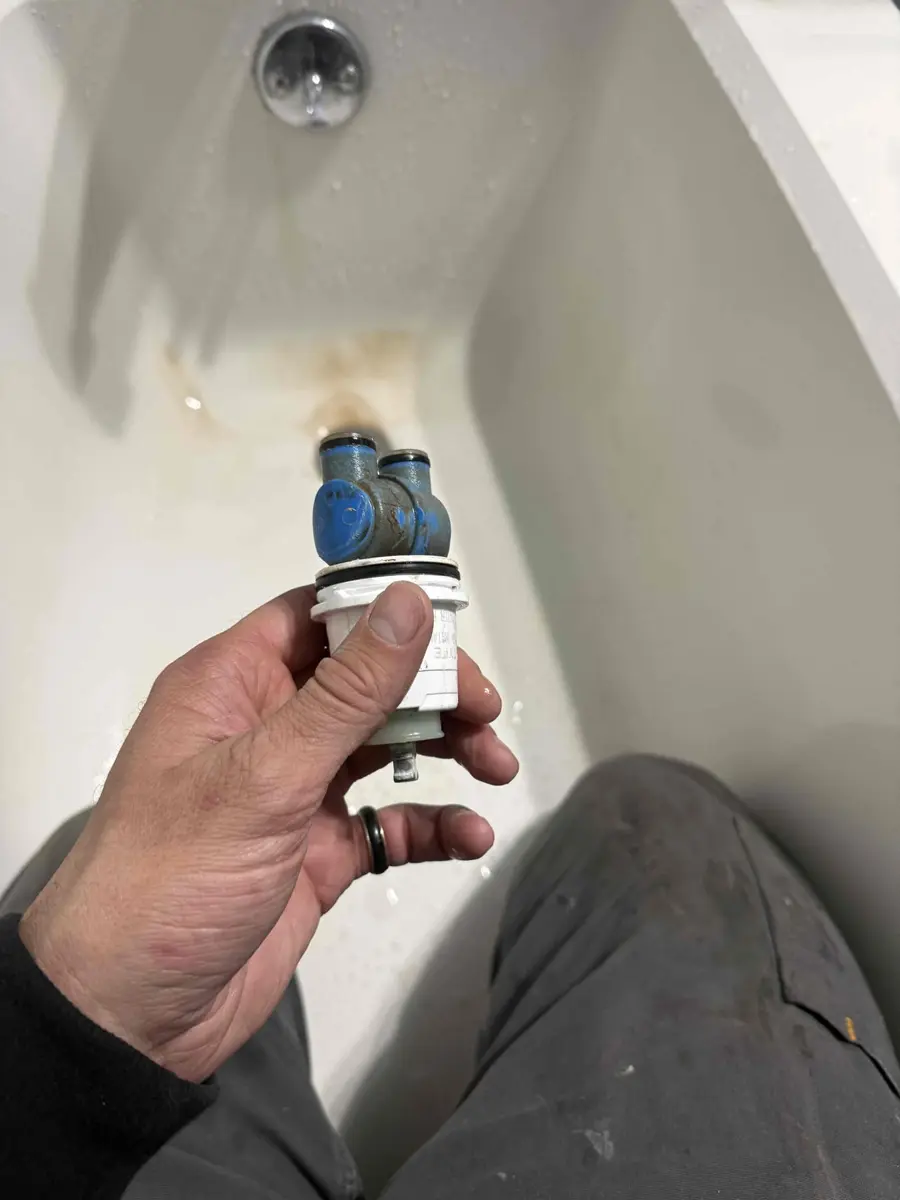
This is the part that failed: a worn cartridge like this is a single part swap, not a new valve. Bring it to the store or let a plumber match it.
What it costs with NSP. The labor line on our residential cartridge replacements ran about $350 to $490 in labor, with a median around $445, based on a small sample of invoices from September 2025 to September 2026. The part itself is billed separately and depends on the brand. That lines up with the cartridge range in our whole house pressure guide.
Some homeowners do this themselves. It is doable if you can shut the water off to the house, match the part and deal with a stuck cartridge. The common trouble spots are a cartridge seized by scale that will not come out, and a clip or nut that breaks during removal. If that happens, turn the water back off at the main and call. We see a fair number of jobs where a half removed cartridge turned a small fix into an urgent one.
What is a pressure balancing valve and can it cause low pressure?
A pressure balancing valve is a type of shower valve built to keep your water temperature steady. When someone flushes a toilet and the cold pressure drops, the valve cuts back the hot side too, so you do not get scalded. That is why the flow can dip for a few seconds when water runs elsewhere in the house.
This is not optional. The Michigan Plumbing Code, Section 412.3 on UpCodes, requires individual shower and tub shower valves to be pressure balancing, thermostatic or a combination of the two. It also requires the valve to be set so the water cannot exceed 120 degrees Fahrenheit, and the valve has to be rated for the flow of the showerhead installed.
Here is what that means for pressure:
- A brief dip when a toilet flushes is normal. That is the safety feature working.
- A shower that stays weak all the time can mean the balancing part is stuck. Scale can jam the small piston or spool inside. In most modern valves that part is built into the cartridge, so a new cartridge fixes it.
- A shower that goes weak when you turn up the heat can mean the temperature limit stop is set too low. A plumber can adjust it within the 120 degree limit.
- A new low flow head on an older valve can sometimes run poorly, because the code wants the valve rated for the head's flow. Matching the head to the valve fixes it.
On older valves that are no longer made, parts can be hard to find. That is usually when replacing the whole valve starts to make sense.
When do I need a new shower valve or new pipes?
Most weak showers never get this far. But there are a few cases where a cartridge will not fix it:
- The valve body itself is cracked or leaking inside the wall.
- The valve is an old model and cartridges are no longer made.
- The brass inside the valve body is corroded so badly that a new cartridge will not seal.
- The pipes feeding the shower are old galvanized steel, which rusts on the inside and narrows over time.
Replacing a valve means opening the wall behind the shower or reaching it from the other side. On many homes we can work from a closet or the room behind the shower, or cut a small opening and cover it with a larger trim plate so the tile stays untouched.
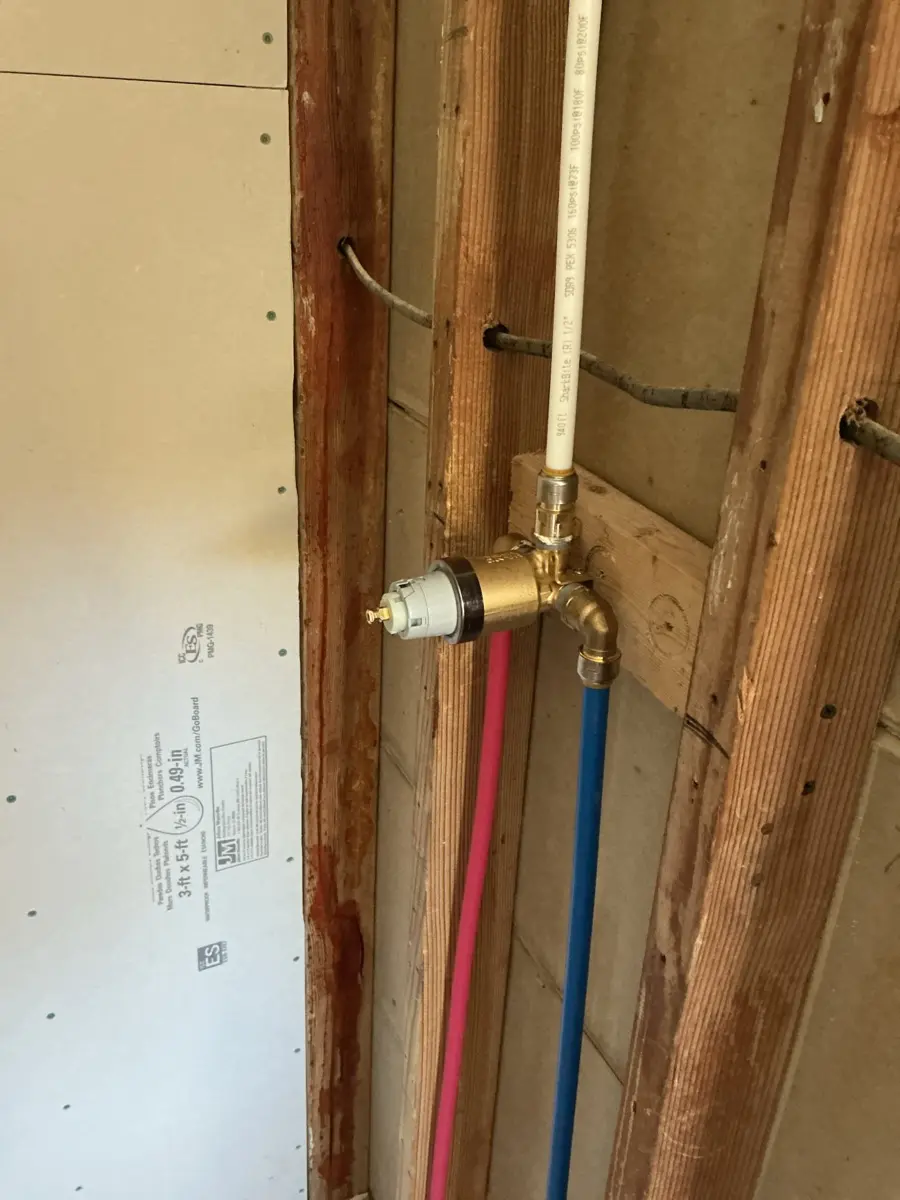
A new valve with fresh hot and cold lines like this is the fix when the old valve body is shot: full flow comes back, and so does a steady temperature. This is the bigger job, so rule out the cartridge first.
What it costs with NSP. Our labor line for installing a new tub or shower valve ran about $900 to $1,400, with a median around $1,100, from a small sample of residential invoices between September 2025 and September 2026. The valve and trim are billed on top, and any tile or drywall repair depends on how the wall is opened.
Supply pipe problems are rarer still. In older Grand Rapids homes, you can sometimes see galvanized pipe, the dull gray threaded steel, running up to the bathroom. If only the upstairs shower is weak and the house has galvanized lines, the pipe itself may be the choke point.
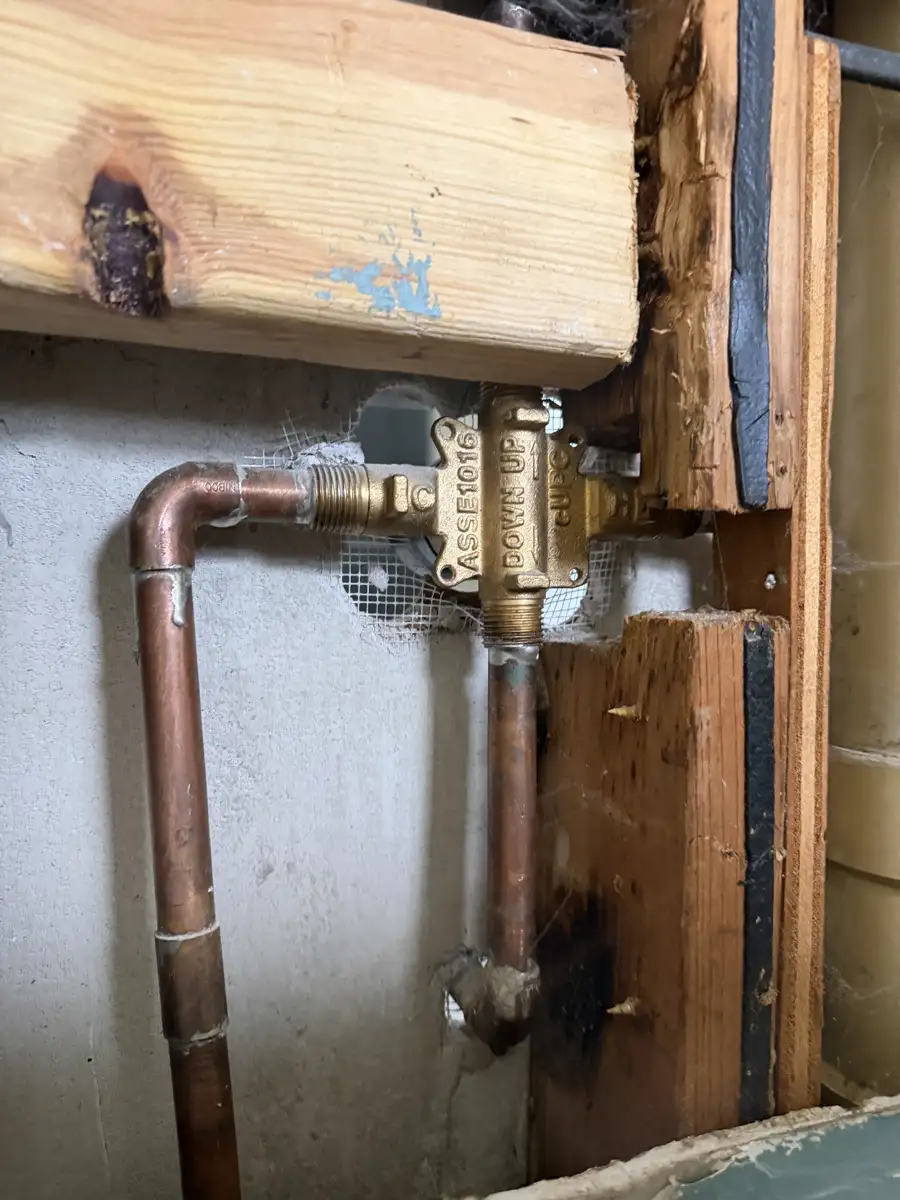
Clean copper supply lines like these are almost never the cause of a weak shower, so if yours look like this, the answer is the valve or the head. Rusty galvanized pipe in the same spot is a different story.
If the pipes turn out to be the problem, that is a water line repair or, in the worst case, a repipe of part of the house. We will tell you plainly if that is what we see, and we will also tell you when it is not.
What does a shower pressure fix cost in Grand Rapids?
Here is the full picture, from our own invoices and typical store prices, cheapest first.
| Fix | Typical cost | Notes |
|---|---|---|
| Clean showerhead with vinegar | Under $5 | Try this first |
| New showerhead, DIY | $20 to $60 | Check the gallons per minute rating |
| Clean or check flow restrictor | $0 | Rinse, do not remove |
| New tub spout with diverter, DIY | $15 to $40 | Match slide on or threaded |
| Showerhead swap by NSP | About $100 to $150 labor | Very small sample |
| Shower cartridge replacement by NSP | About $350 to $490 labor, median about $445 | Part billed separately, small sample |
| Three handle valve stem repair by NSP | About $390 to $610 labor | Small sample |
| New shower valve by NSP | About $900 to $1,400 labor, median about $1,100 | Valve, trim and wall repair extra, small sample |
All NSP figures come from residential work invoiced September 2025 to September 2026. They are estimates, not a guaranteed quote. Your price is set in writing before we start, and you decide whether we go ahead.
The consumer tip: if someone quotes you a new valve or a repipe for a single weak shower, ask whether they have pulled the showerhead and checked the cartridge first. Those two checks rule out most of the expensive answers.
Why is my shower pressure low but the sink is fine?
When only the shower is weak, the problem is in the showerhead, its flow restrictor, the tub diverter or the cartridge inside the shower valve. The house supply is fine, because the sink proves water is reaching the bathroom. Start by cleaning the showerhead in vinegar, then check whether water leaks from the tub spout while the shower runs.
How do I make my shower pressure stronger without a pump?
Clean the showerhead, rinse the flow restrictor inside it, replace a worn tub spout diverter and, if needed, replace the valve cartridge. A pump is almost never the answer for one weak shower. Pumps are for homes where the pressure is low at every fixture and the city or well supply is the real limit.
Can I remove the flow restrictor from my shower head?
You can physically pull it out, but we do not recommend it. The Michigan Plumbing Code and federal rules cap showerheads at 2.5 gallons per minute. Removing the restrictor uses more hot water and can empty your water heater faster. Clean the restrictor instead, or buy a head designed to feel stronger at the same flow.
How much does it cost to replace a shower cartridge?
On NSP Plumbing invoices from September 2025 to September 2026, the labor line for a residential shower cartridge replacement was about $350 to $490, with a median around $445. The cartridge part is billed separately and depends on the valve brand. That comes from a small sample, so your written quote may differ.
Why does my shower pressure drop when someone flushes the toilet?
Your shower valve is a pressure balancing type, which Michigan code requires. When the cold supply drops during a flush, the valve cuts back the hot side so you do not get scalded. A short dip is normal. If the shower stays weak all the time, the balancing part inside the cartridge may be stuck with scale.
Does hard water cause low shower pressure?
Yes, it is the most common cause we see in the Grand Rapids area. Minerals in hard water build up in the showerhead spray holes, the screen behind the head and the cartridge inside the valve. A vinegar soak handles the head. A scaled cartridge needs to be replaced. A water softener slows the buildup across the whole house.
When do I need a new shower valve instead of a cartridge?
You need a new valve when the valve body is cracked, corroded or leaking inside the wall, or when the model is so old that replacement cartridges are no longer made. On NSP invoices from September 2025 to September 2026, new valve labor ran about $900 to $1,400, with valve, trim and wall repair extra.
Get a weak shower fixed by a licensed Grand Rapids plumber
NSP Plumbing is a licensed Michigan plumbing contractor, license #8004990, based in Wyoming, Michigan. We fix weak showers, worn cartridges and failing valves across Grand Rapids, Wyoming, Kentwood, Grandville, Jenison, Walker, East Grand Rapids and the surrounding area.
We start with the cheap checks, tell you what we find, and give you a written price before any work begins. If a cleaning or a part swap fixes it, that is what we recommend. Learn more about our fixture repair and installation work, our general plumbing repair service, or contact us with questions.
Weak shower? We will find the cause.
A licensed NSP plumber checks the showerhead, diverter and valve, tells you what is actually wrong and gives you a written price before any work starts. Most weak showers are fixed in one visit.