
Most no-hot-water calls come down to a pilot light that went out or a tripped breaker. Both take under five minutes to check. Run through these six steps, from the thermostat dial to the age on the data plate, before you pick up the phone. If the tank is over 10 years old and leaking, it is probably time to replace it.
Is It Just One Faucet or Every Faucet in the House?
Before you blame the water heater, check more than one fixture. Turn on the hot side of a bathroom sink, the kitchen faucet, and the bathtub.
If only one fixture runs cold, the problem is at that fixture, not the water heater. A worn cartridge (the valve inside the faucet handle that controls hot and cold flow) or a stuck mixing valve can cut off hot water to a single tap while every other faucet works fine. Try pulling the handle fully to the hot side. If the water gets warm but not hot, the cartridge is probably failing and mixing in cold water it should be blocking.
Single-handle faucets are the most common source of this. The fix is usually a cartridge swap, which runs $150 to $300 depending on the faucet brand. That is a fixture repair, not a water heater job.
If every fixture in the house runs cold, the water heater itself is the issue. Move on to the next check.
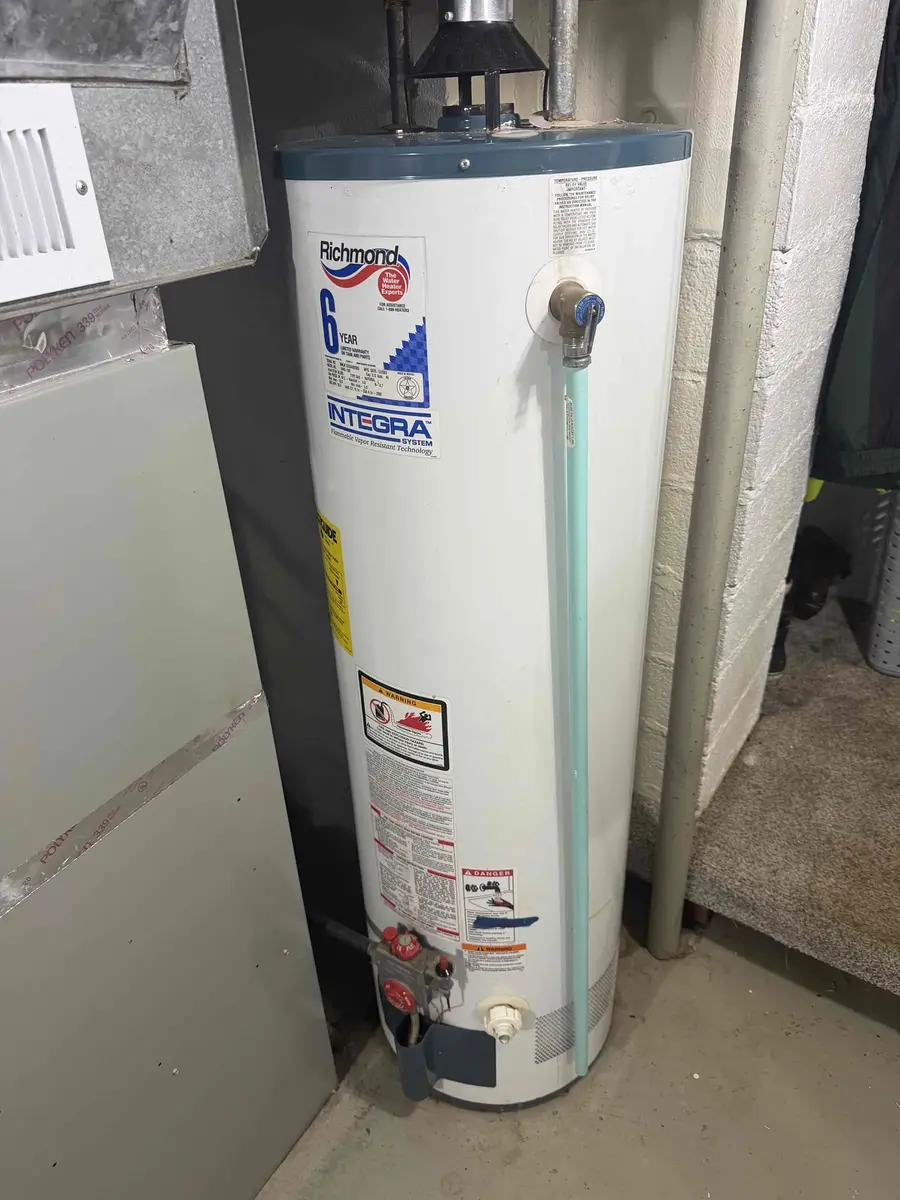
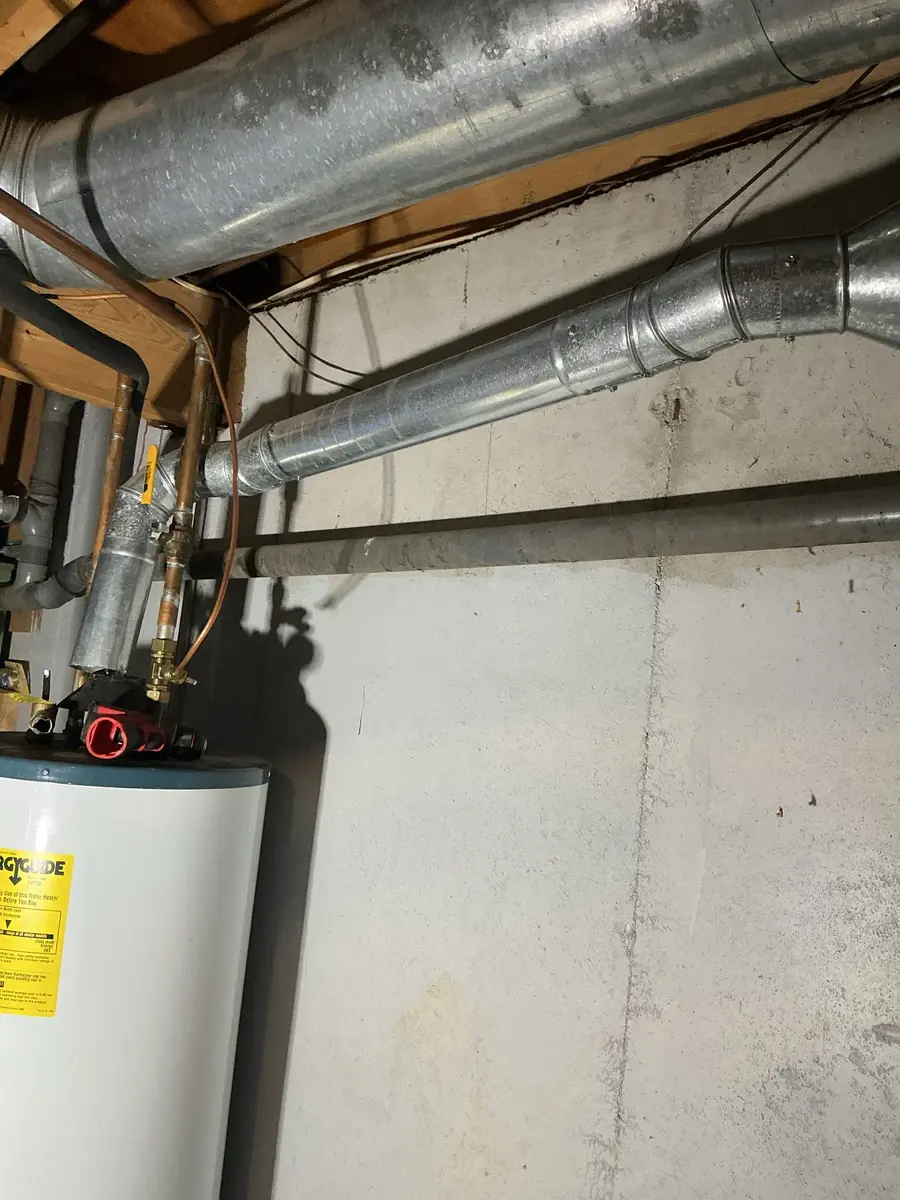
The gas control valve sits near the bottom of the tank, the flue pipe exits from the top, and the temperature and pressure relief valve (the brass valve with a discharge tube running down the side) sits on the upper half. Knowing where these parts are makes the next five checks faster.
One more thing before you troubleshoot the unit. If you just ran the dishwasher, a load of laundry on hot, and a long shower back to back, the tank may simply be empty. A standard 40 to 50 gallon tank needs about 30 to 40 minutes to fully reheat. Wait an hour, test the hot side again, and if it comes back, your water heater is fine. You just outran its capacity.
Is the Thermostat Set High Enough?
Every gas water heater has a temperature dial on the gas control valve at the bottom of the tank. It is usually a round knob labeled with settings like "Vacation," "Warm," "A," "B," "C," and "Very Hot."
The factory default on most units is 120 degrees Fahrenheit, which is the setting ENERGY STAR recommends for balancing safety and efficiency. If someone bumped the dial to "Vacation" or all the way down to "Pilot," the burner will not fire and you will get cold water.
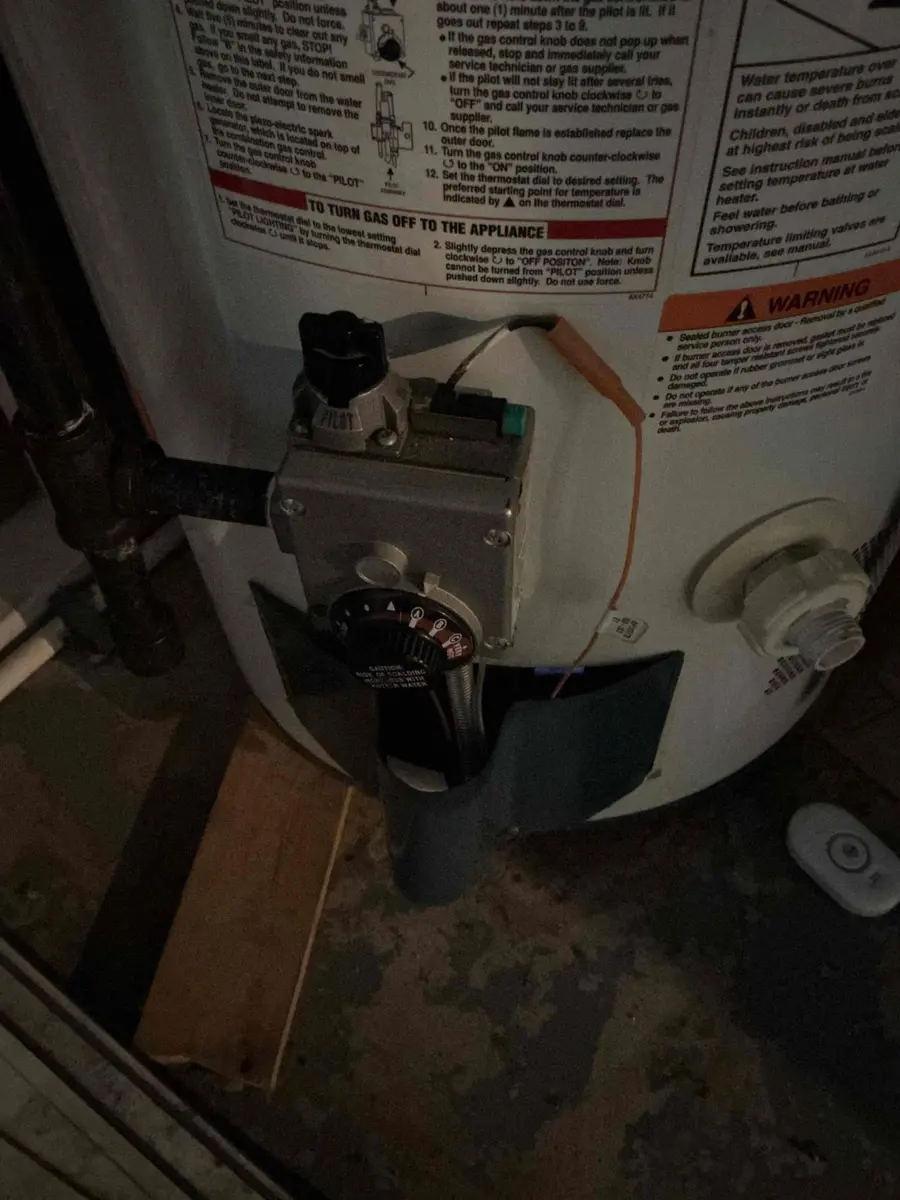
This gas control valve shows the thermostat dial, the pilot light ignition button, and the manufacturer's relighting instructions printed right on the tank. If the dial is turned below the triangle mark or set to "Pilot," the burner is off and no water is being heated.
What to do: Turn the dial so the triangle or arrow points to the "A" or "B" setting (around 120 degrees). Wait 30 minutes and test the hot water again.
On electric water heaters, the thermostat is behind a metal access panel on the side of the tank. You will need a screwdriver to remove the panel and pull back the insulation to see the dial. Most electric units have two thermostats (one upper and one lower), and both should be set to the same temperature. If you are not comfortable working near exposed electrical wiring, skip this step and go straight to calling a plumber.
Is the Pilot Light Still On?
This section applies to gas water heaters only. If you have an electric unit, skip ahead to the breaker section below.
The pilot light is a small flame that burns continuously inside the combustion chamber at the bottom of the tank. It ignites the main burner when the thermostat calls for heat. If the pilot goes out, the burner cannot fire and your water will go cold.
How to check: Look at the small window or gap at the very bottom of the water heater, just below the gas control valve. You should see a small blue flame. No flame means the pilot is out.
How to relight it:
- Turn the gas control knob to the "Off" position. Wait five full minutes for any residual gas to clear.
- Turn the knob to "Pilot."
- Press and hold the knob (or the separate pilot button, depending on the model) while clicking the piezo igniter, which is the small button or trigger next to the gas valve. You should hear a click and see a flame appear in the viewing window.
- Keep holding the knob for 30 to 60 seconds after the flame appears. This heats the thermocouple, a small metal probe next to the pilot flame that tells the gas valve the pilot is lit and it is safe to flow gas.
- Release the knob. If the flame stays on, turn the knob to "On" and set your desired temperature.
If the pilot lights but goes out within a few seconds of releasing the knob, the thermocouple is probably worn out. That is one of the most common water heater repairs. NSP charges $49 for a diagnostic visit, and a thermocouple replacement typically runs $150 to $250 installed.
If you smell gas at any point, do not try to light anything. Leave the house, leave the door open behind you, and call your gas utility's emergency line from outside. Consumers Energy's emergency number is 1-800-477-5050.
Is the Breaker Tripped?
This section applies to electric water heaters only.
Electric water heaters do not have a pilot light. Instead, they use one or two heating elements powered by a dedicated circuit breaker in your electrical panel.
Step 1: Check the breaker panel. Find the breaker labeled "Water Heater" or "WH." If it is in the middle position (not fully on and not fully off), it has tripped. Flip it all the way off, then back on. If you recently lost power during a storm, the breaker may have tripped without you noticing it.
Step 2: Check the reset button. Electric water heaters have a high-temperature cutoff switch, sometimes called the "reset button" or "ECO" (energy cutoff). It sits behind the upper access panel on the side of the tank. Remove the panel with a screwdriver, push the red button, and replace the panel. If the button trips again within a few hours, the thermostat or a heating element is failing and you need a plumber.
Step 3: Listen for heating. After resetting, put your ear near the tank. You should hear a faint hum or the sound of water warming up inside. If the tank is completely silent and the breaker stays on, one or both heating elements may be burned out. Element replacement typically costs $150 to $300 for parts and labor.
Electric water heaters are less common in the Grand Rapids area than gas units. Consumers Energy provides natural gas to most homes in Kent County, so the majority of water heaters NSP services are gas fired. But if your home has an electric unit, these three steps cover the most frequent failure points.
Is There Water Pooled Around the Base?
A puddle under the water heater is never a good sign, but it does not always mean the tank has failed.
Check the temperature and pressure relief valve first. The T&P valve is a brass valve on the upper side of the tank with a copper or CPVC discharge tube running down toward the floor. It is designed to release water if the pressure or temperature inside the tank gets dangerously high. A small drip from the discharge tube can leave a puddle on the floor that looks worse than it is. If the valve is dripping steadily, it may need replacing (about $150 to $200 for parts and labor), or the water pressure coming into your house may be set too high.
Check the connections on top. The hot and cold water lines connect at the top of the tank with threaded fittings. Corrosion or a loose fitting can cause a slow drip that runs down the outside of the tank and collects at the base, mimicking a tank leak. If you see water but cannot pinpoint the source, a leak detection visit can identify it without guessing.
Corrosion and mineral staining around the base of this water heater. The discoloration on the pipes and the water marks on the concrete floor point to a slow leak that has been building for a while. A tank that looks like this is near the end of its useful life.
If the tank itself is leaking, you will usually see water seeping from the bottom seam or from around the drain valve at the very bottom of the unit. A leaking tank cannot be patched or welded. It needs to be replaced before it fails completely and floods the space. Turn off the gas (or breaker) and the cold water supply valve above the tank, then call a plumber.
How Old Is Your Water Heater?
The age of the unit is the single best predictor of whether your no-hot-water problem is a quick repair or the start of a bigger failure.
According to ENERGY STAR, a standard storage tank water heater lasts 10 to 15 years. In West Michigan, where the municipal water is moderately hard (around 150 parts per million in the Grand Rapids supply), mineral buildup inside the tank can shorten that window. NSP regularly replaces units that are 12 to 15 years old and have never been flushed.
How to find the age: Look for the data plate on the side of the tank. It will list the manufacturer, model number, serial number, and usually a manufacturing date.
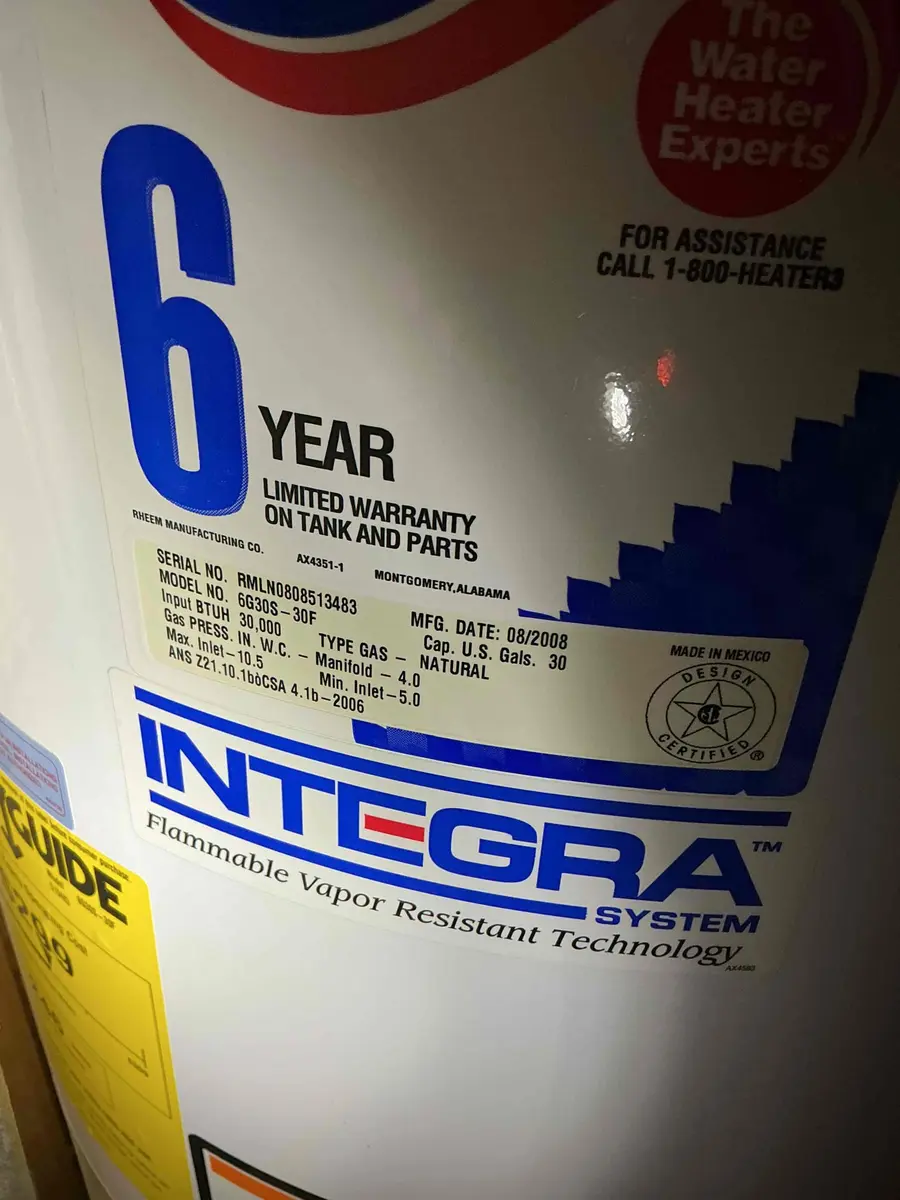
This Rheem label shows a manufacturing date of August 2008 and a six-year limited warranty on tank and parts. A unit built in 2008 would be 18 years old today, well past any reasonable service life. If the pilot will not stay lit on a tank this old, replacement is almost always a better investment than another repair.
Some brands print the date in plain text like the Rheem above. Others embed it in the serial number. A quick web search for your brand plus "serial number date decoder" will show you how to read yours.
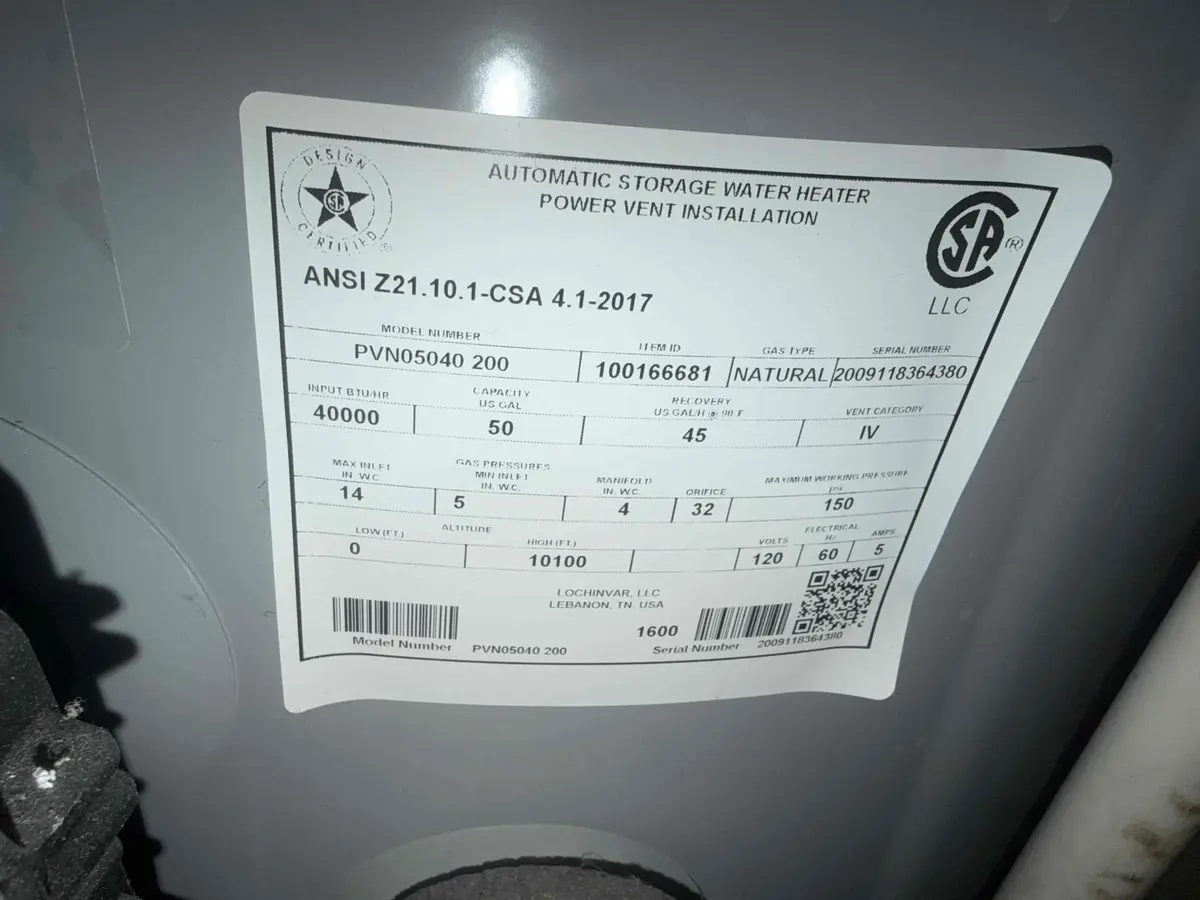
This Lochinvar data plate lists the model, serial number, fuel type, BTU input, and tank capacity. On many brands, the first four digits of the serial number encode the year and week of manufacture. If you cannot find a plain-text date on your unit, the serial number is usually the key.
The math on repair vs. replace is straightforward. A water heater replacement in the Grand Rapids area typically costs between $1,100 and $2,900 for a standard 40 to 50 gallon gas tank, based on work NSP Plumbing has invoiced between January 2025 and August 2026. A repair on a failing 14-year-old unit might cost $200 to $400 and buy you another year or two, or it might leave you calling again in six months. Most plumbers will tell you honestly when the unit is past the point where repair makes financial sense.
For a deeper look at water heater lifespan and what drives the replacement decision, see our guide: How Long Does a Water Heater Last?
When Should You Call a Plumber Instead of Troubleshooting?
Call a plumber if any of these apply:
- You smell gas. Leave the house and call Consumers Energy at 1-800-477-5050. That is not a DIY situation.
- The pilot light will not stay lit after two or three attempts to relight it.
- The breaker trips again right after you reset it.
- Water is leaking from the tank itself, not from a valve or fitting.
- The water coming out of the hot side is rusty, brown, or has a metallic smell. That usually means the inside of the tank is corroding.
- The unit is over 10 years old and has never been serviced.
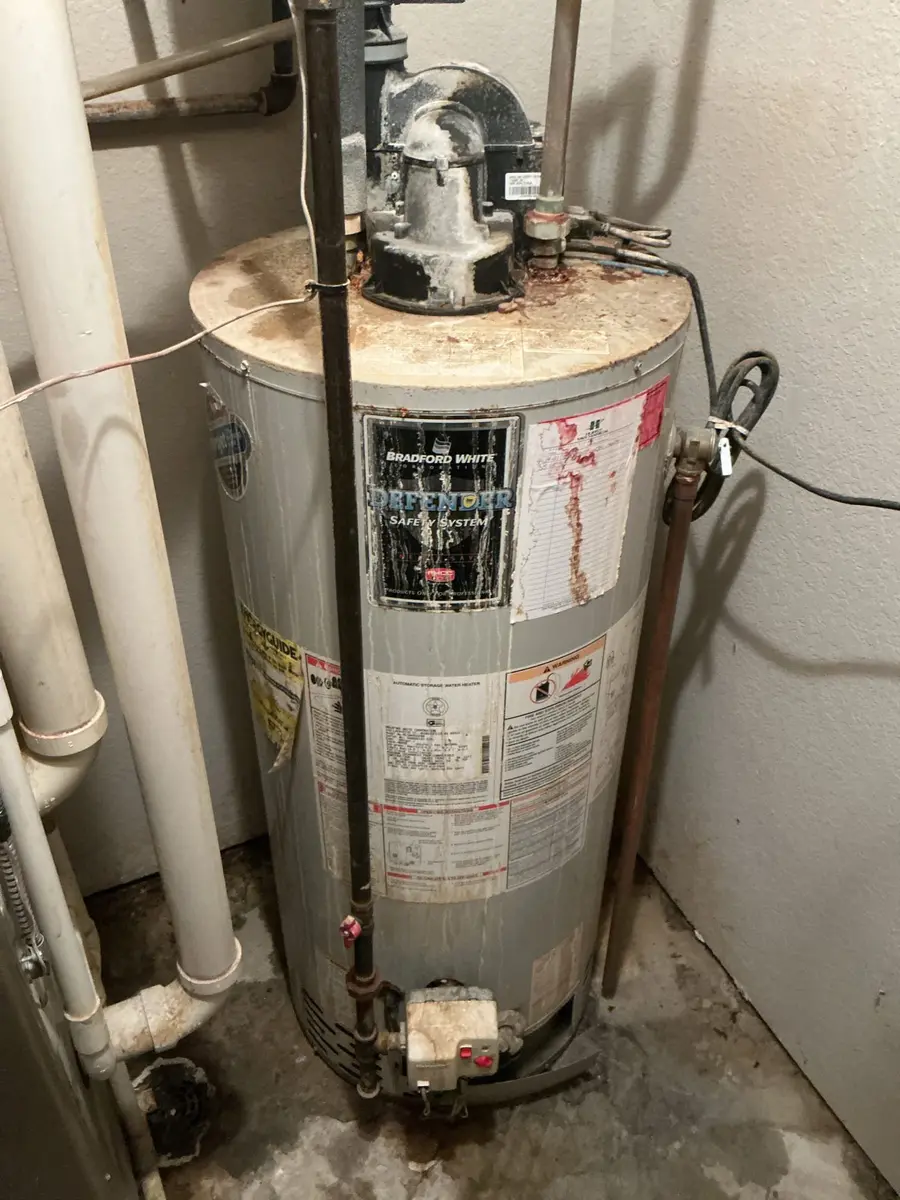
This Bradford White unit is well past its service life. The corrosion on the top of the tank, the rust stains running down the side, and the peeling labels all point to a unit that is failing from the inside out. Repairing a thermocouple on a tank in this condition would be throwing money at a problem that will only get worse.
Two real jobs from the Grand Rapids area show the range:
$99, east side of Grand Rapids, July 2026. Tenant reported no hot water in the entire apartment. The tech found the pilot light had gone out and no other damage. Relit the pilot, confirmed the thermocouple was functioning, and hot water came back within 20 minutes. Total cost: the diagnostic fee.
$2,880, west side of Grand Rapids, July 2026. The water heater was leaking from the top of the tank and the homeowner had already shut off the water supply. The tank was corroded through. NSP removed the old unit, installed a new 50 gallon gas tank, pulled the permit, and passed the city inspection. The old unit was hauled away the same day.
A diagnostic visit from NSP starts at $49. The tech will tell you what is wrong, what it costs to fix, and whether replacement makes more sense. There is no pressure to decide on the spot, and you get a written estimate you can think about.
Can no hot water be a sign of something dangerous?
It can be if you have a gas water heater and you smell gas near the unit. A gas leak means fuel is escaping without being burned, and it can build up in an enclosed space like a basement or utility closet. If you smell rotten eggs or sulfur near your water heater, do not try to light anything. Leave the house with the door open behind you and call your gas company's emergency line. Beyond a gas leak, no hot water by itself is not dangerous. It is uncomfortable, but it is not an emergency unless there are other warning signs like flooding or unusual smells.
How long should it take a water heater to reheat?
A standard 40 gallon gas water heater recovers in about 30 to 40 minutes after the tank has been fully drained by heavy use. A 50 gallon tank takes 40 to 50 minutes. Electric water heaters are slower because the heating elements produce less BTU output than a gas burner, typically needing 60 to 80 minutes for a full recovery. If you recently ran two showers and a dishwasher cycle back to back, the tank may just be empty. Wait an hour and test again before troubleshooting.
Why is my water lukewarm but not hot?
Lukewarm water usually means the water heater is partially working but not reaching full temperature. On a gas unit, the thermostat dial may be set too low, or the burner may not be firing at full capacity because of a dirty or failing thermocouple. On an electric unit, one of the two heating elements may have burned out, so only half the tank is being heated. Either way, a plumber can diagnose the specific cause and tell you whether it is a $150 fix or a sign the tank is on its way out.
Will a gas water heater work during a power outage?
A standard gas water heater with a standing pilot light does not need electricity to heat water. The pilot stays lit on its own and the gas valve is entirely mechanical. However, a power vent gas water heater (one with an electric blower on top that pushes exhaust through PVC pipe instead of a vertical metal flue) does need electricity to run the blower. If the blower cannot run, the unit shuts down as a safety measure until power returns.
Should I turn off a leaking water heater?
Yes. If the tank itself is leaking (not just a drip from a valve or fitting), turn off the gas supply or the circuit breaker, and shut off the cold water supply valve on top of the unit. This stops the tank from refilling and reduces the amount of water that can leak out. Then call a plumber. A leaking tank cannot be repaired. The internal lining has corroded through, and the only fix is replacement.
How much does a plumber charge to diagnose a water heater?
NSP Plumbing charges a $49 residential diagnostic fee for water heater service calls in the Grand Rapids area. That covers the trip, the diagnosis, and a written estimate if work is needed. If you approve a repair on the spot, the diagnostic fee is typically applied toward the total cost of the job. Commercial diagnostic visits are $150.
Can I replace a water heater myself in Michigan?
You can physically install a water heater, but Michigan's plumbing code requires a permit for water heater replacement. The permit applicant must be a licensed plumbing contractor or the homeowner acting as their own contractor on their own primary residence. You would also need to schedule and pass a code inspection. Gas line connections, venting clearances, and the temperature and pressure relief valve discharge all have specific requirements under the 2021 Michigan Plumbing Code. Most homeowners find that the labor savings do not justify the complexity and liability involved.
Licensed Plumber for Water Heater Service in Grand Rapids
NSP Plumbing is a licensed Michigan plumbing contractor (#8004990) serving Grand Rapids, Wyoming, Kentwood, Grandville, Jenison, Byron Center, Caledonia, and the surrounding West Michigan area. We handle everything from a $49 diagnostic visit to a full water heater replacement with permit and inspection included.
If your hot water is not coming back after running through these six checks, call us or book online. Same-day and next-day appointments are available for most water heater and emergency plumbing calls.
For related reading:
- How Long Does a Water Heater Last?
- How to Winterize Your Plumbing for Vacation
- Why Your Toilet Keeps Running (and How to Fix Each Cause)