

A running toilet is almost always caused by one of three parts inside the tank: a worn flapper (the rubber seal at the bottom), a failing fill valve (the part that refills the tank after you flush), or a stuck flush valve. Most repairs cost between $150 and $450, and the fix usually takes under an hour once a plumber is on site.
What causes a toilet to keep running?
Three parts control every flush. When one of them fails, water either leaks out of the tank or the tank never stops refilling. Here is what each part does and how it breaks.
The flapper is a rubber or silicone seal that sits over the drain hole at the bottom of the tank. When you push the handle, a chain lifts the flapper, water rushes into the bowl, and the flapper drops back down to seal the tank. Over time, the flapper warps, cracks, or collects mineral buildup so it no longer seals tightly. Water trickles past it into the bowl, the tank level drops, and the fill valve kicks on to replace the lost water. That cycle repeats endlessly.
The fill valve is the tall assembly on the left side of the tank (on most toilets). It opens when the tank level drops and shuts off when the water reaches a set point. A failing fill valve may not shut off at all, or it may cycle on and off every few minutes even when no one has flushed. You will hear a brief hiss or a phantom flush sound coming from the bathroom.
The flush valve is the assembly the flapper sits on, including the overflow tube in the center of the tank. If the overflow tube cracks or the flush valve seat is corroded, water bypasses the flapper no matter how new it is. This is the least common of the three, but it is the one that a new flapper will not fix.
The photo below shows what these parts look like inside an older toilet tank. The mineral staining on the walls is typical of West Michigan's hard water (around 150 parts per million), which the U.S. Geological Survey classifies as moderately hard. That buildup is what degrades rubber flappers faster here than in areas with softer water.
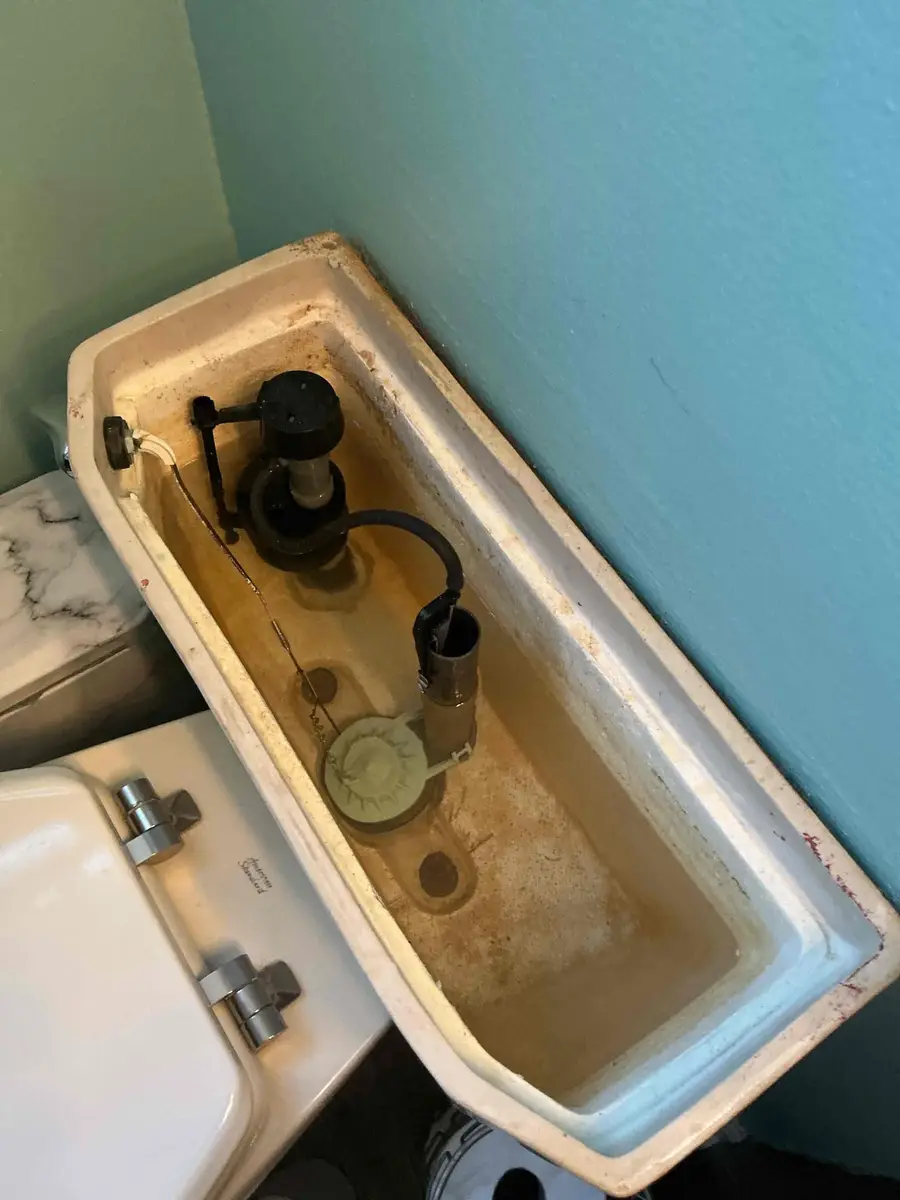
All three parts that cause a running toilet are visible here: the fill valve (black, left), the flapper (clear disc, bottom center), and the overflow tube (right). The brown staining on the porcelain is mineral buildup from hard water, which is exactly what breaks down rubber flappers over a few years.
How do I know if my flapper is the problem?
The flapper is the most common cause. It fails more often than the other parts because it is made of rubber, it sits in water 24 hours a day, and hard water accelerates the breakdown. Here is how to check it without any tools.
The food coloring test. Take the lid off the tank, drop a few drops of food coloring into the tank water, and wait 15 to 20 minutes without flushing. If the color shows up in the bowl, water is leaking past the flapper. That is your answer.
The touch test. Shut off the water supply valve behind the toilet (turn it clockwise), flush to drain the tank, and touch the flapper. If the rubber feels gummy, rough, or leaves black residue on your fingers, it is too degraded to seal. A good flapper feels smooth and pliable.
The chain check. Sometimes the problem is not the flapper itself but the chain connecting it to the handle. If the chain is too short, it holds the flapper partially open. If it is too long, it can slip under the flapper and prevent it from seating. You want about half an inch of slack when the flapper is closed.
Knowing how old the toilet is tells you whether a flapper swap is worth it or whether the whole set of internals is due. Every tank has a date stamp molded into the porcelain, usually on the inside back wall, and you can read it in about ten seconds once the lid is off.
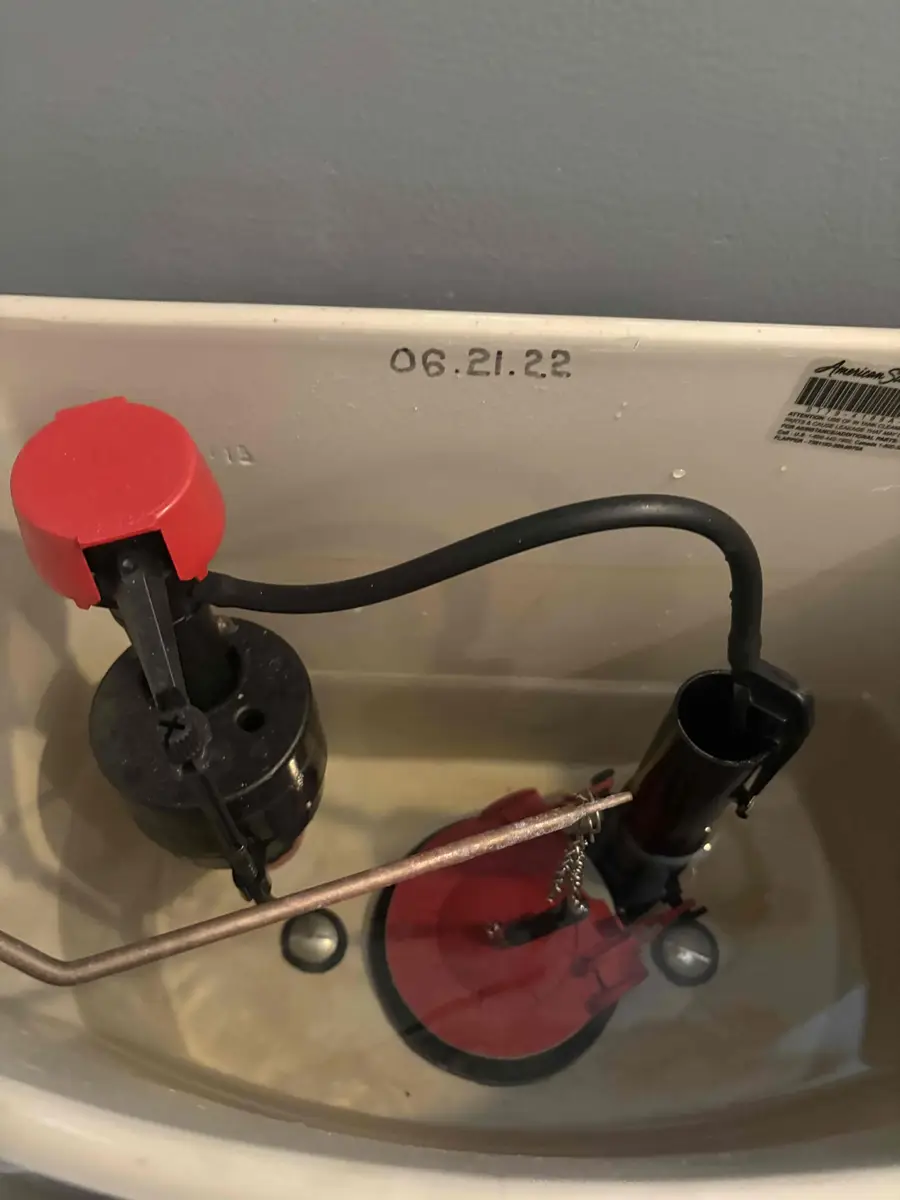
The date stamp on this tank reads 06.21.22, so the toilet was made in June 2022. The red flapper and fill valve are the new parts our tech installed. On a toilet this young, a part swap is clearly the right call. On a tank stamped in the 1990s, the same repair money is usually better spent on a new toilet.
A flapper replacement is the simplest toilet repair. A plumber can swap one in about 15 minutes. On its own, this is usually the least expensive toilet repair we do, often under $200 including the dispatch visit.
What does the fill valve do, and how does it fail?
The fill valve controls the water level in the tank. When the tank empties during a flush, a float drops, the valve opens, and water flows in. When the float rises to the set point, the valve closes. The whole cycle takes about 60 to 90 seconds on a properly working toilet.
A failing fill valve shows up in a few recognizable ways:
Phantom flushing. You hear a brief hiss from the bathroom every few minutes even though no one flushed. The valve is cycling on to top off water that leaked past the flapper or that the valve itself let escape. If a new flapper did not fix the phantom flush, the fill valve is the next suspect.
Never shuts off. The valve stays open and water runs continuously into the tank. If the water level rises above the overflow tube, the excess flows into the bowl nonstop. You will hear constant running. Turn off the supply valve behind the toilet to stop it until you can get a repair.
Noisy operation. Screeching, vibrating, or hammering sounds when the tank refills usually mean the valve's internal seal or diaphragm is worn. The noise gets louder as the valve deteriorates.
Grand Rapids water averages around 150 milligrams per liter of hardness. That is enough to accumulate scale on fill valve internals faster than in areas with treated or naturally soft water.
What scale actually looks like inside a tank is worth seeing, because the buildup is not always obvious from the top.
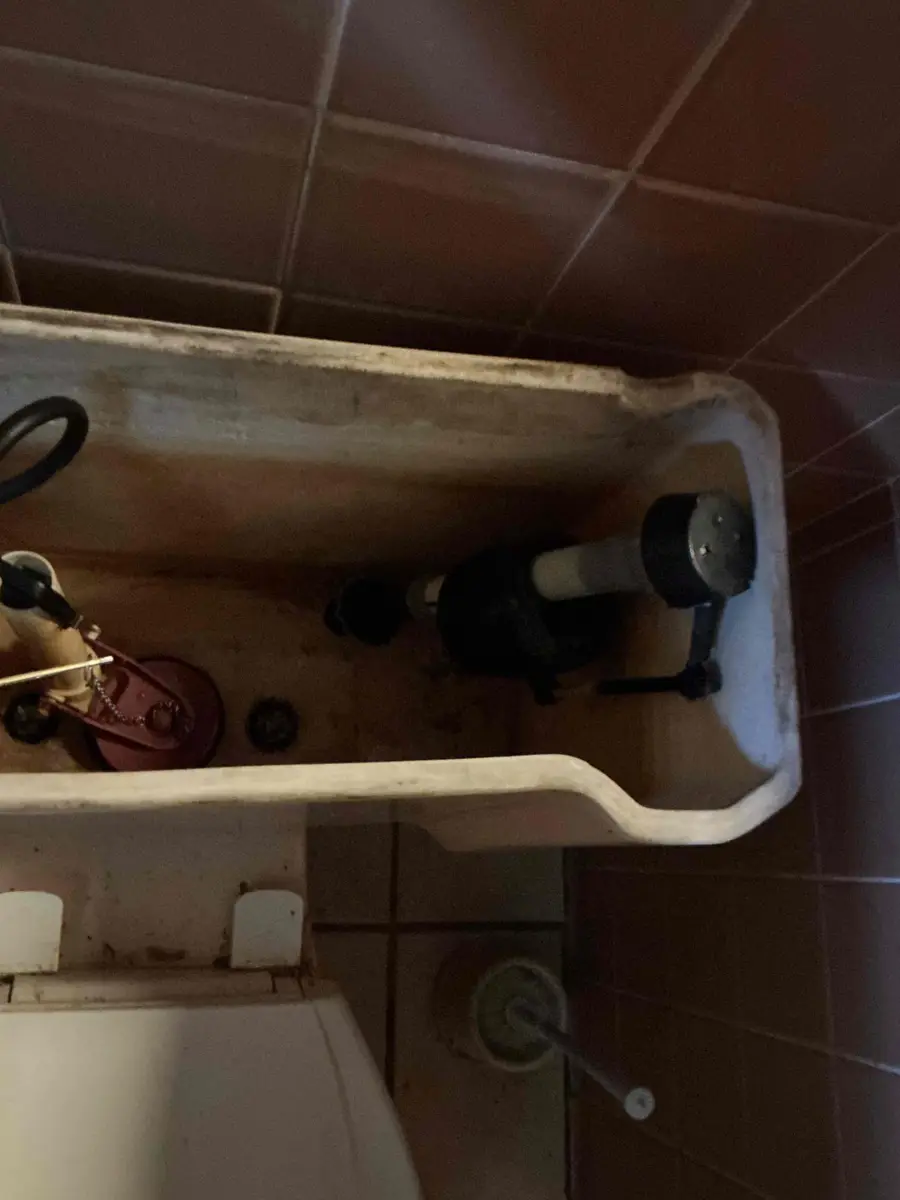
Years of hard water on an untreated line. The chalky band along the rim and the sediment on the fill valve body are mineral scale, and that grit is what keeps a flapper from seating flat. A tank that looks like this will keep eating flappers until either the water is treated or the internals are fully rebuilt.
If you do not have a water softener, expect fill valves to need replacement every 5 to 7 years rather than the 7 to 10 that manufacturers typically rate them for.
A fill valve replacement runs in the same range as a flapper repair, generally between $150 and $300 at our shop, depending on whether the supply line and shut-off valve need attention at the same time.
Can a bad flush valve make a toilet run nonstop?
Yes, but this is the least common of the three causes. The flush valve is the brass or plastic assembly bolted to the bottom of the tank that the flapper sits on. It includes the overflow tube (the open pipe in the center of the tank that prevents the tank from overflowing onto the floor).
Two things go wrong with flush valves:
The valve seat is corroded or pitted. Even a brand new flapper cannot seal against a rough surface. If you replaced the flapper and the food coloring test still fails, the valve seat is the likely culprit. You can sometimes feel the roughness by running a finger around the rim where the flapper sits.
The overflow tube is cracked. A hairline crack in the overflow tube lets water seep into the bowl below the normal water line. This is hard to spot visually but easy to hear: the fill valve cycles on to replace the lost water.
Replacing a flush valve is a bigger job because the tank has to come off the bowl. Most plumbers will recommend a full rebuild (new flapper, fill valve, and flush valve all at once) since the labor to remove the tank is the expensive part. A full toilet rebuild typically runs $250 to $500.
This close-up from an August 2026 job shows the kind of mineral buildup that collects on tank components in West Michigan. The flapper (red, right) and fill valve cap (red, left) are replacement parts the tech installed. The discolored water and sediment on the tank walls is what the original parts had been sitting in.
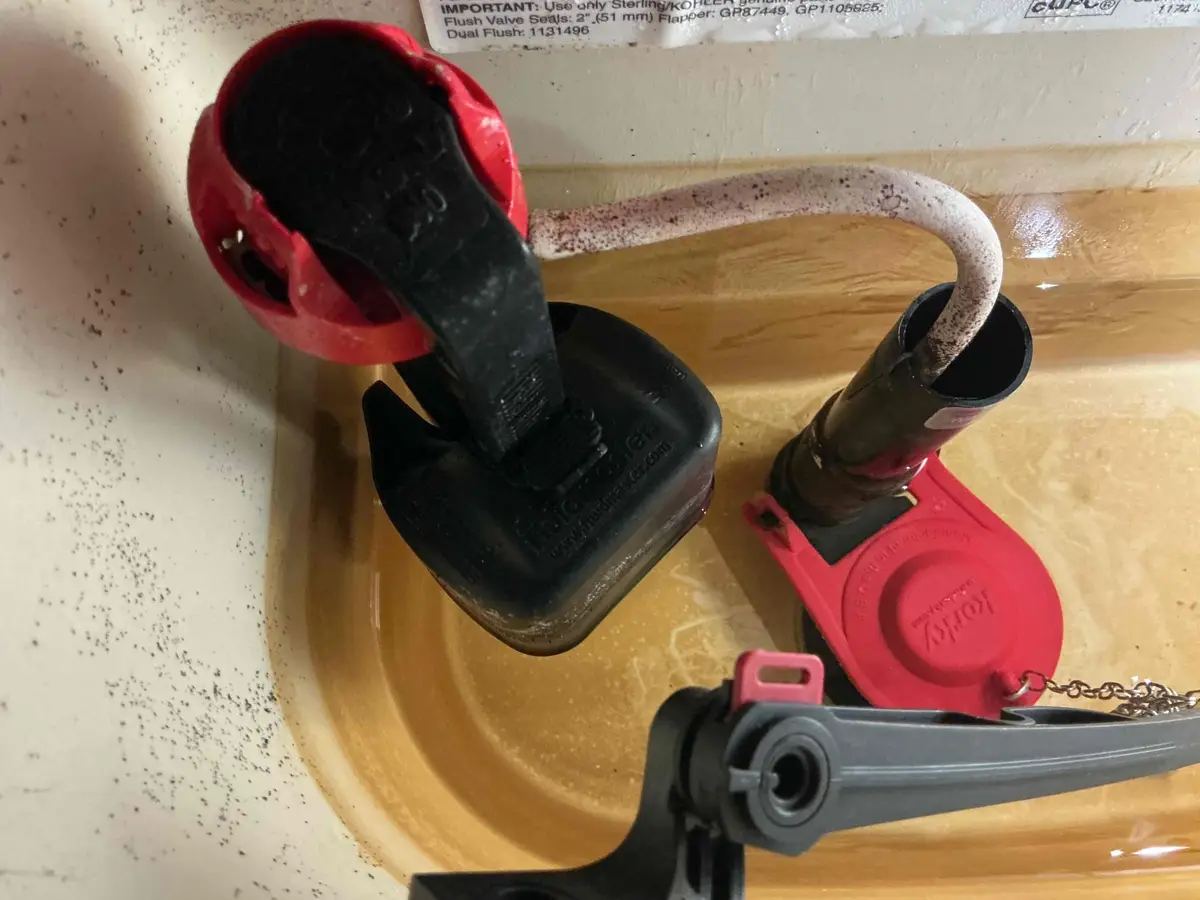
New Korky flapper (red, right) and Fluidmaster fill valve (red cap, left) installed inside a tank with heavy mineral staining. The brown sediment on the porcelain is what hard water leaves behind, and it is the reason the old parts failed.
How much does it cost to fix a running toilet?
Here is what homeowners in the Grand Rapids area actually paid for toilet work we invoiced between May 2025 and August 2026:
| Repair level | Typical range | What it usually covers |
|---|---|---|
| Simple part swap | $150 to $260 | Flapper, fill valve, or handle on one toilet |
| Rebuild | $260 to $500 | Full internal rebuild (flapper + fill valve + flush valve) |
| Replacement | $500 to $800 | Remove old toilet, install new one, new wax ring, supply line |
Median cost across all toilet jobs: $438. The 25th percentile was $263 (a simple repair) and the 75th percentile was $797 (usually a full toilet replacement). The most expensive toilet job in that window was $2,550, which involved replacing multiple toilets in a home.
A few real examples from recent months:
$425, August 2026. Homeowner reported two toilets that were running longer than normal after each flush. The tech rebuilt the internals on both (new flapper, fill valve, and supply lines). Total time on site was about two hours.
$1,075, July 2026. Toilet had been running constantly for months. The homeowner had already replaced the flapper themselves, but the running continued. The tech found the flush valve seat was corroded and the fill valve was also failing. The job included a full rebuild plus work on a slow bathroom sink drain, which is why it ran higher than a toilet-only repair.
$259, July 2026. Only bathroom in the house, toilet would not flush and would not stop running. Single fill valve replacement fixed it. The homeowner was back to a working bathroom the same day.
Your cost depends on which parts need replacing, how many toilets are involved, and whether the shut-off valve or supply line is in rough shape (older homes sometimes have gate valves that seize when you try to turn them, adding a valve replacement to the scope). NSP charges a $49 dispatch fee for residential plumbing visits, which covers the diagnosis.
Should I fix a running toilet myself or call a plumber?
Some running toilet repairs are reasonable DIY projects. Others are not. Here is a practical split.
DIY is reasonable when:
You have identified the flapper as the problem (the food coloring test confirmed it), you can find the right size at a hardware store (most toilets use a 2-inch or 3-inch flapper), and the shut-off valve behind the toilet works. A flapper swap takes about 10 minutes and costs $5 to $15 in parts. Chain adjustments are free.
Buying the right flapper is where most DIY attempts go wrong. Many tanks have the manufacturer's help line and the exact flapper part number printed inside, which removes the guesswork at the hardware store. Part makers publish model-by-model guides as well, including Fluidmaster's toilet repair reference.
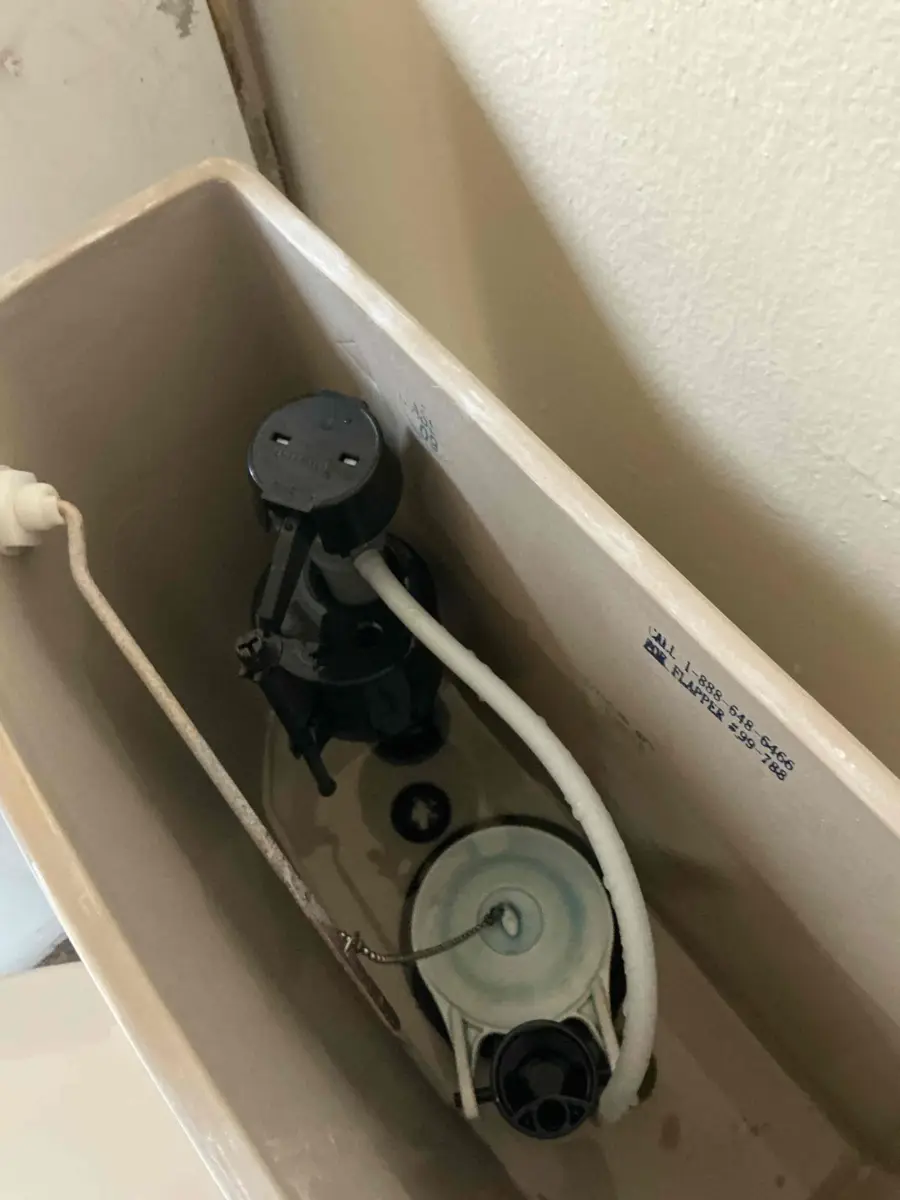
This tank has the flapper part number printed right on the wall, 99-788, next to the manufacturer's phone number. Photograph that line before you go to the store. A flapper that is close but not correct is the single most common reason a homeowner repair does not stop the running.
Call a plumber when:
You replaced the flapper and the toilet still runs. This usually means the flush valve seat is damaged or the fill valve is failing, and guessing your way through both replacements often costs more in parts and frustration than a single service call.
The shut-off valve behind the toilet does not turn or leaks when you try. A stuck or corroded shut-off valve means you need to shut off water to the entire house to work on the toilet, and replacing the valve requires soldering or a compression fitting.
The toilet is rocking, leaking at the base, or smells like sewer. These are not running toilet issues. They point to a failed wax ring (the seal between the toilet and the drain pipe in the floor), loose bolts, or a damaged flange (the metal ring the toilet bolts to).
Resetting a toilet is a two-person job that involves lifting 60 to 80 pounds of porcelain, and the reset has to meet the 2021 Michigan Plumbing Code requirements for the closet flange and seal.
You have already spent more than $50 in parts at the hardware store. At that point, you are approaching the cost of a professional repair and the plumber will warranty the work.
How much water does a running toilet waste?
A running toilet can waste a surprising amount of water. According to the EPA WaterSense program, household leaks can waste nearly 10,000 gallons of water per year, and toilets are among the most common sources.
The exact amount depends on the size of the leak. A slow flapper drip might waste 30 to 50 gallons a day. A fill valve that never shuts off can waste 200 or more gallons a day.
On a municipal water bill in the Grand Rapids area, where combined water and sewer rates run roughly $12 to $15 per 1,000 gallons, a badly running toilet can add $60 to $90 a month.
That math changes the cost calculation. A $200 repair pays for itself in two to three months of water savings if the leak was moderate. If the toilet has been running for six months (we see this more often than you would think), the wasted water may have already cost more than the repair.
One practical tip: most water utilities in West Michigan will adjust a bill if you can show the high usage was from a leak that has been repaired. Call your utility, explain the situation, and ask about a leak adjustment. It does not always work, but it is worth the five-minute phone call.
When is it smarter to replace the whole toilet?
Sometimes a repair is not the right call. Here is when replacement makes more financial sense.
The toilet is 20 or more years old and needs more than a flapper. A full rebuild on a 25-year-old toilet costs $300 to $500 in labor, and the porcelain itself may be stained, cracked at the bolts, or using 3.5 gallons per flush. The EPA WaterSense standard is 1.28 gallons per flush, 20 percent below the current federal maximum of 1.6, and EPA puts toilets at nearly 30 percent of a home's indoor water use, so the flush volume alone is worth the swap. A new toilet installation typically runs $500 to $800 including the toilet, and you get a unit that flushes better on less water.
The bowl or tank is cracked. Porcelain cracks do not heal and cannot be reliably patched. A crack in the tank is a leak waiting to happen (or already happening). Replace it.
You are remodeling. If the floor is getting replaced or the bathroom is being updated, it is cheaper to install a new toilet while the floor is open than to pull and reset the old one on new flooring.
The flange is damaged. If the metal or PVC ring in the floor that the toilet bolts to is broken, corroded, or too low, resetting the old toilet on it will just create a new problem. A plumber can replace the flange and set a new toilet in the same visit.
This is what our techs find once the toilet comes off the floor, and it is the part of the job a homeowner never sees.
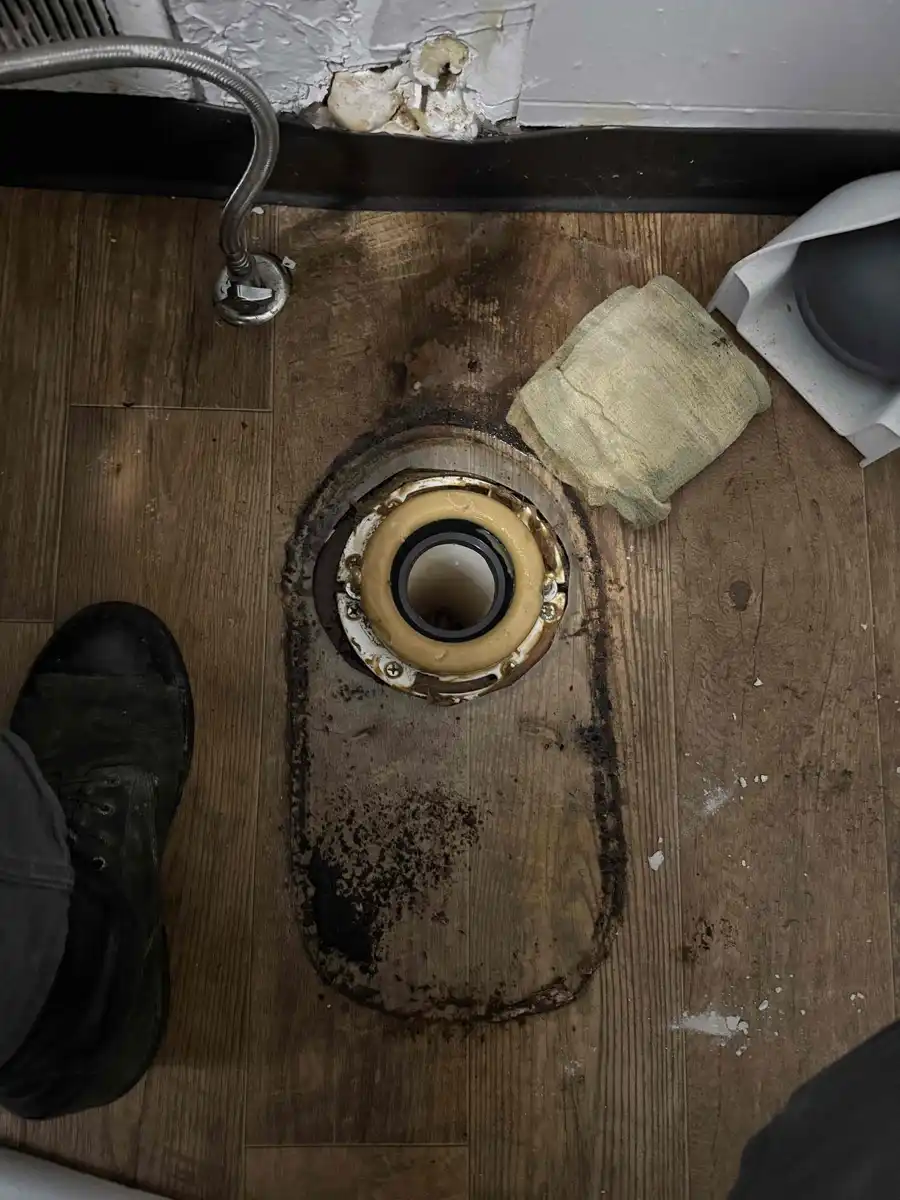
Toilet pulled, flange exposed, new wax ring set. The dark outline on the floor is the footprint of the old toilet, and that staining means water had been working its way out at the base for a long time. If the flange sits below the finished floor or the bolts have rusted through, resetting the old toilet just recreates the leak.
In practice, most of the toilet calls we run end in a replacement rather than a repair. A new toilet solves the running, the weak flush, and the water waste all at once. For many homeowners the price difference between a rebuild and a new unit is small enough that replacement is the better value.
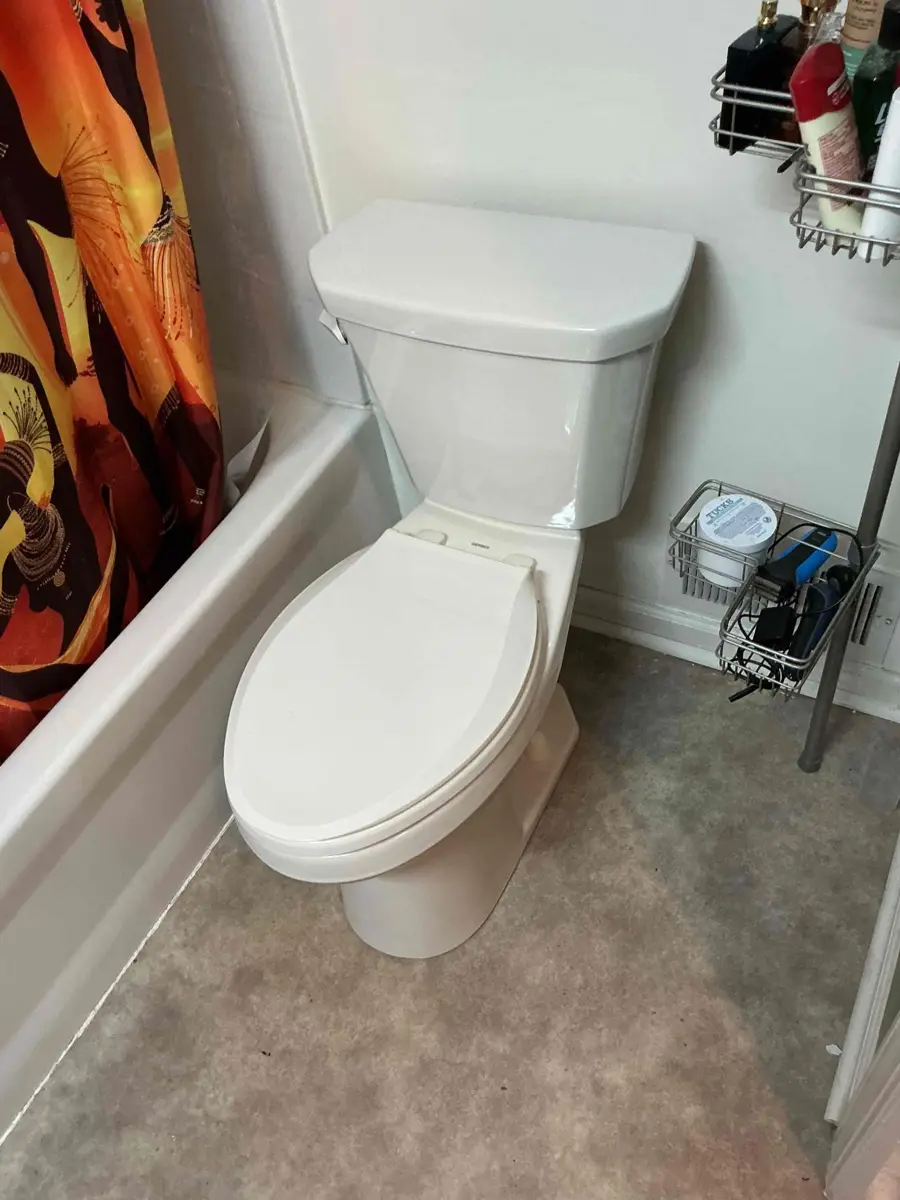
A finished replacement from a recent Grand Rapids job. New bowl, new tank, new wax ring and supply line, base sealed and the floor left clean. Most replacements are in and working within about two hours.
Can a running toilet increase my water bill?
Yes. A slow flapper leak can waste 30 to 50 gallons per day. A stuck-open fill valve can waste 200 or more.
In the Grand Rapids area, where combined water and sewer rates run roughly $12 to $15 per 1,000 gallons, a moderate leak adds $30 to $90 to a monthly bill. Many West Michigan utilities offer a one-time leak adjustment if you show the repair is done.
Why does my toilet run for a few seconds every 15 or 20 minutes?
This is called phantom flushing. The flapper is not sealing completely, so water slowly leaks into the bowl. The tank level drops just enough to trigger the fill valve, and the valve runs for a few seconds to top it off.
A new flapper usually fixes it. If it does not, the flush valve seat (the surface the flapper sits on) may be rough or corroded.
I replaced the flapper and the toilet still runs. Why?
Three common reasons. First, you may have installed the wrong size (2-inch and 3-inch are not interchangeable, and some brands like Kohler and American Standard require proprietary flappers). Second, the flush valve seat may be corroded, so even a new flapper cannot seal against it.
Third, the fill valve may also be failing independently. A plumber can diagnose which one in a single visit.
How long does a toilet flapper last?
Most rubber flappers last 3 to 5 years. In areas with hard water like Grand Rapids (around 150 milligrams per liter), mineral deposits accelerate the breakdown, so 2 to 4 years is more realistic if you do not have a water softener. Silicone flappers last longer (often 7 to 10 years) but cost slightly more and are not compatible with every toilet model.
Is a running toilet an emergency?
Not usually. A running toilet wastes water and money, but it will not flood your house the way a burst pipe would.
The exception: if the fill valve is stuck open and water is overflowing past the bowl's rim, turn off the supply valve behind the toilet immediately and call for emergency plumbing service. If the valve will not turn, shut off the main water supply (here is how to find your main shut-off valve).
Does hard water cause toilets to run?
Not directly, but it accelerates the failure of the parts that do. Mineral deposits (mostly calcium and magnesium) build up on the flapper, fill valve, and flush valve seat. The flapper loses its flexibility. The fill valve's internal diaphragm stiffens and stops closing properly.
Grand Rapids water is considered moderately hard, which is why we see tank components wear out faster than the manufacturer's stated lifespan. A water softener extends the life of every fixture in the house, including toilet internals.
Can I just jiggle the handle to fix a running toilet?
Jiggling the handle works temporarily because it reseats the flapper or frees a tangled chain. But it is a sign that the flapper is warped or the chain length is wrong. If you have to jiggle the handle after every flush, the flapper or chain needs to be replaced. The fix is usually under $200.
How long does a toilet repair take?
A simple part swap (flapper or fill valve) takes 15 to 30 minutes once the plumber is on site. A full rebuild (all internal components) takes about an hour. A complete toilet replacement, including pulling the old unit, replacing the wax ring and potentially the flange, and setting the new one, takes one to two hours. Most toilet repairs are same-day appointments.
Licensed Plumber Serving Grand Rapids and West Michigan
NSP Plumbing is a licensed Michigan plumbing contractor (license #8004990) serving Grand Rapids, Wyoming, Kentwood, Grandville, Caledonia, Walker, and the surrounding West Michigan area. We handle everything from a $49 diagnostic visit and flapper replacement to full toilet installations, fixture upgrades, and whole-home plumbing inspections. Read what homeowners say on our reviews page or learn more about our team.
Toilet running? We will diagnose it for $49.
NSP Plumbing dispatches same-day in most of the Grand Rapids metro. The $49 fee covers the diagnosis, and it applies toward the repair if you move forward.