
Most homeowners only think about the sump pump once the basement is already wet. The honest planning number is simple. A typical sump pump lasts about 7 to 10 years, and a pump that runs hard every spring in a high water table can be done sooner.
How Long Do Sump Pumps Last?
Plan on roughly 7 to 10 years for a standard submersible pump in a West Michigan basement. InterNACHI puts the average at 7 years in its home component life expectancy chart, and that matches what we see when we pull an old pump out of a pit.
The range is wide because a sump pump does not wear out by the calendar. It wears out by how many times it starts and how hard it works each time. Two pumps installed the same week can have very different lives.
A pump in a dry basement can run for well over a decade. If the pit only fills during a big spring thaw, the motor might start a few hundred times a year. We have been called out to a pump the homeowner said was about 30 years old. It was still running, it just would not shut off anymore.
A pump in a wet basement can wear out in five or six. If yours kicks on every few minutes from March through May, it is doing years of work in a single season. Those are the pumps we replace early, and they almost always fail during the wettest week of the year.
So the useful question is not just "how old is it" but "how hard has it worked." If you do not know the age, look for a date sticker on the pump body or the cord tag, or check your home inspection report if you bought the house recently.
Here is how the three common setups compare.
| Type of pump | Typical life | What usually ends it |
|---|---|---|
| Submersible primary pump | About 7 to 10 years | Worn motor, failed float switch, debris |
| Pedestal pump (motor above the pit) | Often longer, 10 years or more | Switch and motor wear, it is loud and weaker |
| Battery backup pump | Pump often lasts years; the battery wears out first | Dead battery nobody tested |
| Water powered backup | Long life, few moving parts | Valve wear, needs a yearly backflow test |
If your pump is already past seven years, that does not mean it will fail tomorrow. It means it is time to test it before spring and have a plan for when it goes. Our guide on how to check if your sump pump is working walks through the five minute bucket test.
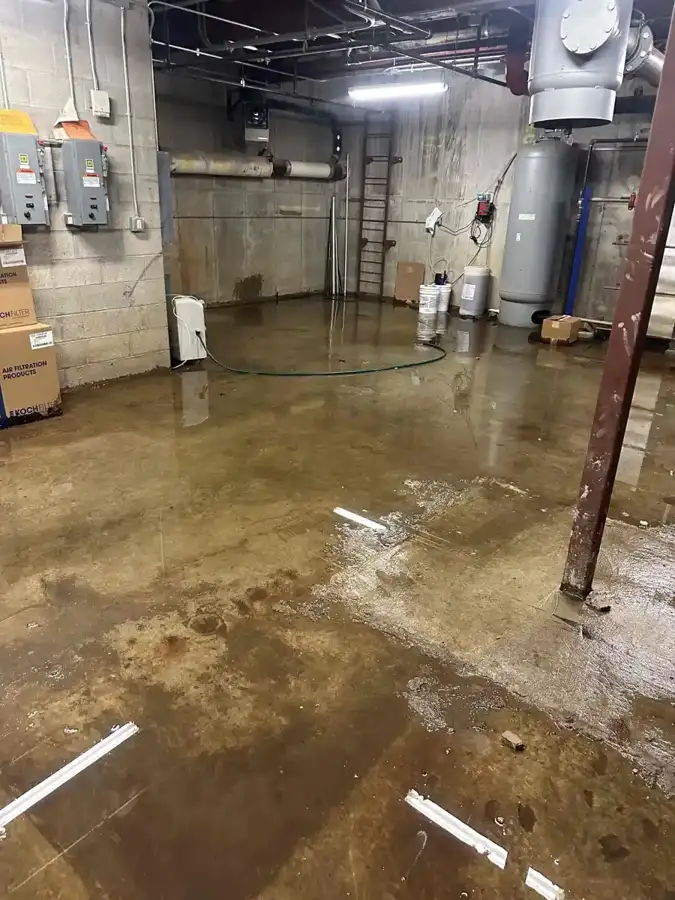
This is what the end of a sump pump looks like: the pump quit and the whole floor took on water. The pump itself is a small part of the bill. The flooring, drywall and everything stored on the floor are the real cost.
What Makes a Sump Pump Wear Out Early?
A sump pump is a simple machine: a motor, a spinning part called an impeller that pushes water, and a float switch that turns it on when water rises. Almost every early failure we see traces back to one of a handful of causes, and most of them are fixable if you catch them.
Running too often. This is the biggest one in the Grand Rapids area.
Homes near rivers, low spots and clay soil can have groundwater sitting just below the basement floor. Every start heats the motor and wears the switch. A pump that cycles every minute or two through spring can burn itself out years ahead of schedule.
One homeowner called us about a pump that ran every 20 to 30 seconds. They had already ruled out the check valve; the pit was simply filling that fast.
A missing or failed check valve. The check valve is a one way valve on the discharge pipe, the pipe that carries water up and out of the house.
When it fails, the water in that pipe falls back into the pit every time the pump shuts off, and the pump pumps the same water again. InterNACHI notes in its sump pump inspection guide that without this valve the pump has to work twice as hard. The Michigan Plumbing Code also calls for a full flow check valve on sump discharge piping in Section 1113.1.4.
We also see leaking check valves drip onto the pump below and rust it out.
Dirt, gravel and debris in the pit. Sediment washes in through the drain tile, the perforated pipe around your foundation that feeds the pit. It clogs the intake screen and jams the float. A pump sitting in sludge works harder and fails sooner.
A float switch that sticks. The float can hang up on the side of the pit, the discharge pipe or the power cord. Stuck down, the pump never starts. Stuck up, it runs until the motor cooks.
The wrong size pump. A pump that is too small for the water coming in runs nonstop. A pump that is far too big empties the pit in seconds and short cycles, which wears the switch.
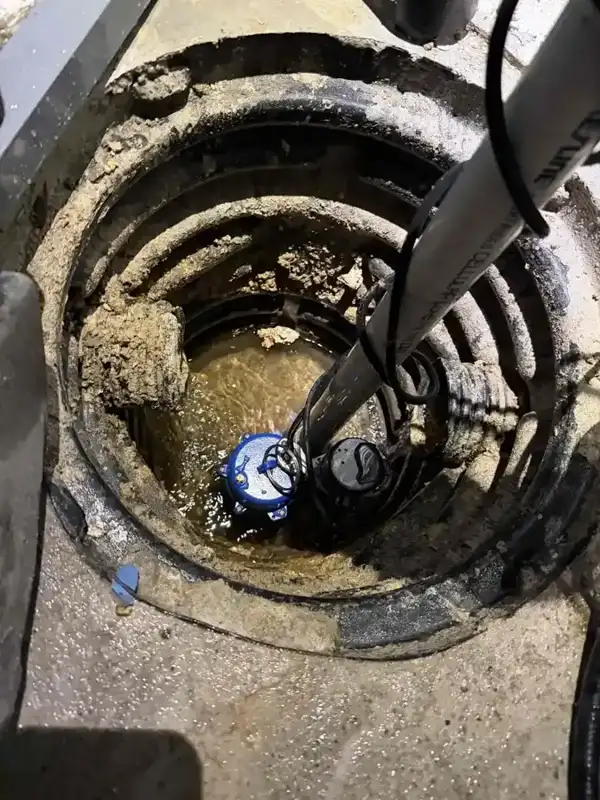
Sediment packed around the pump and float: this pit was wearing its pump out early. The homeowner called because the float would not turn the pump on. Cleaning the pit and replacing the switch is often cheaper than a new pump, but a pump that has sat in this for years is usually near the end anyway.
Freezing is the other one to watch here. A discharge line that runs across the yard can freeze shut in January, and a pump pushing against a frozen line will run without moving water. Keep the outside end clear of snow and make sure it drains away from the house.
How Long Do Pedestal, Submersible and Battery Backup Pumps Last?
The kind of pump you have changes how long you can expect it to last, and the backup side has its own clock that most homeowners forget about.
Submersible pumps sit in the water at the bottom of the pit. They are quieter, more powerful and by far the most common type we install in West Michigan basements.
The water around them keeps the motor cool. A cast iron body sheds heat better and holds up longer than a plastic one, which is why we stock cast iron 1/3 and 1/2 horsepower pumps on our trucks. Expect about 7 to 10 years of normal duty.
Pedestal pumps have the motor on a post above the pit, with only the bottom in the water.
Because the motor stays dry, they often last longer than a submersible. The tradeoff is that they are louder, usually move less water, and the open pit lets in debris. They make sense for a narrow pit; they are rarely the right choice for a wet basement.
Battery backup pumps sit in the same pit, slightly higher than the main pump, and run off a large battery when the power goes out or the main pump fails. The backup pump itself does not run much, so it can last a long time.
The battery is the weak link. It wears out after a few years whether it was used or not, and a backup battery nobody has tested is one of the first things we check when a main pump trips its breaker.
Write the install date on the battery and test the backup every time you test the main pump.
Water powered backups use your home's water pressure to pull water out of the pit, with no battery at all.
Because they have so few moving parts, they last a long time and they never go flat during a long power outage. They do connect to your drinking water, so they need a backflow device, a valve that keeps pit water from being pulled back into your water lines.
Some West Michigan cities, including Wyoming, require that device to be tested and the results filed with the city. We handle that through our backflow testing service.
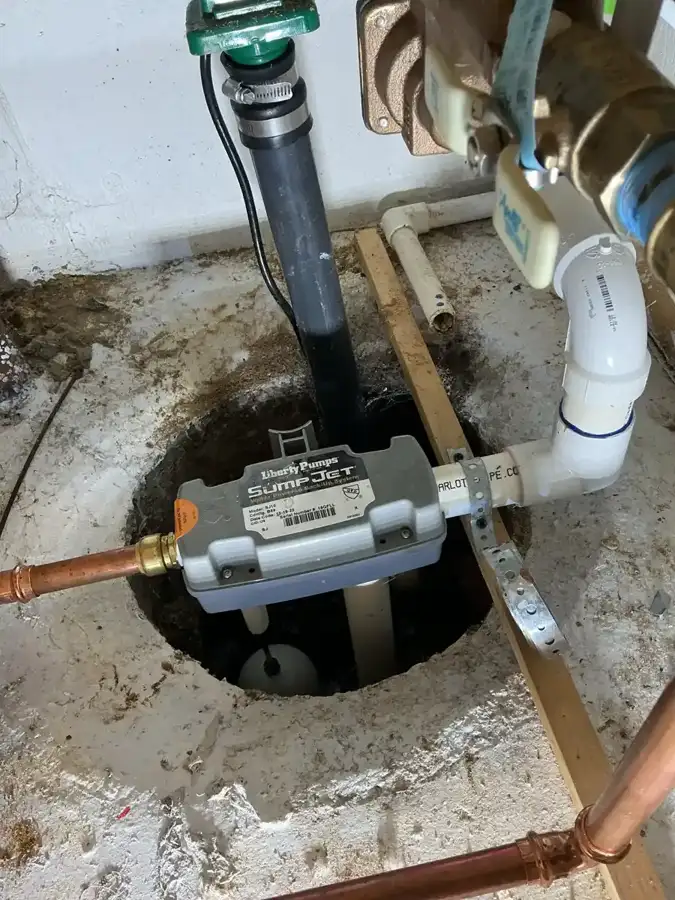
A water powered backup: no battery to die, but it needs its yearly backflow test. The copper line feeding it is your house water, which is why the backflow device on that line matters. For homes on city water that lose power during storms, this is often the most dependable backup.
If you have no backup at all and a finished basement, adding one is usually a better use of money than replacing a primary pump that still tests fine.
What Are the Signs a Sump Pump Is Near the End?
A pump rarely dies without warning. It usually gives you a season of hints first. These are the signs we look for, roughly in the order homeowners notice them.
It is past seven years old. Age alone is not a failure, but it changes the math. A seven year old pump that needs a new switch is often a candidate for replacement instead of repair.
It runs constantly or cycles every few seconds. A pump that never shuts off may have a stuck float, a failed check valve, or more water coming in than it can handle. A pump that clicks on and off rapidly is wearing its switch fast.
It runs but the water does not go down. This one is serious. The motor spins but the impeller is worn or jammed, or the discharge line is blocked or frozen. Several of our calls started with a homeowner saying the pump was running but nothing was going up the pipe.
It makes new noises. Grinding, rattling or a loud clunk when it shuts off point to worn bearings, a damaged impeller or a check valve slamming shut.
It hums but does not start. The motor is getting power but cannot turn, often from a seized impeller or debris. Sometimes clearing the debris brings it back; often it means the motor is done.
It trips the breaker or the outlet. A pump that keeps popping its outlet has a motor or cord problem. That is also a safety issue, so unplug it and call.
You can see rust or the pit is full of sludge. Rust on the pump body or the pit lid means water has been dripping on it, often from a leaking check valve above.
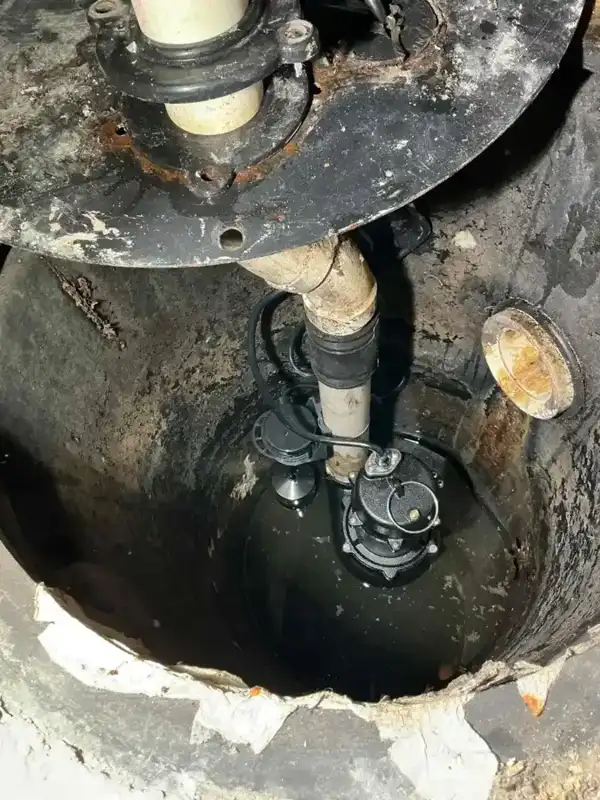
Heavy rust on the lid and crock plus a constant running noise: at this point, plan on replacement, not repair. The homeowner had already shut the pump off so it would not burn up. When a pit looks like this, a repair usually only buys a few months.
If you notice any one of these, run the bucket test. If you notice two, start planning a replacement before spring.
When Should You Replace an Aging Sump Pump in Michigan?
The best time to replace an old sump pump is before you need it, and in West Michigan that means fall or winter, not March.
Our own service data shows the pattern clearly. March and April are by far our busiest sump pump months, with April alone well ahead of any other month of the year.
That is the spring thaw: snow melting off the yard, frost coming out of the ground and spring rain all landing at once, while the ground underneath is still too frozen or saturated to soak it up.
The National Weather Service flood safety guide lists snowmelt alongside heavy rain as a leading cause of flooding.
That is also when an old pump is most likely to fail, because it is running harder than it has all year. Replacing it in a hurry during a busy week usually means:
- You wait longer for a technician, because everyone else's pump is failing too.
- You may pay for an after hours visit if it fails at night or on a weekend.
- The install itself is harder when the pit is filling fast. On one job our estimate specifically recommended waiting until the groundwater slowed, because the pit refilled too quickly to work in.
A planned replacement in October through February avoids all three. The pit is often dry or slow, the work is quicker, and you go into spring with a new pump and a tested backup.
A simple rule we give homeowners: if your pump is seven years old or more, test it every fall. If it fails the test or shows any of the signs above, replace it before the thaw. If it is ten years old or more and you have a finished basement, replace it on schedule even if it still passes.
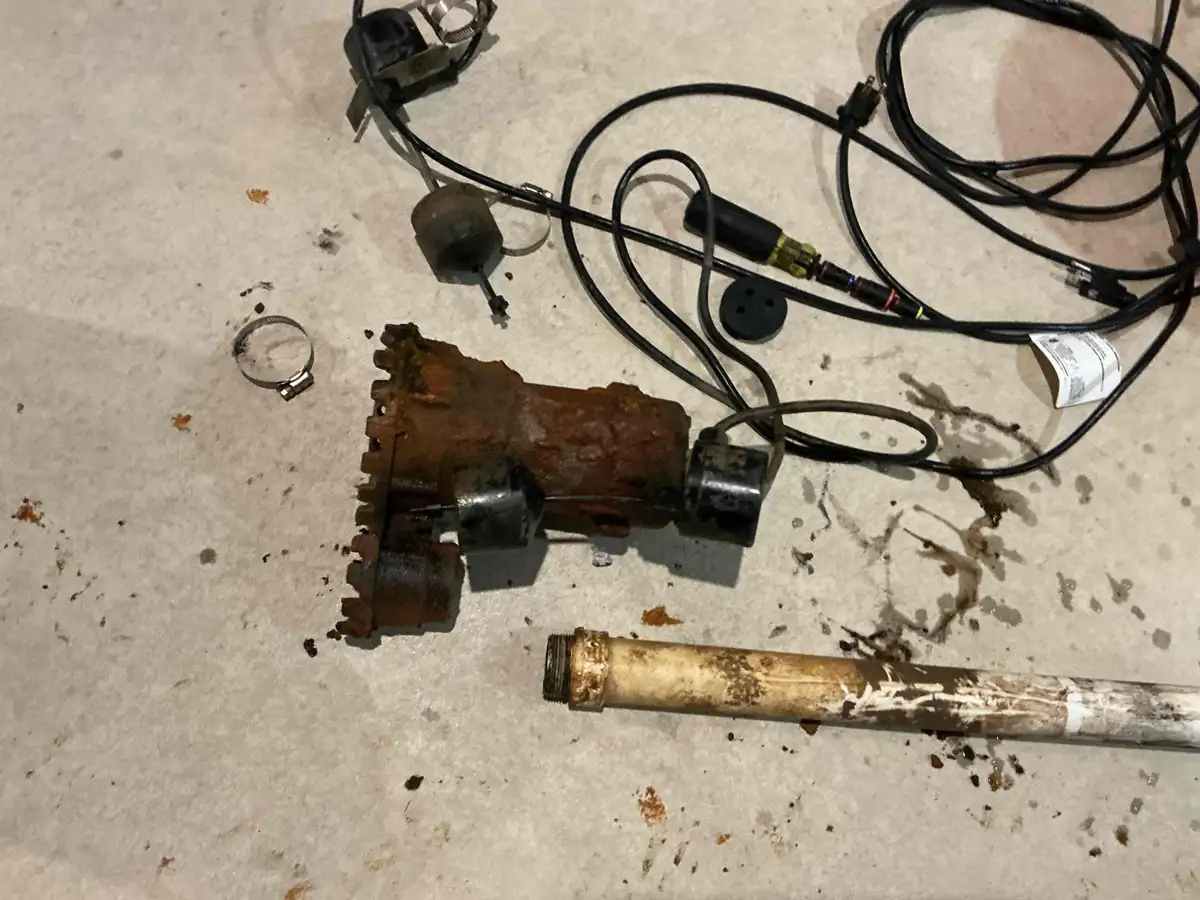
A pump pulled out after it quit during a February thaw: this is what waiting until it fails looks like. The homeowner had water coming into the basement and wanted to avoid an after hours charge. Swapping an aging pump in the fall avoids that scramble entirely.
If your basement has flooded before, also read our post on sewer backups in the basement during heavy rain, because not every wet basement is a sump problem.
Should You Repair or Replace an Old Sump Pump?
Some sump problems really are cheap repairs, and we would rather tell you that than sell you a pump you do not need. The deciding factors are age, what failed and what is at stake if it fails again.
Usually worth repairing:
- A stuck float caught on the cord or pipe. Freeing it and securing the cord can fix it on the spot.
- A failed check valve on a pump that is otherwise healthy.
- A clogged intake screen or a pit full of debris on a pump that is only a few years old.
- A frozen or blocked discharge line outside.
Usually time to replace:
- The pump is seven years or older and needs a new switch or motor work.
- It hums but will not turn, or it runs but does not move water, after the pit and line are cleared.
- The body is rusted, cracked or leaking.
- It has failed once already and your basement is finished.
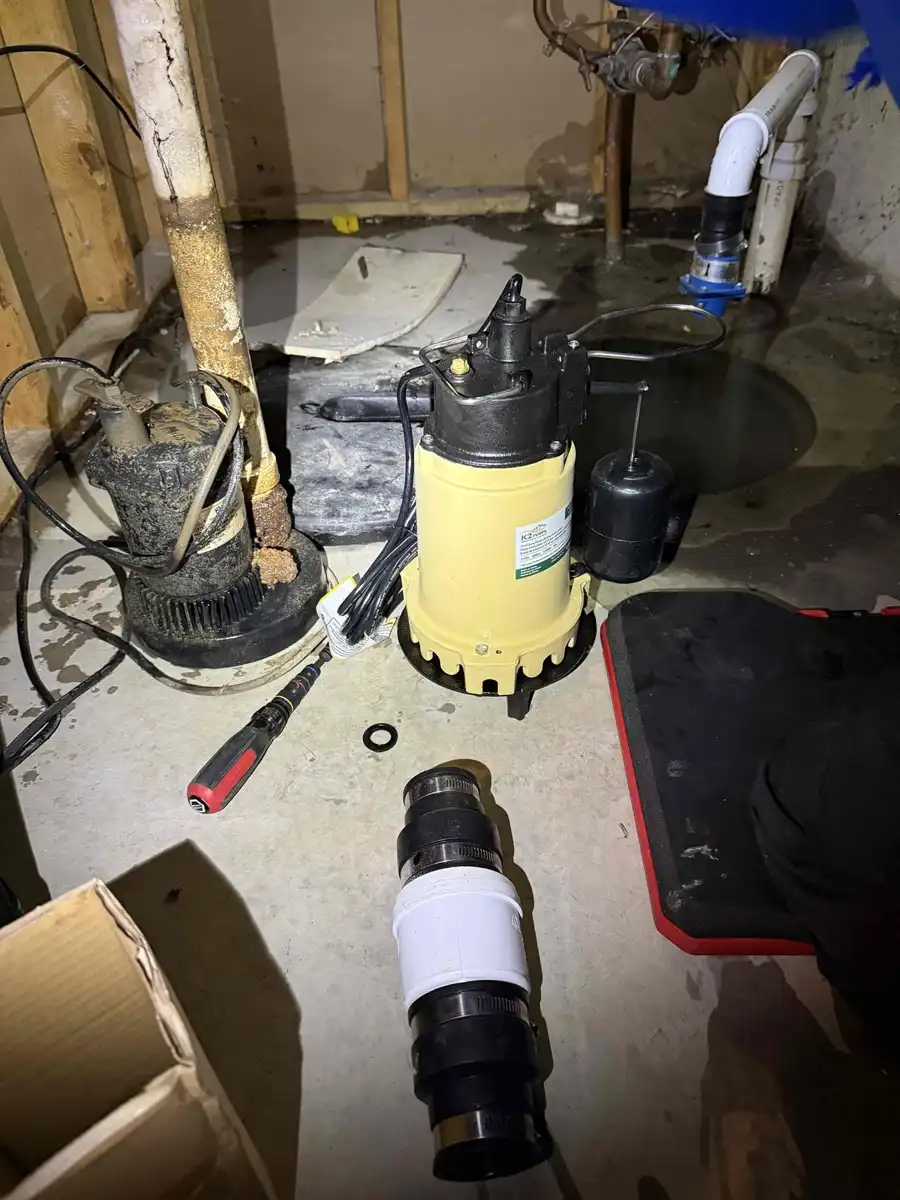
Old pump out, new pump in: when the motor quits on an older unit, replacement is the right call. This one would not restart after a breaker problem, even once power was back. That is a motor that is finished, so a new pump goes in rather than another repair.
When we come out, a technician checks the whole system, not just the pump. That means the float and switch, the check valve, the discharge line inside and out, the outlet and power, the pit itself, and any backup system. Often the real problem is one of those parts, not the pump.
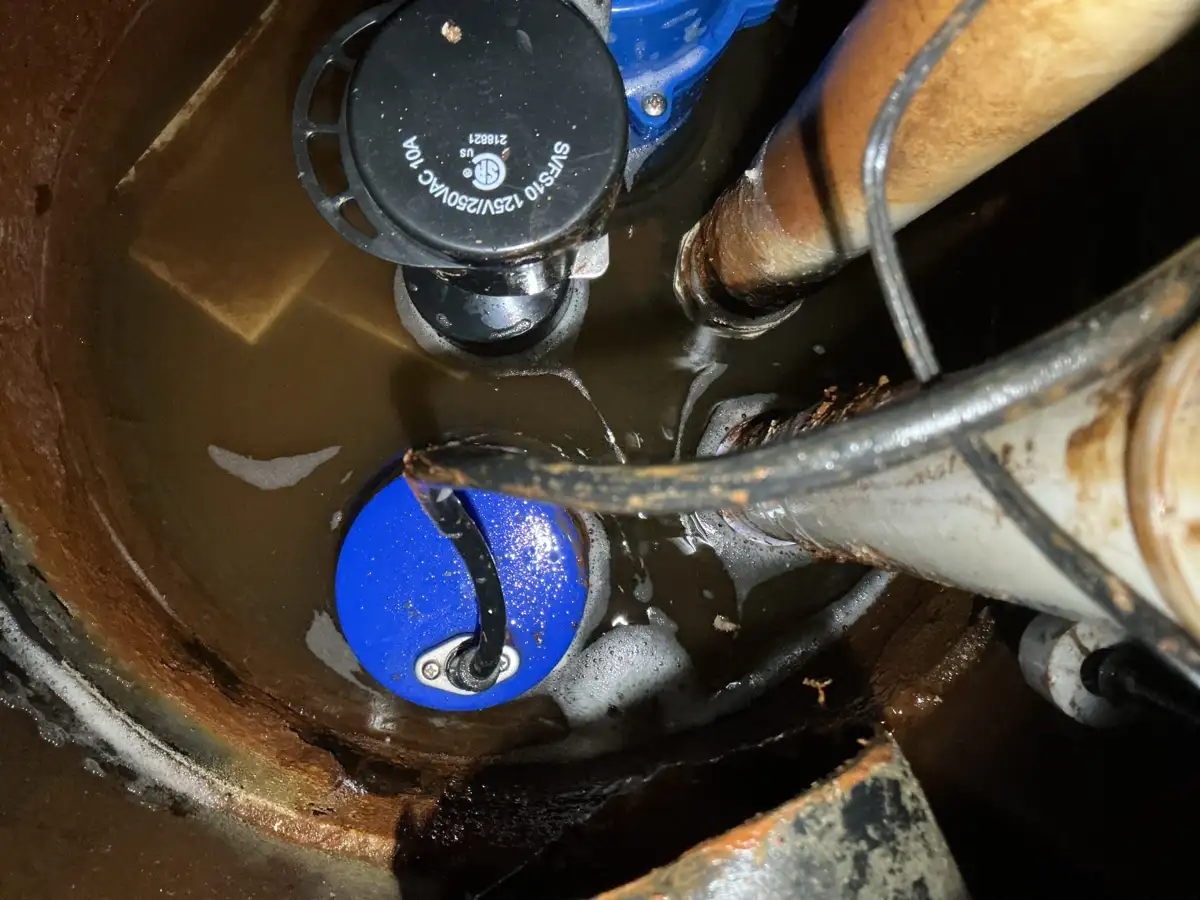
The float is the switch that tells the pump to run: if it cannot move freely, the pump cannot do its job. Murky water and a crowded pit are why we check the float first on every call.
Want a professional opinion? Our sump pump service covers testing, repair, replacement and battery or water powered backups. If water is coming in right now, go straight to our emergency plumbing service.
How long does a sump pump last on average?
Most sump pumps last about 7 to 10 years. InterNACHI lists 7 years as the average life expectancy. Pumps in dry basements can last much longer, while pumps that run constantly through a wet spring often wear out in five or six years.
How often should a sump pump be replaced?
There is no fixed schedule, but plan on replacing a primary pump every 7 to 10 years. Replace it sooner if it fails a bucket test, runs nonstop, or shows rust. If your basement is finished and the pump is 10 years old, replacing it on schedule is cheap insurance.
How long does a battery backup sump pump last?
The backup pump itself can last many years because it rarely runs. The battery is what wears out, usually after a few years even if it was never used. Write the install date on it and test the backup every time you test the main pump.
Can a sump pump last 20 years?
It can, mostly in dry basements where the pump rarely starts. We have seen pumps decades old that were still running. Do not count on it, though: an old pump that has barely run can still fail the first time it gets a heavy workload.
What is the most common reason a sump pump fails?
Running too often is the biggest cause around Grand Rapids, followed by float switches that stick and failed check valves. Debris in the pit and frozen discharge lines in winter round out the list. Most of these show warning signs a season ahead.
What time of year should I replace my sump pump?
Fall or winter, before the spring thaw. March and April are the busiest sump months in West Michigan, so replacing an aging pump early means no waiting, no after hours charges and a dry pit to work in.
How do I know how old my sump pump is?
Look for a date sticker on the pump body or a tag on the power cord. Your home inspection report may list it too. If you cannot find any date and the pump looks rusted or worn, treat it as old and test it.
Get Your Sump Pump Checked by a Licensed West Michigan Plumber
NSP Plumbing is a licensed Michigan plumbing contractor, license #8004990, based in Wyoming, MI. We test, repair and replace sump pumps and install battery and water powered backups across Grand Rapids, Wyoming, Kentwood, Grandville, Byron Center, Hudsonville and the surrounding area.
If your pump is getting old, the smart move is a check this fall, before the thaw. Our technician tests the pump, float, check valve, discharge line and backup, then tells you plainly whether it needs a repair, a replacement or nothing at all. If you want a broader look at the house, ask about a whole home plumbing inspection.
Curious how other big components age? Our guide to how long a water heater lasts uses the same approach. You can also read our reviews or contact us with questions.
Is your sump pump ready for spring?
Book a visit and a licensed NSP Plumbing technician will test your pump, float, check valve and backup, then tell you whether it needs a repair, a replacement or nothing at all before the spring thaw.