
A standard tank water heater lasts 10 to 12 years. A tankless unit lasts roughly twice that, 20 years or more. The 10 to 12 figure is the EPA's, and it holds up in the field with one catch: hard water, a skipped flush, or a tank that runs at capacity every day can cut it in half.
How long does a tank water heater last?
Plan on 10 to 12 years, and treat anything past 10 as living on borrowed time.
The tank is steel with a glass or ceramic lining sprayed on the inside. That lining is the only thing standing between hot water and bare steel, and it eventually develops cracks. Behind it sits a sacrificial anode rod, a metal rod that corrodes on purpose so the tank does not have to. When the rod is used up and nobody replaces it, corrosion moves to the tank wall and the countdown speeds up.
Manufacturer warranty length is a rough proxy for that. Bradford White, the brand we install most, ships most residential tanks with a 6 year warranty on the tank, with 8 and 10 year coverage on higher models. No manufacturer warranties a tank for 15 years, which tells you something about what they expect.
One honest caveat on our own data. Our technicians recorded the old unit's age on only a handful of tank jobs, and on those the median age at replacement was 15 years. A handful of jobs is not a statistic, so we are not going to dress it up as one. It does run past the EPA's 10 to 12 years, and it matches what our crews see day to day: units in West Michigan basements often keep running into their teens on borrowed time, then fail all at once.
How long does a tankless water heater last?
Around 20 years or more, and the parts inside are replaceable in a way a corroded tank is not.
The reason is simple. A tankless unit does not hold 40 gallons of hot water against a steel wall all day, so it never faces the corrosion problem that kills tanks. What it does face is scale. Minerals plate onto the heat exchanger and choke the flow, which is why a tankless unit needs a descaling flush every 1 to 2 years in hard water.
We are not going to pretend we have deep first-party data here. NSP has completed only a small number of tankless jobs since January 2024 against a much larger volume of tank work, and most of those were service on relatively young units rather than end-of-life replacements. Tankless is still uncommon in older housing stock around here. If you want the local read: the tank is what your neighbors have, and the tankless payback depends heavily on how much hot water your household actually uses.
How do you find out how old yours is?
Two places to look, and neither one requires a plumber.
The serial number on the data plate. Every manufacturer encodes the build date in the serial, and most encode it in the first few characters. Bradford White states that the first two characters of the serial are the year and month of manufacture, and publishes its own lookup for determining a unit's age. Rheem, AO Smith and State each use their own scheme, so match the brand to the brand's chart rather than guessing.
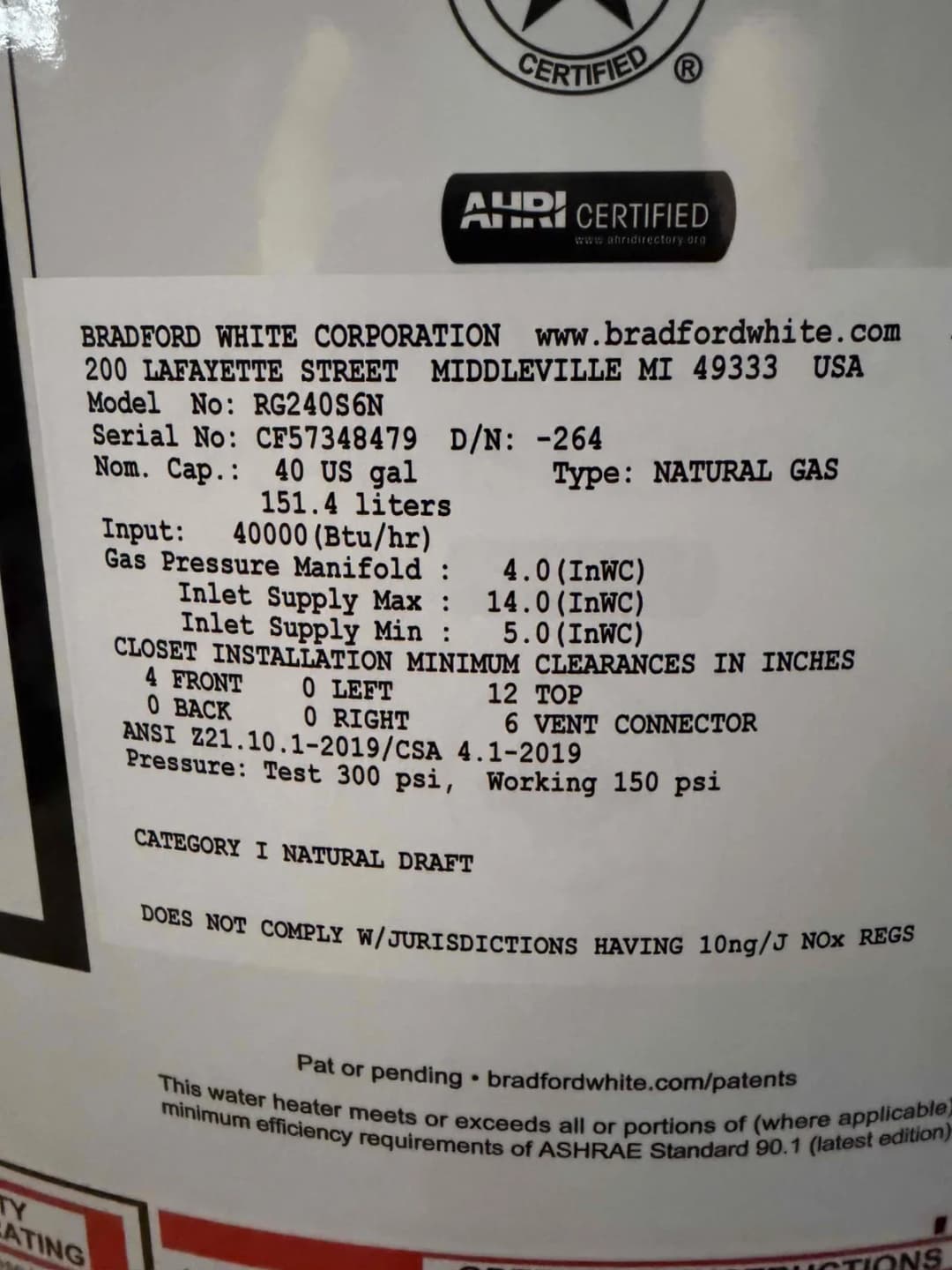
The plate is where the age lives. The serial number here starts with two characters that encode the month and year the tank was built. Take a photo of this plate before you call anyone, because the first thing a good plumber asks is how old the unit is, and the second thing they ask is what brand.
One more habit worth insisting on: have the installer write the install date on the tank in marker. It costs nothing and it settles the repair versus replace question ten years from now in about two seconds, even if the plate has gone unreadable.
If the plate is unreadable and there is no date on the tank, the age of the house and the style of the venting usually put it within a few years. Any licensed plumber can read that off a service call.
What actually shortens a water heater's life?
Four things, roughly in order of how much damage they do.
Hard water with no softener. This is the big one here. Grand Rapids treats Lake Michigan water, and the city's own water quality reporting puts total hardness around 150 mg/L, roughly 9 grains per gallon. That is squarely in the hard range. Those minerals drop out of solution when the water is heated and build up as scale on the burner plate, the elements and the fittings.
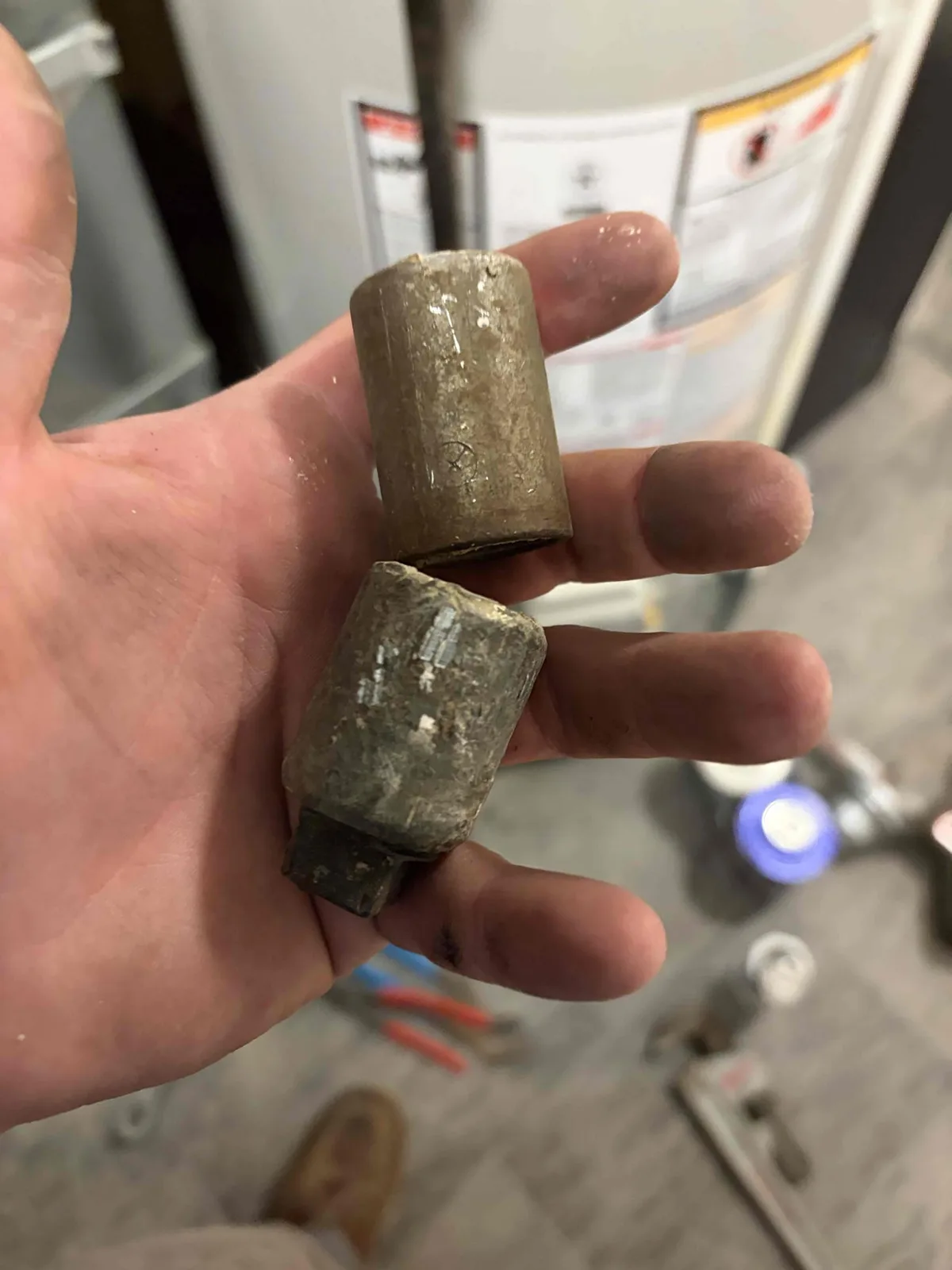
This is what hard water does inside your heater. Those are two nipples cut off a tank on a West Michigan job, and the mineral crust is thick enough to see from across the room. The same layer is coating the inside of the tank and insulating the water from the burner, so the burner runs longer and hotter to do the same job. A water softener or a treatment system is the fix, and it protects your fixtures and dishwasher at the same time.
Skipping the flush. Sediment settles on the bottom of the tank and bakes onto the burner plate, which makes the steel above it run hotter than designed. An annual flush is $150 with us. Against a $2,150 replacement, it is the cheapest maintenance in the house.
Running at capacity every day. A 40 gallon tank serving five people reheats constantly. Every heat cycle is wear. If your house runs out of hot water on a normal evening, the unit is undersized and it is aging faster than the label suggests.
High incoming water pressure. Pressure above about 80 psi stresses the tank and the relief valve. It is cheap to test and cheap to correct with a pressure reducing valve, and most homeowners have never had it checked.
What are the warning signs it is failing?
Some tanks give no warning at all and the first sign is water on the floor. Most give at least one of these first.
| What you notice | What it usually means | Repair or replace |
|---|---|---|
| Rusty or brown hot water, cold runs clear | The tank lining has failed and you are seeing the steel | Replace |
| Water pooling at the base of the tank body | The steel has corroded through | Replace, this does not get repaired |
| Rumbling or popping when the burner fires | Hardened sediment on the tank bottom | Flush first, replace if the noise stays |
| No hot water at all, unit is under 8 years old | Thermostat, element, or gas control valve | Repair, and check the warranty |
| Hot water runs out faster than it used to | Scale buildup, or the household outgrew the tank | Repair or resize |
| Water at a fitting or valve, not the tank body | A connection, not the tank | Repair |
| Age past 12 years plus any symptom above | The tank is at the end of its service life | Replace on your schedule |
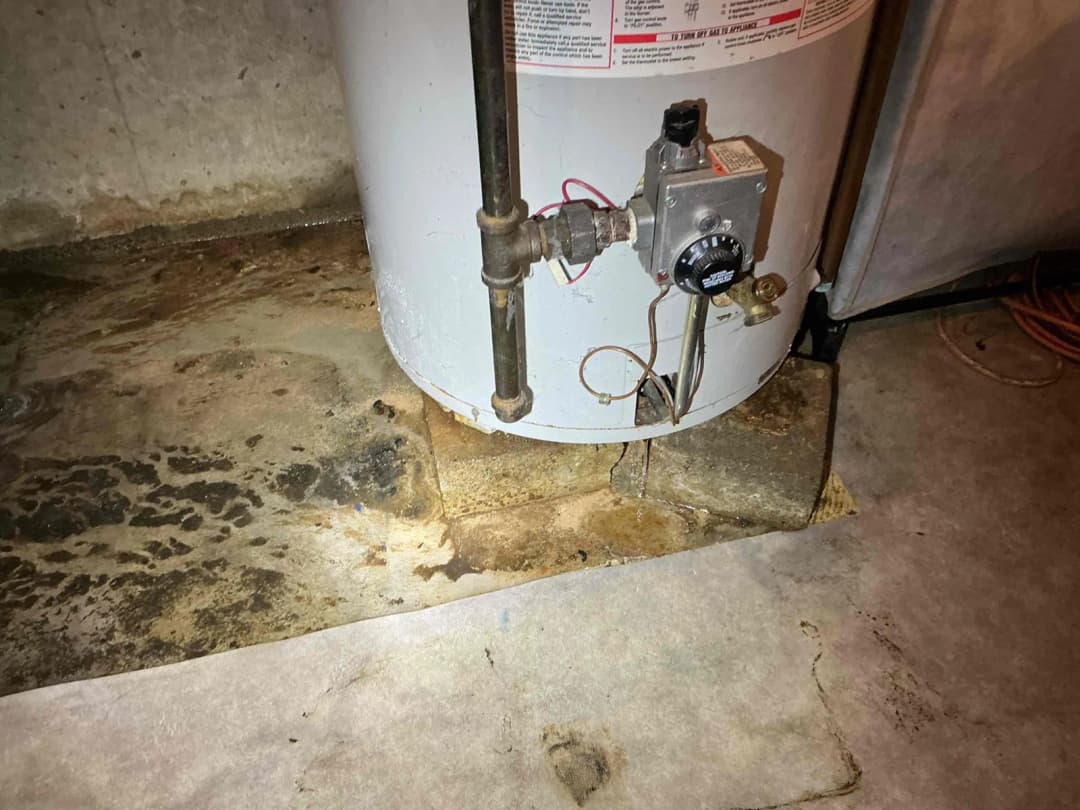
Staining that spreads out from under the tank is the end. This is the unit we pulled out, not the one we put in. It is not a wet fitting either. Water has been weeping from the tank body long enough to leave a rust map on the floor, which means the steel is compromised and there is nothing to tighten or replace. A tank in this condition gets replaced, and the only question left is whether you do it this week or after it lets go all at once.
Notice what is not under it: a pan. That is why this leak ended up on the floor instead of in a drain. Pans are not required everywhere, and on a bare basement floor like this one, where a slow leak runs to a floor drain and damages nothing, an install without one can be perfectly legal. Where it matters is a finished basement, a closet, or an upstairs laundry, and that is what Section 504.7 below is about. If you are getting a tank replaced, ask whether your location needs a pan and a drain line, because the answer changes what the job should cost.
Should you repair it or replace it?
Use the age of the unit, not the price of the part.
Replace it if the tank body is leaking, if the unit is past 10 years and needs a major component, or if the repair quote lands at more than half the cost of a new install. Spending $700 on a 13 year old tank buys you an unknown amount of time.
Repair it if the unit is under 8 years old, the tank shows no corrosion, and the failure is a replaceable part: thermostat, heating element, gas control valve or relief valve. Check the manufacturer warranty first. On one job this summer a 4 year old unit quit producing hot water entirely, the tank was covered under warranty, and the homeowner paid labor only.
The best case is boring. We replaced a 20 year old electric unit on the east side of Grand Rapids in June 2026 with nothing wrong with it yet. The homeowner looked at the age, decided not to gamble on a January failure, and picked the date. That is a planned replacement instead of an emergency call with water spreading across a finished basement, and it costs the same.
What does replacement cost, and what belongs in the quote?
Across the tank water heater work we have invoiced since January 2024, our median came to $2,150. A quarter of those jobs landed at or under $700, and three quarters came in at or under $2,795. The top of the range, about $3,800, is where venting changes, gas line work, relocations or a code correction are part of the job.
| Job | What is involved | What it ran |
|---|---|---|
| Straight tank swap | Same size, same location, existing venting and gas line reused | Around $700 to $1,600 |
| Typical tank replacement | New unit, connections, permit, code items brought current | Around $2,150 median |
| Complex tank replacement | New venting, gas line rework, relocation, or a larger unit | $2,800 to $3,800 |
| Tankless | Unit plus install, venting and gas sizing | $4,450 to $7,535, too small a sample to call a range |
| Annual flush | Drain sediment, inspect the burner and anode | $150 |
Water heater replacement is permitted work in Michigan. We pull the permit under our license, meet the inspector, and the $100 fee is inside the quoted price rather than showing up later.
How long does a 40 gallon water heater last?
The same 10 to 12 years as any other tank size. Capacity does not change the corrosion clock, but it changes how hard the unit works. A 40 gallon tank serving a family of five reheats far more often than the same tank serving two people, and the extra cycles push it toward the short end of the range.
How do I check the age of my water heater?
Read the serial number off the data plate, usually on the upper front of the tank, then look it up on the manufacturer's chart. Bradford White encodes the year and month in the first two characters of the serial and publishes its own age lookup. Rheem, AO Smith and State each use a different scheme, so use the chart that matches your brand. If a plumber wrote the install date on the tank, that is faster and more useful.
Does flushing a water heater actually extend its life?
Yes, and it is the highest return maintenance on the appliance. Flushing removes the sediment layer that bakes onto the tank bottom and forces the burner to run longer to heat the same water. NSP charges $150 for a flush. In hard water with no softener, it matters more, not less.
Should I replace my water heater before it fails?
If it is past 10 years, yes, and the reason is the flood, not the appliance. A tank that lets go dumps 40 gallons and keeps feeding the leak until someone closes the supply. A planned replacement costs the same as an emergency one and you get to pick the day, the unit and the size.
Is a tankless water heater worth it?
It depends on how much hot water your household uses. Tankless costs more upfront, lasts roughly twice as long, and never runs out mid shower. For a large household that runs back to back showers and laundry, that math tends to work. For two people in a small house, a standard tank is hard to beat on value. In hard water, budget for a descaling flush every 1 to 2 years either way.
Does a water softener make my water heater last longer?
Yes. Grand Rapids water runs around 150 mg/L total hardness, and that mineral load is one of the main reasons tanks here fail early. A softener cuts the scale that insulates your burner and coats your fittings. If you already have one, confirm it is actually regenerating and the salt is kept up, because a softener that quit working is doing nothing.
Can I replace a water heater myself in Michigan?
Michigan requires a plumbing permit for water heater installation, and the applicant has to be a licensed plumbing contractor or the homeowner of a single family residence doing their own work. So a homeowner can legally do it on their own house, and the work still has to pass inspection. Gas connections, venting and the relief valve discharge are where a self install usually goes wrong.
My water heater is 9 years old and working fine. Do I need to do anything?
Get it flushed, have the anode rod checked, and take a photo of the data plate so you are not diagnosing an emergency at 10 pm. That is the whole list. Nine years is the point to start planning, not the point to panic.
Licensed water heater service across greater Grand Rapids
NSP Plumbing is a licensed Michigan plumbing contractor (license #8004990) based in Wyoming, MI, serving Grand Rapids, Wyoming, Kentwood, Grandville, Jenison, Byron Center, Caledonia, Rockford, Ada and Walker. We install and flush tank and tankless water heaters, handle warranty replacements, install water softeners and filtration, and pull the permit and meet the inspector on every install.
If the tank is leaking right now, close the cold supply valve on top of the unit and call our emergency line. If it is just old and you want a straight answer on whether it is worth repairing, a service call is $49 and we will tell you what we find before anything gets replaced.
Not sure if yours has years left or weeks
We read the plate, check the anode and the relief valve, test your water pressure, and tell you whether this is a $150 flush, a part, or a replacement. You get the number in writing before we touch anything.