
By: Nathan Paggeot, Master Plumbing Contractor (MI License #8004990) & CEO of NSP Plumbing
June 17, 2026
A pipe bursts behind a wall. The water heater splits at the seam. A supply line under the kitchen sink lets go while you're at work. In every one of these emergencies, the single most important thing you can do is the same: shut off the water. The faster you find and turn your main water shut-off valve, the less your home floods — and the difference between knowing where it is and hunting for it can be thousands of dollars in damage.
Here's the problem we run into on emergency calls all over West Michigan: most homeowners have no idea where their main shut-off valve is until water is already pouring across the floor. This guide fixes that. We'll show you exactly where to look in a typical Grand Rapids home, how to operate the valve once you find it, what to do when the valve won't budge, and which other shut-offs every homeowner should know.
Key Takeaways
- Your main water shut-off valve is usually in the basement on the street-facing wall, next to the water meter — or in the garage/utility area in slab homes, and inside the crawlspace in crawlspace homes.
- A ball valve (lever handle) closes with a single quarter turn; a gate valve (round wheel) takes several clockwise turns — never force a stiff one.
- Test it once a year: shut the valve, confirm a low faucet stops, then reopen it slowly.
- If it's stuck, won't fully close, or leaks, use the water heater inlet valve or the street-side curb stop and call a licensed plumber.
- Know your secondary shut-offs too — water heater, toilets, sinks, washing machine, and outdoor hose bibs.
Why Every Grand Rapids Homeowner Needs to Know This
Water damage is not slow. A burst half-inch supply line can release more than 50 gallons of water in a few minutes, and a failed main line or water heater can push hundreds of gallons across a finished basement before you've finished looking up a plumber's number. Every second the water keeps running is more drywall, more flooring, more insulation, and more of your belongings ruined — and the longer it sits, the higher the risk of mold. It's not a rare disaster, either: water damage and freezing is one of the most common homeowners insurance claims, hitting about one in 67 insured homes every year, with the average claim topping $15,000.
This is why the 60 seconds it takes to walk to your shut-off valve matters so much. We've stood in two nearly identical basements after a water heater failure: one homeowner knew exactly where the valve was and shut it off in under a minute with a damp floor to show for it; the other spent ten minutes searching while water spread into a finished family room, and the restoration bill ran into five figures. The plumbing failure was the same. The only variable was whether they knew where the valve was.
The three failures we get called for most often in West Michigan all come down to the same first move:
- Burst and frozen pipes. Michigan winters are hard on plumbing. When a frozen pipe lets go, shutting the main is the first step before any frozen pipe repair can begin. (For prevention, see our guide on how to prevent frozen pipes.)
- Water heater failure. Tanks rust from the inside out and eventually split. When that happens, you shut the main (or the valve on the tank) before it empties 40–50 gallons onto the floor.
- Failed supply lines and fittings. The braided lines under sinks and behind toilets and washing machines have a service life. When one fails, the main shut-off stops the flood.
Knowing where your valve is — and confirming it actually works — is the cheapest insurance you'll ever buy. It costs nothing and takes five minutes. Do it before you need it, not during an emergency.
Where Is My Water Shut-Off Valve? Main Valve Location by Home Type
The single rule that finds almost every main shut-off valve: find your water meter first, then look right beside it. The main shut-off is almost always within a few feet of the meter, on the house side, where the water line enters from the street — usually on the wall that faces the street. Where that entry point actually is depends on how your home is built, and Grand Rapids has all three major foundation types in abundance.
Basement homes (most of Grand Rapids)
The majority of Grand Rapids and West Michigan homes have full basements, and this is the easiest case. Because our climate freezes hard, the water meter is almost always inside the basement rather than in a pit out at the curb. Look along the foundation wall that faces the street — typically the front of the house — about one to three feet up from the floor. You'll usually see the water line come through the wall, then a shut-off valve, then the meter, and often a second shut-off valve on the house side of the meter.
In older Grand Rapids neighborhoods — Heritage Hill, Eastown, the West Side, Creston, Alger Heights — the valve is often an older round-handled gate valve, sometimes tucked behind a furnace, water softener, or storage shelving. In newer subdivisions you're more likely to find a modern lever-handled ball valve. Either way, start at the street-facing wall.
Slab-on-grade homes
Homes built on a concrete slab — common in some newer developments and ranch-style builds around Kentwood, Wyoming, and Caledonia — have no basement, so the main shut-off is usually in one of these spots:
- In the garage, often near the water heater or on the wall shared with the house.
- In a utility closet or mechanical room near the water heater.
- On an exterior wall, sometimes inside a small access panel.
- Under the kitchen sink — in some homes the main shut-off is tucked in the cabinet near where the line enters.
- Outside near the foundation, occasionally in an in-ground box.
If you can't find an interior valve in a slab home, the water heater's cold-water inlet is your backup, and the street-side curb stop is the last resort (see below).
Crawlspace homes
For homes over a crawlspace — found throughout the more rural and lakefront areas around Grand Rapids, Ada, Rockford, and the inland-lake communities — the main shut-off is typically inside the crawlspace where the supply line enters. It may also be in a closet, utility area, or where the line passes up into the living space. Crawlspace valves are the easiest to neglect, so it's worth locating yours on a dry, calm day rather than crawling under the house in an emergency.
The curb stop: the city's valve at the street
Every home also has a second shut-off out at the property line called the curb stop, usually under a small metal or plastic cap (the "buffalo box") in the lawn or near the sidewalk, often marked "WATER." The lid is lifted with a T-shaped meter key, and if you see two valves inside, the one closest to your house is the shut-off. This valve is owned by the City of Grand Rapids, which maintains the service line up to and including the curb stop, and requires a special long-handled "curb key" to operate — a screwdriver or wrench won't do it. More importantly, the curb stop is city-owned infrastructure, and operating it yourself without authorization may violate Grand Rapids Water Department regulations. The curb stop is your backup if the interior valve fails, but in a true emergency you should call the city or a licensed plumber rather than risk damaging it.
How to Find & Operate Your Valve, Step by Step
Do this walkthrough now, while everything is dry and calm. The goal is to find the valve, confirm it works, and make sure everyone in the house knows where it is.
- Find where the water enters. Go to the wall that faces the street and look low, one to three feet off the floor. Follow the largest water pipe back to the meter — the main shut-off is right beside it.
- Identify the valve type. A lever handle is a ball valve (quarter turn). A round wheel handle is a gate valve (multiple turns). See the next section for exactly how each one operates.
- Clear access and label it. Move any boxes or shelving blocking it. Tie a bright tag or zip-tie a ribbon to the handle so anyone can spot it instantly, and snap a photo on your phone so you can describe its location to a family member or plumber.
- Test that it actually works. Turn the valve fully off, then go open a faucet on the lowest level. The water should slow to a stop within a few seconds. Turn the valve back on slowly and confirm normal flow returns. A valve that won't fully stop the water, won't turn, or drips around the stem needs attention before an emergency — not during one.
- Show everyone in the house. A shut-off only helps if the person standing in the flooding basement knows where it is. Make sure every adult and capable teen in the home can find and operate it.
If turning the valve off and back on reveals a problem, don't force it. Read the troubleshooting section below, and when in doubt, have it replaced before you're depending on it during a real leak.
Gate Valve vs. Ball Valve: How to Turn Off the Water Main
There are two valve types you'll find on a residential main, and they operate differently. Knowing which one you have means you won't fumble during an emergency.
If you're not sure which one you've got, look at the handle: a lever (a flat bar) is a ball valve, and a round wheel like an outdoor spigot is a gate valve. Older Grand Rapids homes built before the 1990s almost always have gate valves.
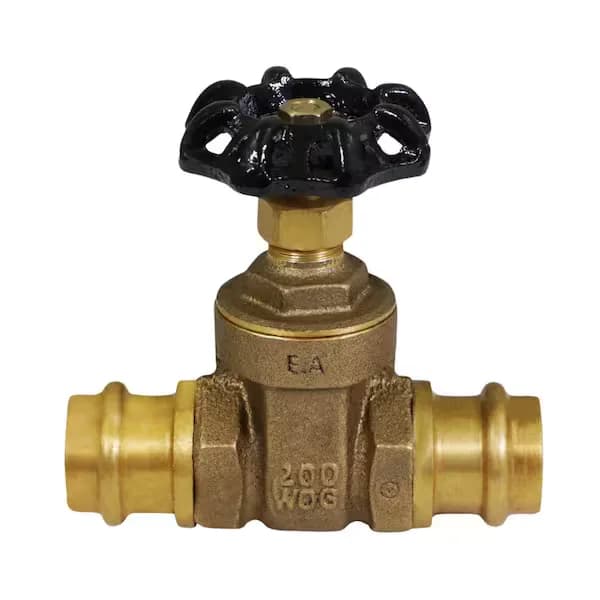
Gate Valve
A round wheel handle, like an outdoor spigot. Common in older Grand Rapids homes. Turn clockwise several full turns to close — and never force it if it's stiff.
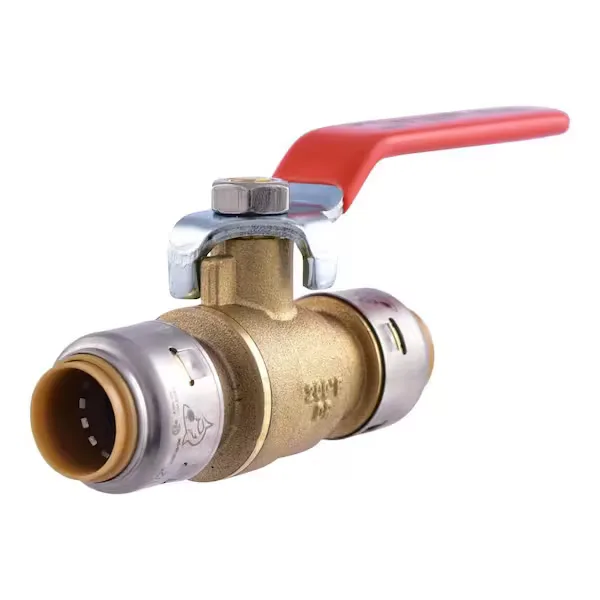
Ball Valve
A straight lever handle. Found in modern and updated plumbing. A single quarter turn shuts it off: handle crossways to the pipe means the water is off.
Ball valve (lever handle)
Modern homes and updated plumbing use ball valves. They have a straight lever handle and operate with a single quarter turn:
- Handle in line with the pipe = ON.
- Handle perpendicular (crossways) to the pipe = OFF.
To shut the water off, rotate the lever a quarter turn until it sits across the pipe and stops. Ball valves are fast, reliable, and rarely seize — if you're replacing an old valve, this is what you want installed.
Gate valve (round wheel handle)
Older Grand Rapids homes usually have gate valves, which have a round wheel handle like an outdoor spigot. These take multiple full turns:
- Turn clockwise ("righty-tighty") to close — it may take six or more full turns.
- Turn counterclockwise to open.
- When it's snug, stop — don't crank it hard. Forcing a corroded gate valve is the most common way they break.
Gate valves are prone to seizing, corroding, and failing to fully close after years of sitting untouched. If yours is stiff, won't fully stop the water, or you have to wrestle with it, plan to have it replaced with a ball valve. It's an inexpensive upgrade that pays for itself the first time you need a reliable shut-off.
When Your Shut-Off Valve Doesn't Work
This is the scenario nobody wants: you find the valve, you go to turn it, and it won't cooperate. Here's what's happening and what to do.
The valve is stuck or won't turn
Old gate valves seize because mineral deposits and corrosion lock the internal gate to the stem. Do not force it — a snapped valve or stem in the middle of an emergency turns a leak into a flood. If it won't move with reasonable hand pressure, stop, and use the water heater's inlet valve or the curb stop instead while you call a plumber.
It turns but won't fully stop the water
If the valve spins but water still trickles past, the internal gate or seat has worn out or corroded through. The valve is no longer doing its job and needs to be replaced. In the meantime, shut the curb stop or call for help.
It leaks around the handle or stem
A valve that drips around the stem when you operate it has a failing packing or a cracked body. Sometimes the packing nut can be snugged, but a leaking main valve is a warning sign it's near the end of its life — have it evaluated.
When to call a plumber
Replacing a main shut-off valve is not a DIY job in most homes. The water has to be shut at the curb stop first, the valve is often soldered or threaded onto the main line, and a mistake means flooding the very area you're trying to protect. Call a licensed plumber if your valve is stuck, won't fully close, leaks, or is an old gate valve you'd like upgraded to a reliable ball valve. Swapping an old gate valve for a modern ball valve is usually a same-day job of a few hundred dollars depending on access and whether the line needs soldering — give us a call for a firm quote. If a pipe is actively leaking right now and you can't stop it, that's a 24/7 emergency plumbing call — shut the curb stop if you can, and get a plumber on the way.
While you wait for help to arrive: move valuables and anything electrical out of the water's path, shut off power at the breaker to any outlet or panel in or near the flooded area, and take photos or video of the damage for your homeowner's insurance claim before you start cleaning up. If the water heater is the source, also shut off its power (flip the breaker) or gas to prevent damage to the unit.
While you're thinking about reliable shut-offs, it's worth knowing there's now a way to take the human reaction time out of the equation entirely. An automatic water shut-off detects a leak and closes the main for you — even when you're asleep or away from home. For homeowners who travel, own a second property, or simply want peace of mind, it's one of the smartest upgrades in plumbing.
Other Shut-Off Valves You Should Know
The main valve stops everything, but it's often faster — and less disruptive — to shut off water at the source. Knowing these secondary valves means you can isolate a problem fixture without killing water to the whole house.
- Water heater. There's a shut-off valve on the cold-water inlet pipe at the top of the tank. If the tank itself fails, closing this valve stops it from refilling. In a slab home with no obvious main valve, this is often your best interior shut-off. A leaking or aging tank usually means it's time for water heater service or replacement.
- Toilets. Each toilet has a small oval or football-shaped valve on the supply line where it meets the wall or floor, usually behind and below the tank. Turn it clockwise to stop a running or overflowing toilet.
- Sinks. Open the cabinet under any sink and you'll find two valves — hot and cold — on the supply lines. Shut these for a leaking faucet or to swap a fixture.
- Washing machine. Behind the machine are two valves (hot and cold) feeding the braided hoses. Washing-machine hoses are a leading cause of household floods — keep these valves accessible, and consider single-lever shut-off boxes that close both at once.
- Outdoor hose bibs. Each exterior faucet usually has its own shut-off valve on the interior side of the wall it passes through. In Michigan, closing these in fall and draining the line is a key step to prevent the spigot from freezing and splitting over winter.
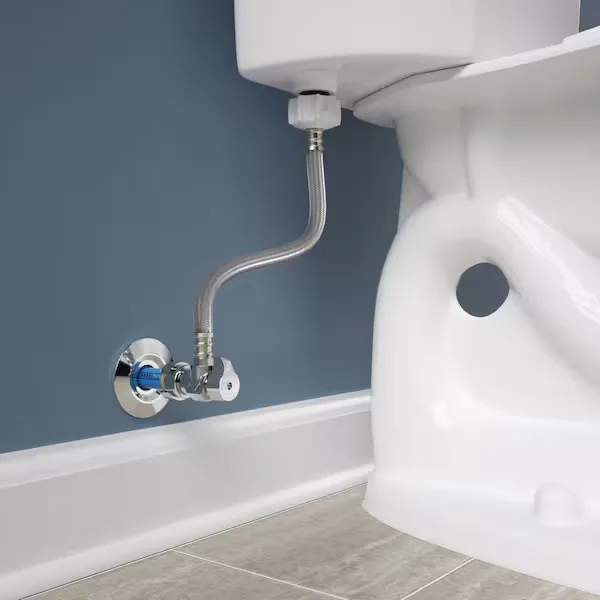
Toilet Shut-Off
A small valve on the wall behind and below the tank, feeding the braided supply line. Turn it clockwise to stop a running or overflowing toilet.
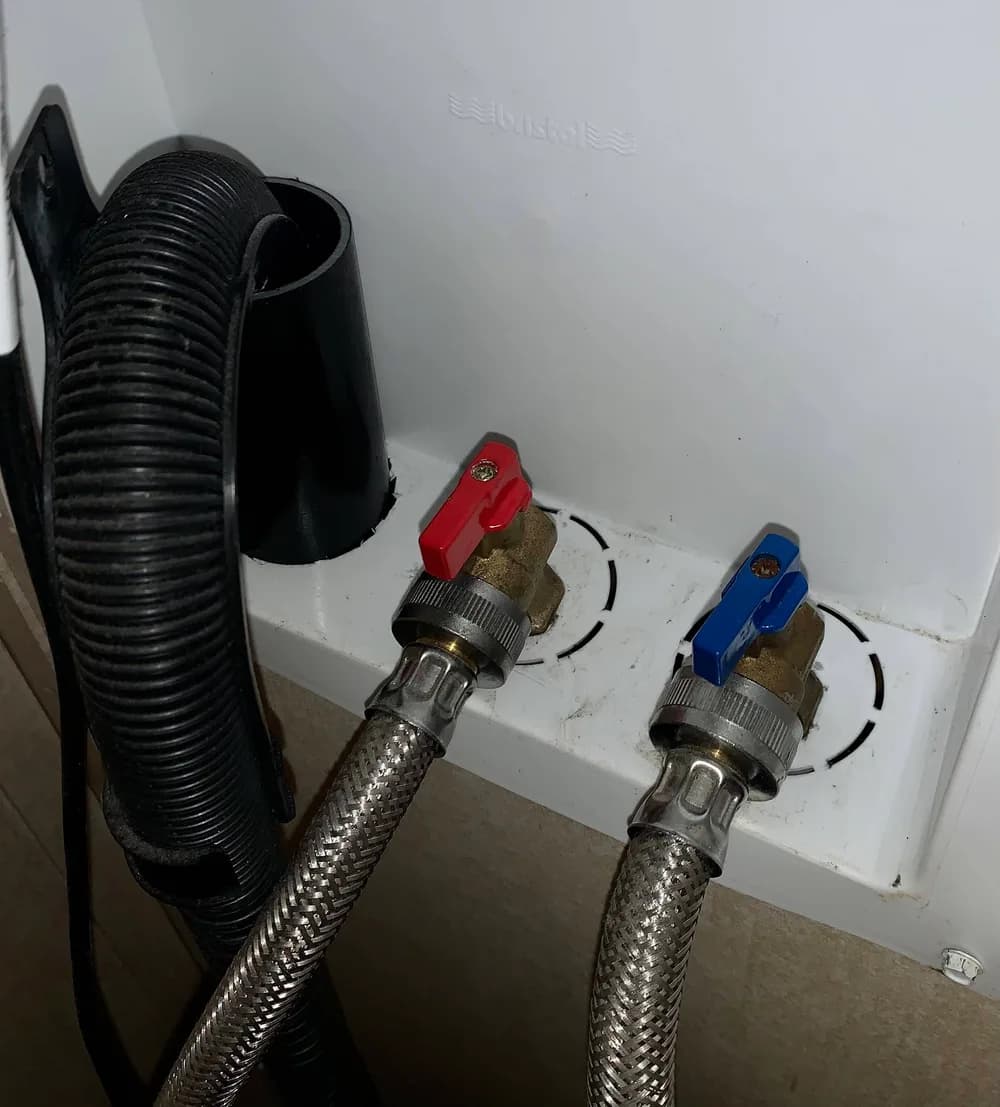
Washing Machine Shut-Offs
Two valves behind the machine — red for hot, blue for cold — feeding the braided hoses. A leading cause of household floods, so keep them accessible.
Take a few minutes to locate each of these along with your main. Once you've mapped your home's shut-offs, a leak goes from a panic to a 30-second fix.
Frequently Asked Questions
In most Grand Rapids homes the main shut-off valve is in the basement, on the wall that faces the street, about one to three feet off the floor and next to the water meter — that's your main water shutoff valve. Because our climate freezes hard, meters here are kept inside rather than in a curb pit. In slab homes, check the garage, a utility closet, or near the water heater; in crawlspace homes, look inside the crawlspace where the line enters.
It depends on the valve. If you have a ball valve (a straight lever handle), turn it a quarter turn until the handle sits crossways to the pipe — that's off. If you have a gate valve (a round wheel handle), turn it clockwise several full turns until it's snug, but don't force it. After shutting it, open a low faucet to confirm the water stops.
A ball valve has a lever handle and closes with a single quarter turn — it's fast and reliable. A gate valve has a round wheel handle and takes multiple turns to close. Gate valves are common in older homes and tend to seize or fail to fully close over time. If you have an aging gate valve, upgrading to a ball valve is an inexpensive, worthwhile improvement.
Don't force it — an old, corroded valve can snap and turn a leak into a flood. If it won't move with reasonable hand pressure, shut the water at the water heater's inlet valve or at the curb stop instead, then call a licensed plumber to replace the failed valve. A stuck main valve discovered during testing should be replaced before you ever need it in an emergency.
The curb stop is a city-owned shut-off out near your property line, under a small capped box in the lawn (often called a "buffalo box"). It requires a special long curb key to operate — a wrench or screwdriver won't work and can damage it. Use it as a backup if your interior valve fails, but in a true emergency it's best to call the City of Grand Rapids or a licensed plumber to operate it.
Very fast. A burst supply line can release more than 50 gallons in minutes, and a failed water heater or main line can put hundreds of gallons across a finished basement before you stop it. Every minute of delay means more ruined drywall, flooring, and belongings, plus mold risk if it sits. That's why locating and testing your valve in advance — a five-minute task — is so valuable.
Yes. An automatic water shut-off uses leak sensors and a motorized valve on your main line to detect a leak and close the water automatically — even when you're asleep or away. It's an excellent safeguard for homeowners who travel, own rental or vacation properties, or simply want protection that doesn't depend on someone being home to react.
Yes — test it about once a year. Turn the valve fully off, open a low faucet to confirm the water stops, then turn it back on slowly. This keeps the valve from seizing and confirms it still fully closes. New homebuyers should test it right after moving in. If the valve won't turn, won't fully stop the flow, or leaks at the stem, have it replaced before you're relying on it during a leak.
Stuck Valve? Leak Right Now? We're On Call.
Whether your main shut-off won't budge, you need an old gate valve upgraded to a reliable ball valve, or you're standing in water right now, NSP Plumbing is here. We're licensed, insured, and available 24/7 for emergency plumbing across Grand Rapids and West Michigan — and we can install an automatic water shut-off so a future leak stops itself.
Serving Grand Rapids, Wyoming, Kentwood, Ada, Jenison, Grandville, Hudsonville, Byron Center, Caledonia, Holland & beyond.