


A plumbing stack replacement is when a plumber removes the main vertical drain and vent pipe that carries waste from every toilet, tub and sink in your home and installs new pipe in its place. In most older homes it means swapping corroded cast iron for PVC, then pressure testing the new stack before it goes back into service.
What is a plumbing stack?
The plumbing code defines a stack as any vertical line of soil, waste or vent piping that runs through at least one story of a building. In plain English, it is the big pipe, usually 3 or 4 inches wide, that runs straight up through your house from the basement floor to the roof. Every drain in the home connects to it, either directly or through smaller branch lines.
The stack does two jobs at once. The lower part carries wastewater down to the building drain and out to the sewer. The upper part, which pokes through your roof, lets air into the system so water can flow freely and sewer gas can escape outside instead of into your living space.
People use a few terms for parts of this system, and they get mixed up constantly:
| Term | What it means | Where you see it |
|---|---|---|
| Soil stack | A stack carrying toilet waste | Usually the biggest pipe in the basement |
| Waste stack | A stack carrying only sink, tub and laundry water | Smaller homes may not have a separate one |
| Stack vent | The top part of the soil or waste stack, above the highest drain | The pipe sticking out of your roof |
| Vent stack | A separate vertical pipe that only moves air | Common in larger or multi story homes |
| Building drain | The horizontal pipe at the bottom that leads out to the sewer | Under or along the basement floor |
When a plumber says your "main stack" needs replacing, they almost always mean the soil stack, the one your toilets drain into.
What does a stack replacement actually involve?
A stack replacement means cutting out the old vertical pipe, along with the fittings that connect the branch drains to it, and installing new pipe that meets current code. How much gets replaced depends on how much of the old pipe has failed and how much is reachable without tearing out finished walls.
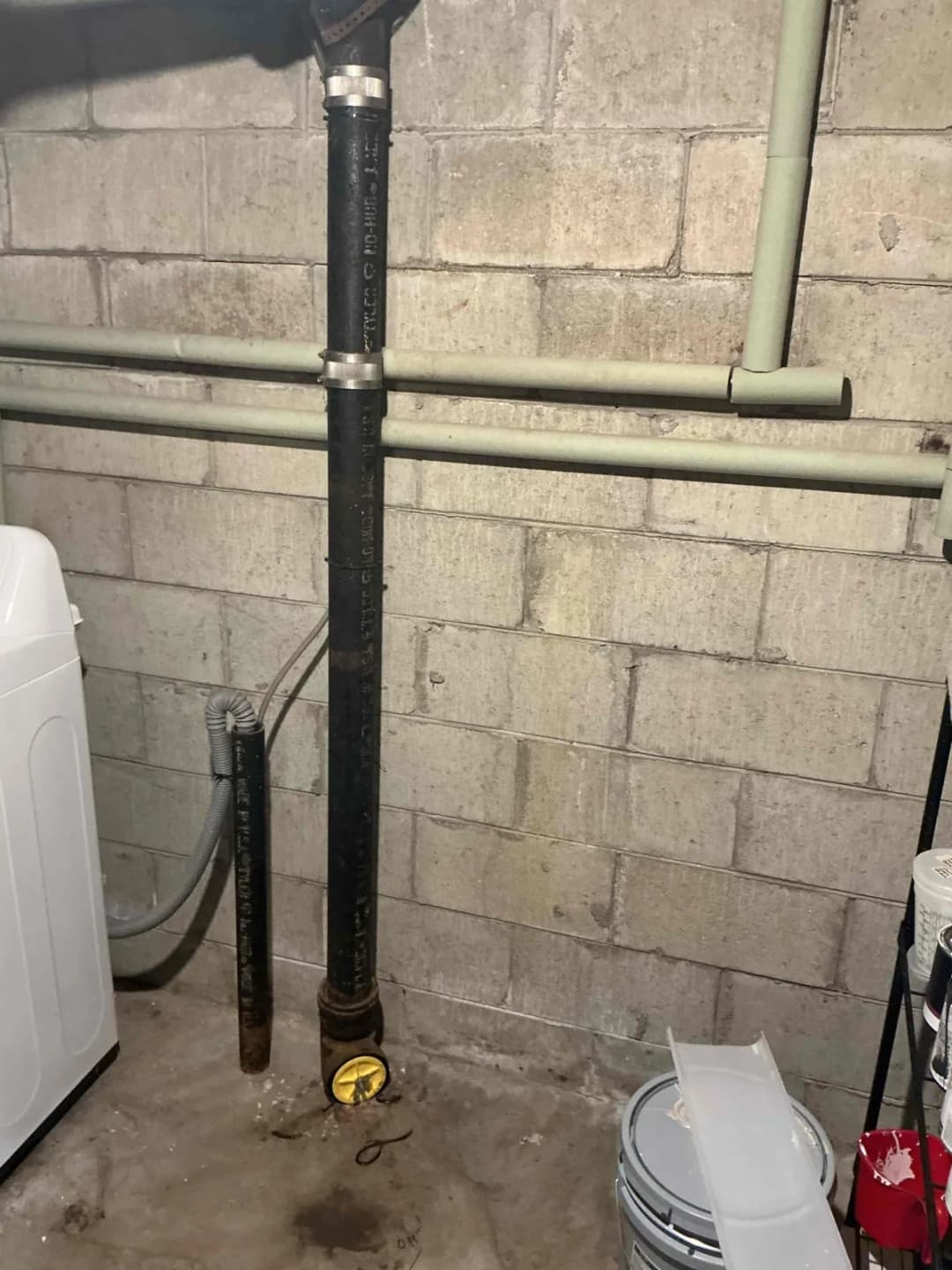 An original cast iron main stack in a customer's basement before our crew replaced it.
On a typical NSP job, the scope reads like this: remove the existing cast iron main stack starting at the highest point we can reach in the basement, connect to the existing vent line above, and replace everything from there down to the concrete floor. The new pipe is usually schedule 30 or schedule 40 PVC, which are wall thickness ratings for plastic drain pipe. The main stack is 3 inches, and the branch drains for sinks and tubs are usually 1 1/2 inches.
Where the new plastic meets the old cast iron that stays in place, we use a heavy rubber coupling with stainless steel clamps. Plumbers often call these Fernco couplings after the most common brand. They make a sealed, slightly flexible joint between two different pipe materials, and they need to be a listed product, not a hardware store patch.
We also reconnect every branch line that tied into the old stack, add a new toilet flange (the ring the toilet bolts to) when the toilet drain is part of the work, and install an accessible cleanout. A cleanout is a capped opening, usually just above the basement floor, that lets a plumber get a drain cable into the line later without pulling a toilet.
Partial vs full stack replacement
Most homeowners hear "stack replacement" and picture walls torn open on every floor. That is the worst case, not the normal case.
Partial replacement is by far the most common. The lower part of a cast iron stack, from the first floor down through the basement, takes the most abuse. It carries the most water, sits closest to the sewer gases that cause internal corrosion, and is where the toilet fitting usually sits. We replace that section and tie into the healthier pipe above with a listed coupling. On one recent job that meant about 20 feet of main stack with four branch lines reconnected, finished in the basement without opening any upstairs walls.
Full replacement goes from the basement all the way through the roof. We do this when the upper pipe is cracked too, when a remodel already has the walls open, or when the old stack was never vented correctly. On one full job our crew replaced the cast iron across the basement ceiling, opened a wall to run the new vent up, worked through the attic, and installed a new vent through the roof.
The deciding factor is the condition of the pipe you cannot see. That is why we camera the line and check the upper stack where it is exposed before we commit to a scope.
Why do cast iron stacks fail?
Cast iron was the standard drain pipe in American homes for most of the 1900s, and it can last a long time. Many sources quote 50 to 100 years. But it does not fail evenly, and it rarely fails from the outside first.
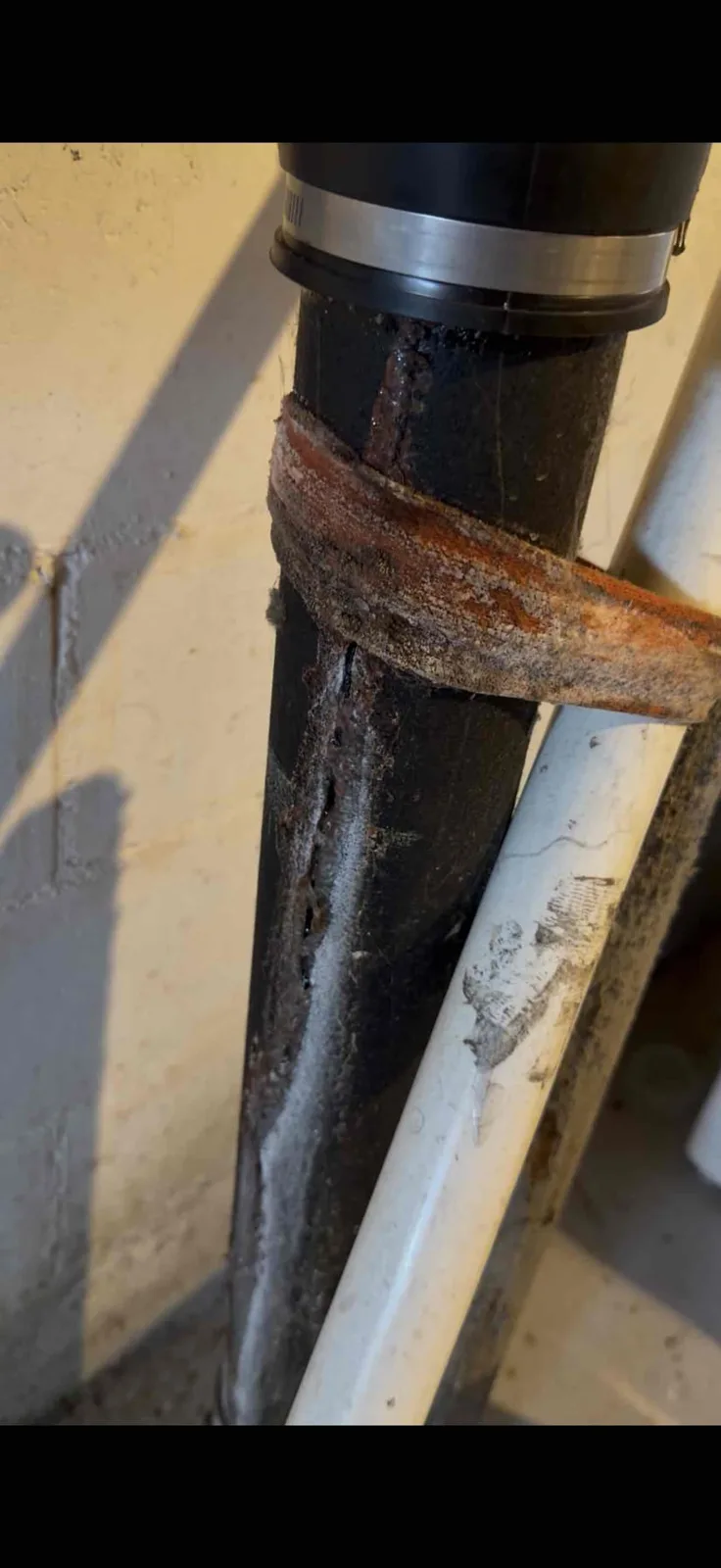 A corroded cast iron stack we replaced. The rust band is where the pipe wall had thinned.
Sewer gas inside the pipe contains hydrogen sulfide, which turns into a mild acid on the damp upper surface of the pipe. Over decades it eats the pipe from the inside, so the bottom stays smooth while the top and sides turn thin and flaky. Water that sits in fittings rusts them faster than straight pipe. Joints made with lead and oakum, the old method of sealing cast iron, can dry out and seep.
Other causes we see in the field:
- Settling. In one building we worked on, the structure had settled enough that the stack was sinking and cracking at its joints.
- Leaking wyes. A wye is the Y shaped fitting where a branch joins the stack. They crack along the seam, and a small patch only lasts so long.
- Old mixed materials. Many older homes have galvanized steel branch lines tied into cast iron, and some have copper drain stacks. Galvanized pipe rusts shut from the inside long before cast iron does.
- Previous patch jobs. Clamps, epoxy and tape on a stack are a sign someone already found a problem.
What are the signs your stack needs to be replaced?
These are the warning signs we actually get called for. One alone might mean a clog. Two or more on an older home usually point at the stack.
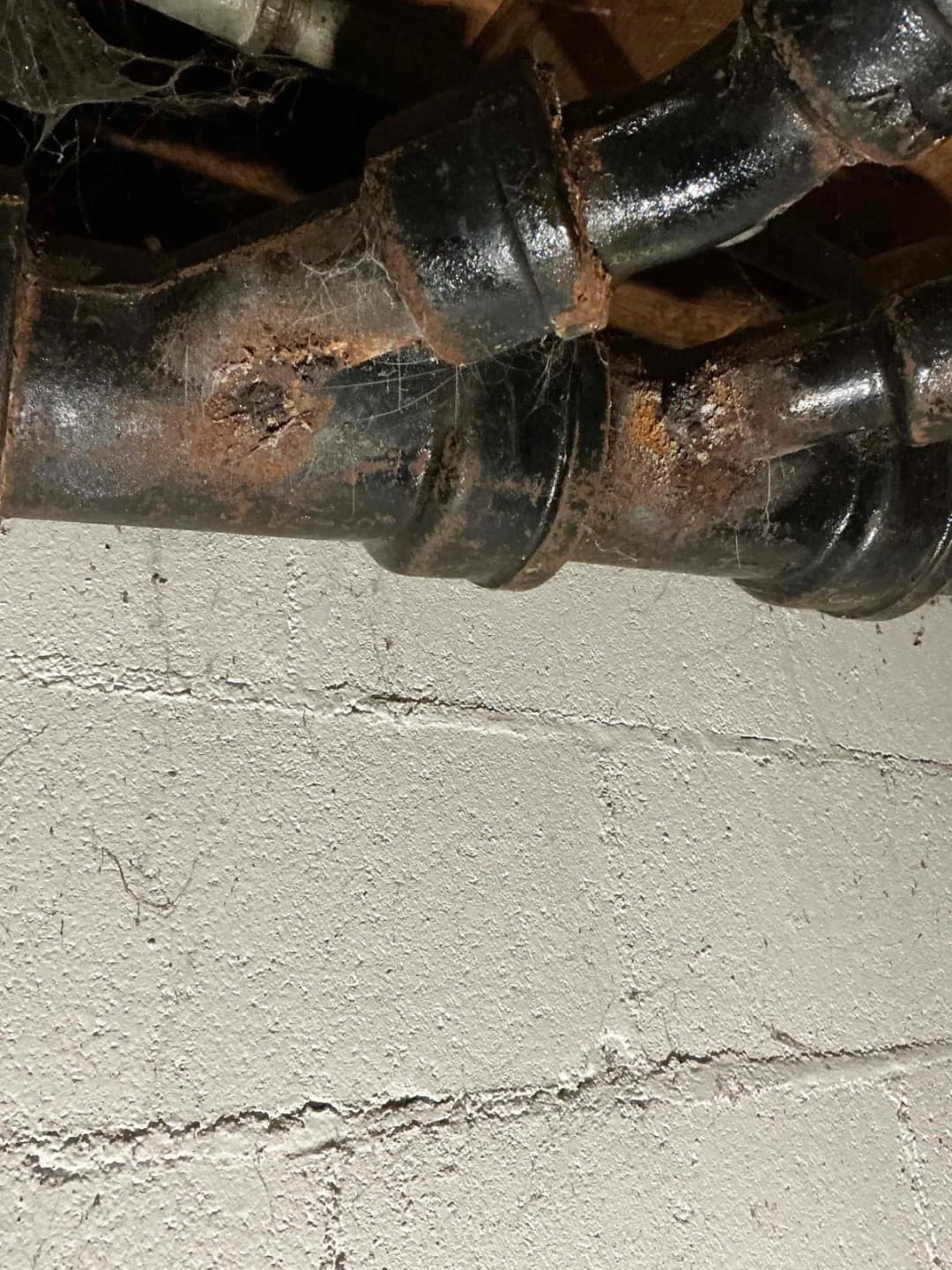 Rusted cast iron fittings at the base of a soil stack, found on a drain call.
- Several drains are slow at once. When the tub, sink and toilet all drain slowly, the problem is usually in the shared pipe, not each fixture.
- Sewer smell in the basement or a bathroom. Homeowners describe "large black stacks starting to smell." A crack too small to drip can still leak gas.
- Rust scale, flaking or crust on the pipe. Heavy buildup on the outside often means the wall is thin underneath.
- Water stains or bubbling paint along a wall or ceiling where the stack runs.
- Damp spots or water at the base of the stack.
- Gurgling toilets or toilet water that drops on its own. This can also be a blocked roof vent. We have traced gurgling toilets to a vent blockage and cleared it with a camera run from the roof.
- Repeated patches. If the same stack has had two or three spot repairs, the pipe around those repairs is usually just as old.
- Drain flies hanging around a basement floor drain or a crack in the pipe.
If you see crusty fittings or a cracked hub, do not hit, scrape or wire brush them. Weak cast iron can break open under pressure, and then a small issue becomes an emergency.
What is a Boosie fitting and why does it matter?
If you own an older home, there is a good chance your bathroom drains into a one piece cast iron fitting that catches the toilet, tub and sink all together. Plumbers in our area call it a "Boosie" fitting. It was a fast way to plumb a bathroom decades ago.
The problem is that when one part of that fitting cracks or rusts through, you cannot replace just that part. The whole fitting has to come out. Removing it usually means pulling the toilet, taking out the old cast iron toilet flange, and cutting out the galvanized branch lines that feed it.
When we replace a Boosie, we do not just recreate it in plastic. We catch each drain separately with its own fittings, sized and vented the way the current code calls for. Each fixture gets the right slope and the right size pipe, and future repairs can be made to one drain without touching the others.
Leaks from a Boosie are easy to blame on the toilet seal or the tub. If you have a water stain on the ceiling under a bathroom and replacing the wax ring did not fix it, the fitting below the floor is worth a look.
Repair or replace: how do you decide?
Not every problem on a stack calls for replacement. Here is how we think about it.
| Situation | Usually repair | Usually replace |
|---|---|---|
| One leaking joint on otherwise solid pipe | Yes, cut out and couple | |
| A single cracked wye with good pipe on both sides | Yes, swap the fitting | |
| Rust crust and flaking along a long section | Yes | |
| Pipe that crushes or flakes when lightly pressed | Yes | |
| Third or fourth patch on the same stack | Yes | |
| Sewer smell with no single visible leak | Camera first | Often |
| Bathroom remodel with walls already open | Strongly consider it | |
| Old Boosie fitting leaking | Replace the fitting and catch drains separately |
The camera inspection is what separates a repair from a replacement. A spot repair on a stack that is thin everywhere is money spent twice. A full replacement on a stack with one bad joint is money you did not need to spend. We show you the footage and the pipe before recommending either one.
How is a stack replacement done, step by step?
Every job is different, but the process on a typical basement stack replacement looks like this:
- Inspect and camera. We look at the visible pipe and run a camera through the main drain to see what is happening inside and below the floor.
- Write the scope. You get a written description of exactly what will be removed, what stays, and where new pipe ties into old.
- Pull a permit. Replacing drain, waste and vent piping requires a plumbing permit in Michigan, and the work is inspected.
- Support the stack above. Cast iron is heavy. Before cutting, we clamp and support the pipe that stays above so it cannot drop when the section below comes out.
- Cut and remove. The old pipe and fittings are cut out in manageable pieces and hauled away.
- Install new pipe. New PVC goes in with proper fittings, a cleanout near the floor, and branch drains reconnected. The code does not allow the pipe to get smaller in the direction of flow, so sizes are matched or increased.
- Test. The new piping is tested before it is put in service (more on this below).
- Camera the main line. After the stack is done, we camera the remaining drain to the sewer so you know the rest of the system is clear.
- Inspection and cleanup. The local inspector signs off, and the work area is cleaned up.
Most basement only replacements are completed in one to two days. Jobs that go through finished walls or the roof take longer, and wall repair is usually a separate trade.
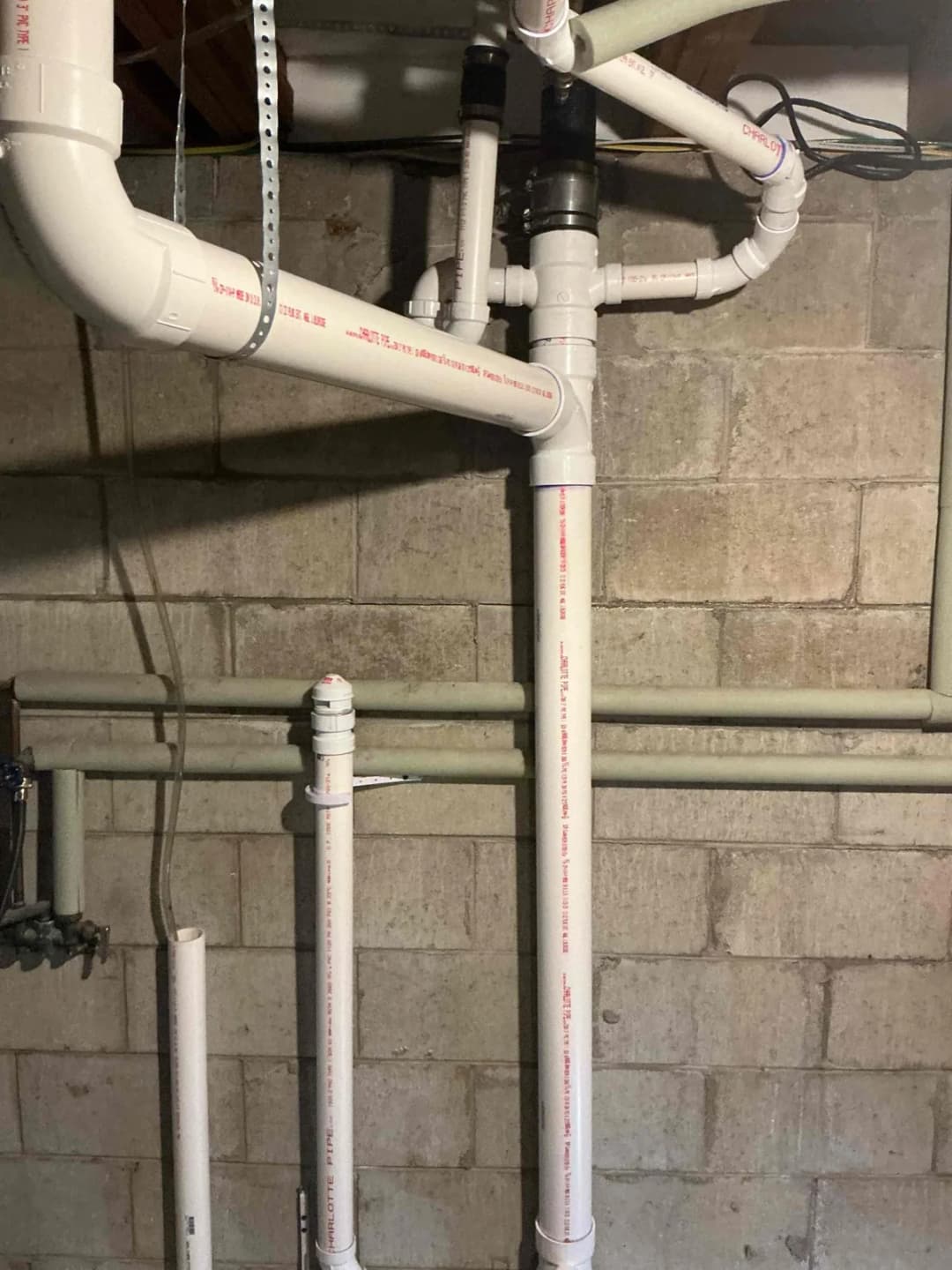 The same basement after the stack replacement: new PVC main stack, separate branch connections and a cleanout.
What does the plumbing code require for a new stack?
The code rules matter because they decide whether the work passes inspection and whether it lasts. These are the key points from the Michigan Plumbing Code, which is based on the International Plumbing Code:
- Listed materials. Section 303.5 requires cast iron pipe, fittings and couplings to be listed by a third party. Couplings that join cast iron to plastic must also be approved for that use. The Cast Iron Soil Pipe Institute publishes the standards for cast iron and its couplings.
- Testing. Section 312 requires new drain and vent piping to be tested. A water test fills the system to at least 10 feet of head with no leaks. An air test holds 5 psi for 15 minutes. Replacement sections get tested too.
- No size reductions. Section 704.2 says drain pipe cannot get smaller in the direction of flow.
- Cleanouts. Section 708 sets where cleanouts go and how accessible they need to be.
- Venting to the outside. Sections 903 and 904 in the vents chapter require at least one vent to extend outdoors and terminate at least 1 foot above the roof, or 7 feet if the roof is used for other purposes.
A stack that is not tested, not vented to the outside, or joined with the wrong couplings may work for a while, but it will not pass inspection and it can create sewer gas problems later.
Which pipe material is best for a new stack?
Here is how the common stack materials compare in a home:
| Material | Where you find it | Pros | Cons |
|---|---|---|---|
| Cast iron | Original pipe in most older homes, some new high end builds | Very quiet, fire resistant, long life | Heavy, corrodes from inside, expensive to install |
| Galvanized steel | Branch drains in older homes | Strong | Rusts closed from inside, shortest life of the group |
| Copper DWV | Some homes from the 1950s to 1970s | Light, smooth inside | Can pinhole, high material cost |
| PVC | Most replacements today | Light, smooth, does not corrode, easy to test | Louder than cast iron when water runs |
| ABS | Some newer homes and regions | Similar to PVC, black plastic | Less common locally, cannot be mixed freely with PVC |
For most stack replacements, PVC is the right choice. It does not rust, it is smooth inside so it resists buildup, and it is light enough that a crew can install it without heavy rigging. The one real downside is noise. You may hear water moving through a PVC stack more than you did with cast iron. If the stack runs past a bedroom or living space, wrapping the pipe in sound insulation before the wall is closed helps.
Can you leave the old stack alone?
You can, until you cannot. A cast iron stack does not usually fail all at once. It seeps, smells, gets patched, and keeps going until a crack opens up or a section breaks while someone is working near it.
The risk with waiting is not the stack itself. It is what a slow leak does to everything around it. Water inside walls and ceilings leads to rot and mold. The EPA's guidance on mold is clear that the fix starts with stopping the water source. Sewer gas leaking into the house is unpleasant and is not something you want to live with. A stack that breaks unexpectedly can turn a planned project into an emergency repair with water on the floor.
If your stack shows early signs but is not leaking, scheduling the replacement on your timeline, often alongside a bathroom remodel or basement finishing project, is usually the smartest move. If it is actively leaking or smells, have it looked at soon.
How long does a plumbing stack replacement take?
Most basement only stack replacements take one to two days, including testing. Jobs that run through finished walls, the attic or the roof take longer, and drywall repair is usually a separate step after the plumbing passes inspection.
Can I use my plumbing during a stack replacement?
Not while the stack is open. The drains connected to it are out of service during the cut and install, which is usually a matter of hours. We plan the work so you have working drains back as soon as possible and tell you ahead of time when water use needs to stop.
Do I need a permit to replace a plumbing stack?
Yes. Replacing drain, waste and vent piping requires a plumbing permit in Michigan, and the finished work is inspected. A licensed plumbing contractor pulls the permit and schedules the inspection.
Is it better to replace cast iron with PVC?
For most homes, yes. PVC does not corrode, is smooth inside, and is much lighter to install. The main tradeoff is that it is louder when water runs through it, which sound insulation can reduce.
What is the difference between a stack vent and a vent stack?
A stack vent is the top part of your main soil or waste stack, above the highest drain, that goes out through the roof. A vent stack is a separate vertical pipe that only carries air and is common in larger homes.
Does homeowners insurance cover a stack replacement?
Policies usually cover sudden water damage, but often not the pipe itself when it fails from age and wear. Check your policy and talk to your agent. We document what we find with photos, which helps if you do file a claim.
Can a stack be repaired instead of replaced?
Often, if the damage is one joint or one fitting and the pipe on both sides is solid. A camera inspection tells us whether a repair will last or whether the rest of the stack is just as worn.
Get a stack inspection from NSP Plumbing
NSP Plumbing is a licensed Michigan plumbing contractor (license #8004990). We replace cast iron main stacks, swap out leaking Boosie fittings, repair cracked wyes and joints, and install the cleanouts most older homes are missing. Every job starts with an honest look at the pipe you can see and a camera look at the pipe you cannot.
Our camera inspection service shows you exactly what the inside of your drain looks like before anyone recommends a repair. If the stack is fine and the problem is a clog, our drain cleaning service handles it. If the stack is part of a bigger picture, such as old galvanized or cast iron throughout the house, we can talk through a repipe. Problems past the foundation are handled by our sewer line replacement team, and our guide to sewer line replacement explains what that work involves. Buying an older home? A plumbing inspection before closing tells you what condition the stack is in before it becomes your problem.
What helps us give you an accurate scope on the first visit:
- A photo of the stack in your basement, top to bottom if you can.
- Whether you have noticed smells, stains, slow drains or gurgling, and where.
- Whether any part of the stack has been patched before.
- Whether the basement ceiling or walls around the stack are finished.
- Whether a remodel is planned that might open walls anyway.
With that information we can usually tell you on the first visit whether you are looking at a spot repair, a partial replacement or a full replacement. You get a written scope and price before any work starts, and we walk you through the camera footage and photos so you see what we see.
Worried about an old cast iron stack? Let us take a look.
A licensed NSP plumber will inspect your stack, camera the drain, and give you a clear written scope, repair or replace, before any work begins.