Most Grand Rapids homeowners spend around $6,500 to replace a sewer line. If only one section has failed, it's usually $1,000 to $2,600. A full replacement from your house out to the city main runs $6,900 to $16,400. The rare worst case, a long line relined from the inside, has reached $19,445.
That's a wide range, and most people land nowhere near the top of it. This page explains where your house is likely to fall and how to find out before you agree to anything.
How much does sewer line replacement cost in Grand Rapids?
It depends on how much pipe has to come out of the ground. Replacing one bad section under a driveway is a completely different job from replacing the whole run to the city main. Here's what each version costs.
| Type of job | What's involved | What it costs in Grand Rapids |
|---|---|---|
| One failed section | Cut the concrete, dig down, replace the broken piece, fill it back in | $1,000 to $2,600 |
| A longer stretch, not the whole line | A bad run under a driveway or sidewalk, or capping an old septic tank and connecting to city sewer | $4,800 to $7,700 |
| The whole line, house to street | New pipe the entire way, a new access point, and putting back whatever got dug up | $6,900 to $16,400 (most around $6,500) |
| Trenchless lining instead of a long trench | A new pipe formed inside the old one, so the yard mostly stays put | $19,445 on the hardest one we've done |
| Storm water lines | The separate underground pipes that carry rain water, not sewage | $3,150 to $14,500 |
Two jobs from July 2026 show why.
$19,445, southeast side of Grand Rapids. The whole line had failed, foundation to city main. We relined it from the inside so the yard stayed put. One spot where the neighbor's garage tied in couldn't be lined, so that piece got dug up on its own, and concrete had to come out of the back yard to reach it.
$1,000, northeast side. One cracked section under the driveway, leaking about a gallon every time someone ran water. Cut the concrete, swap the section, done.
Same city, same month, and one cost nineteen times the other.
What separated them: how much of the line had actually failed, and how much concrete was sitting on top of it. That's why a national "average sewer replacement cost" tells you nothing about your house, and why anyone who quotes you a price over the phone, without looking inside your pipe, is guessing.
What decides where your price lands?
How far your house sits from the street. The length of pipe between your foundation and the city main is the single biggest factor. A 1920s home in Heritage Hill sitting close to the street is a much smaller job than a 1990s build set back 80 feet.
How deep the line is buried. Sewer lines around here commonly sit deep enough that the sides of the trench have to be braced before anyone can safely climb in. Deeper takes longer, and longer costs more.
What has to be cut through to reach it. Digging in grass is the cheap version. A concrete driveway, a public sidewalk or a finished basement floor is not. Cutting concrete and then putting it back adds real hours to the job.
What your pipe is made of. Older homes here usually have clay pipe, cast iron, or a tar paper pipe called Orangeburg, and they each fail differently. Clay comes in short sections, and roots get in at the joints. Cast iron rusts and flakes from the inside until the bottom of the pipe is gone. Orangeburg simply goes soft and collapses. What you have affects both the fix and whether relining is even an option.
Whether you dig it up or line it. Lining forms a new pipe inside the old one, so your yard and driveway mostly stay where they are. It costs more per foot, and it only works if the old pipe is still whole enough to line.
How much of the line is yours. Around here the part of the line on your property is normally yours to maintain, and on several local jobs that responsibility ran all the way to where it meets the city main. Check with your city before you assume the piece under the street is their problem.
Do you actually need a full replacement?
Plenty of homeowners who call convinced they need a new sewer line don't. Before you sign anything, work through these steps in order. Each one is cheaper than the next, and one of them might be all you need.
- Try clearing the line first. Having the main line snaked out typically runs about $384 around here. If that opens the line and the camera shows solid pipe behind the blockage, you're done, and you just saved thousands.
- Get a camera inspection. A standalone sewer camera inspection with NSP Plumbing is $150, and we take that $150 back off whatever service you book with us afterward. If the camera goes down the line as part of a drain cleaning, jetting or sewer repair you already booked, it is included. This is the step that decides everything, and skipping it is how homeowners end up paying for work they never needed.
- Consider jetting if it's grease or sludge. Hydro jetting typically runs about $800. Here's the full Grand Rapids hydro jetting cost breakdown.
- Replace only what the camera proves has failed. That means pipe that has cracked or caved in, joints that have shifted so the two ends no longer line up, a low spot that holds standing water, or roots that come back every few months no matter how often the line is cleared.
What the camera actually shows you
Step 2 is where the money gets decided, so it helps to know what you're looking at when a plumber turns the screen toward you. These are two real inspections from West Michigan homes, and they point to two very different bills.
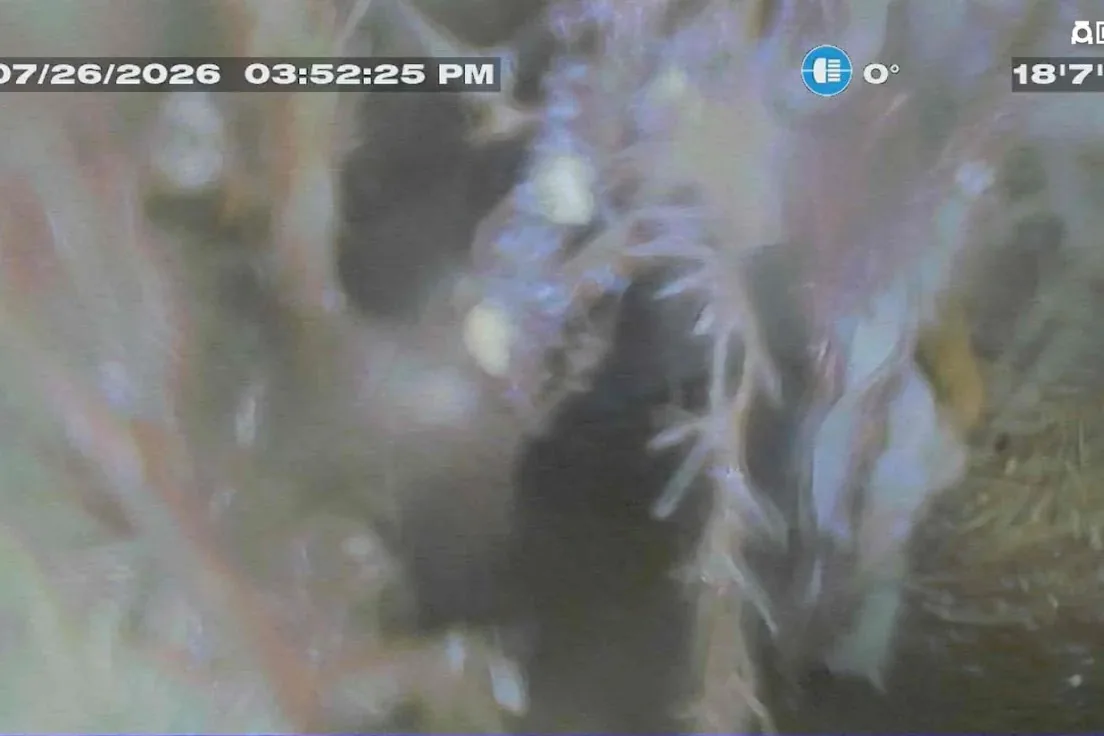
Roots at 18 feet 7 inches: usually not a replacement. Roots work their way in through a joint. Cut them out and the line flows again. If the pipe behind them is solid, you need a cleaning and a plan to keep the roots back, not a new sewer.
The number in the corner counts the feet from where the camera went in. That's how a crew knows the exact spot to dig, instead of opening up half your yard looking for it.
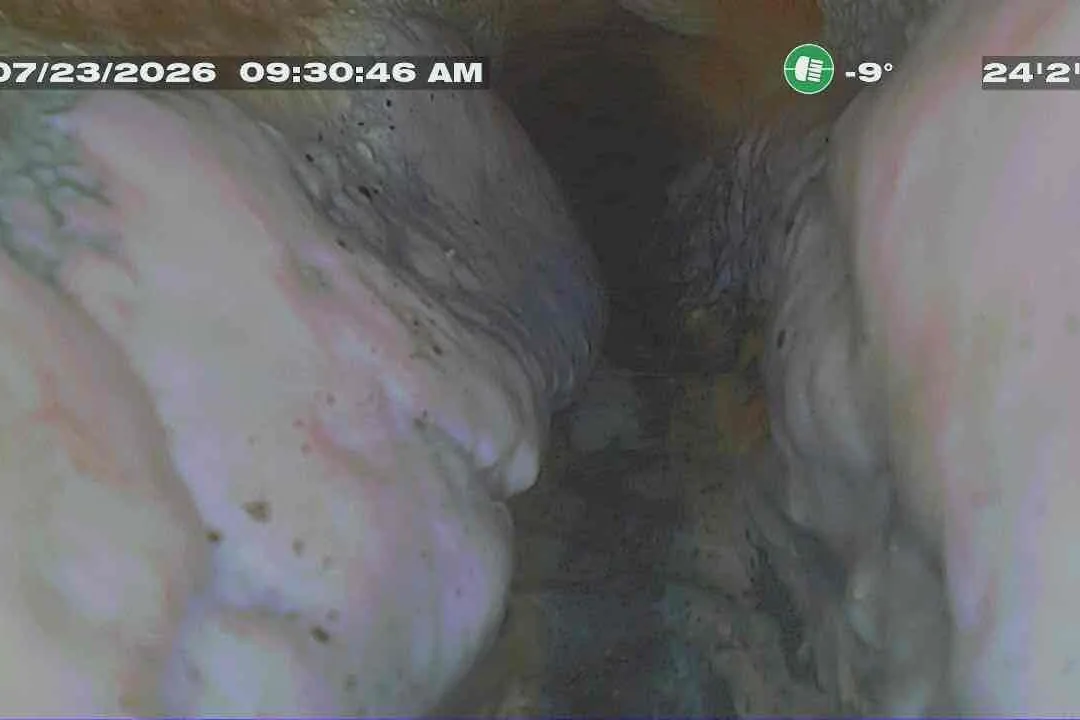
Broken pipe at 24 feet 2 inches: this line has to be replaced. The wall of the pipe is crumbling away, and the two sections have shifted so they no longer line up. Waste catches on that lip instead of flowing past it. Cleaning a pipe in this shape buys a few weeks at best, because the problem isn't a blockage, it's the pipe itself. No amount of snaking fixes a pipe that's falling apart.
The difference between those two pictures is roughly $384 and $6,500. That's the whole reason to put a camera down the line before you spend anything else, and the reason to ask which one your line looks like.
What do the permits cost, and who pulls them?
Replacing a sewer line is permitted work everywhere in West Michigan. Michigan's rule is that a plumbing permit applicant has to be a licensed plumbing contractor or a homeowner doing their own plumbing, building sewer or private sewer, so a real contractor pulls it under their own license instead of asking you to pull it as the homeowner. If a quote doesn't mention a permit at all, that's your first red flag.
| City | Plumbing permit | Outside sewer permit | Extra inspections |
|---|---|---|---|
| Grand Rapids | $52, includes 1 inspection | Priced in the plumbing schedule | $42 each |
| Wyoming | $50, includes 1 inspection | $60 | $40 each |
| Kentwood | $50 base fee | $25 (new, replacement, repair, capping or septic) | $50 each; storm sewer $40 |
Those fees come from the Grand Rapids FY26 fee schedule, the City of Wyoming fee schedules and the City of Kentwood permit fees. If the dig reaches into the street, the city also requires a separate right-of-way permit.
On our jobs, we pull the permit and meet the inspector. Both are priced into the quote, so none of it lands on you later as a surprise.
What does the work look like in your yard?
For most straightforward homes, plan on one to two days of work at your house, plus a visit from the city inspector before the trench gets filled back in.
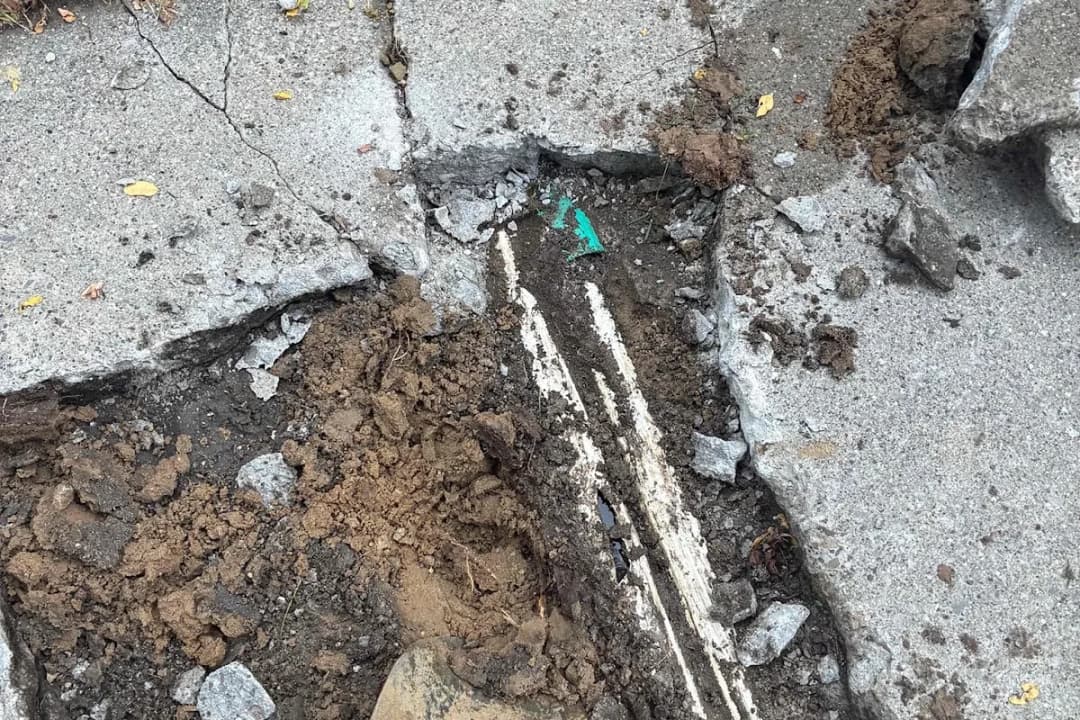
Concrete gets cut in clean squares rather than broken up, so it can be put back neatly when the work is done. This sidewalk was cut to reach a sewer line running directly underneath it.
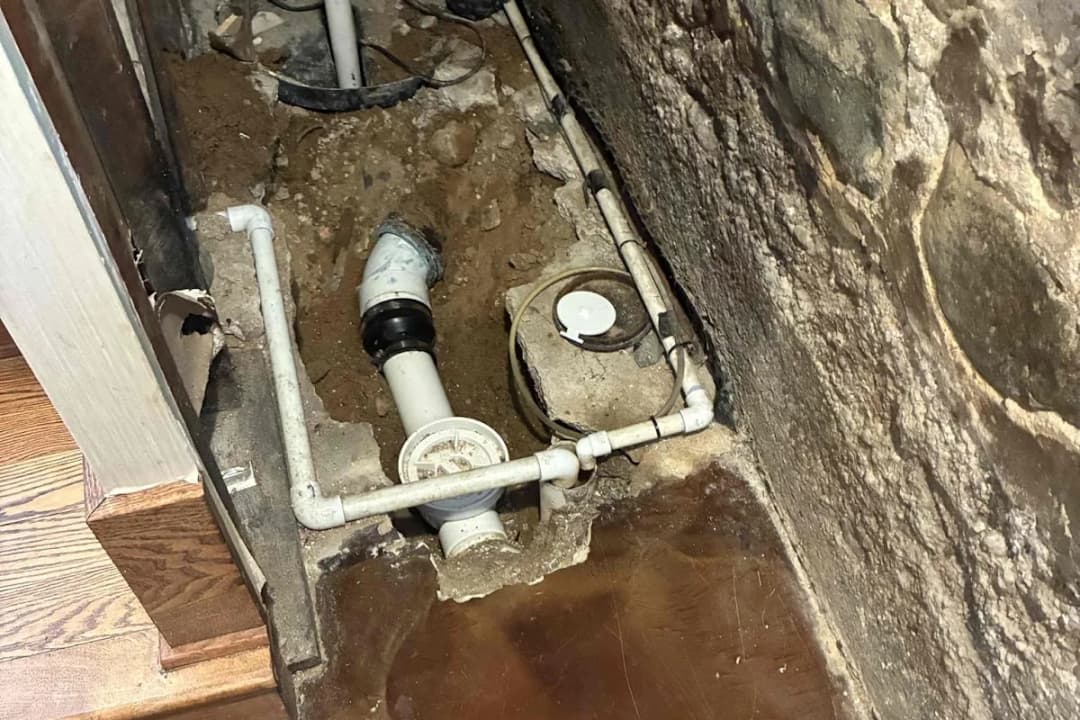
New pipe coming through the basement wall with two cleanouts brought up to floor level. Those are the capped access points a plumber uses later, and they're the difference between a future service call being a quick visit or another dig, so make sure they show up in your quote.
How do you avoid overpaying?
- Ask to watch the video. Not a description of it, the actual recording from inside your pipe. Anyone who won't show you is asking you to spend thousands on their word.
- Ask where the problem is and how deep. "It's bad down there" tells you nothing. "The joint has shifted at 24 feet, roots at 18 feet" tells you they actually looked.
- Ask what gets put back, in writing: concrete, driveway, grass. This is where a cheap-looking quote turns expensive later.
- Confirm the contractor pulls the permit under their license number, and that inspection is part of the price. You can check any Michigan license yourself in the state's MiPLUS license lookup.
- Ask whether your pipe can be lined instead of dug up. It costs more, but it can save a driveway or a mature tree worth more than the difference.
- Make sure you're comparing the same job. A $6,900 quote to replace the whole line and a $4,800 quote to fix part of it look close on paper, but they aren't the same work.
How much does it cost to replace a sewer line in Grand Rapids?
Most homeowners land around $6,500, based on sewer jobs we've completed across the Grand Rapids area since 2024. If only one section has failed, it's usually $1,000 to $2,600. Replacing the whole line from the house to the city main runs $6,900 to $16,400. The most complicated job we've done, a long line relined from the inside, came to $19,445. Where you land depends mostly on how far your house sits from the street and what has to be cut through to reach the pipe.
How long does a sewer line replacement take?
Most straightforward jobs in the Grand Rapids area take one to two days at your house, plus a visit from the city inspector before the trench is filled back in. Deep lines, long runs and digs that cross a driveway or sidewalk take longer, and putting concrete back can add another visit after the pipe work is done.
Do I need a permit to replace a sewer line in Michigan?
Yes, and your plumber should pull it under their license rather than asking you to do it. Grand Rapids charges $52 for the plumbing permit including one inspection, Wyoming charges $50 plus $60 for the outside sewer permit, and Kentwood charges $50 plus $25. On our jobs we pull the permit, meet the inspector and include both in the price.
Is trenchless sewer replacement cheaper than digging?
No, it usually costs more per foot. People choose it to protect what sits above the pipe, like a driveway, a patio or mature trees. It also needs an old pipe that's still whole enough to line, so a section that has already caved in rules it out. If the line runs under open grass, digging is almost always cheaper.
Who is responsible for the sewer line, me or the city?
The part of the line on your property is normally yours, and on several West Michigan jobs that responsibility ran all the way to where it meets the city main. The rules are set city by city, so check with yours rather than assuming the piece under the street belongs to them. It's an expensive thing to guess wrong about.
Will homeowners insurance cover a sewer line replacement?
Standard policies generally don't cover a line that failed from age, tree roots or normal deterioration. Coverage for things like sewer backup is typically sold as a separate endorsement on a homeowners policy, and some carriers sell a service line endorsement as well. Check whether your policy has a service line rider before you assume either way, and ask your agent before the work starts rather than after.
Does a sewer camera inspection cost extra?
Not with us. When the camera is part of a drain cleaning, jetting or sewer repair you book with NSP Plumbing, the inspection is included. On its own it is $150, and we credit that $150 back toward any service you book with us after the inspection. It's what determines whether you need a $384 cleaning or a $6,500 replacement, which makes it the cheapest money you'll spend on the problem. Never agree to a replacement quote from someone who hasn't put a camera down the line.
Find out what's actually wrong before you replace anything
NSP Plumbing is a licensed Michigan plumbing contractor (license #8004990) based in Wyoming, MI, handling sewer, drain and underground work across Grand Rapids, Wyoming, Kentwood, Grandville, Jenison, Byron Center, Caledonia, Ada, Rockford, Walker, Lowell and Hudsonville. If your line keeps backing up, start with a camera inspection so you know what you're actually dealing with before anyone quotes you a sewer line repair or a full sewer line replacement.
More on sewer problems: why your basement backs up during heavy rain and what hydro jetting costs in Grand Rapids.
Find out what's wrong before you spend $6,500
A standalone camera inspection is $150 and tells you whether this is a $384 cleaning or a new sewer line. Book the work with us afterward and we take that $150 right back off the job. We send a camera down your line, show you what's on the screen with you standing there, and put the price in writing before anyone starts digging.