
You want to plant a tree, build a fence, put in a patio, or you just got told your sewer line needs work. Before any of that, you need to know where the pipe is and how far down it sits.
There is no single number, but there is a usual range. In West Michigan, most residential sewer lines are buried between 4 and 8 feet deep, shallower where they leave the house and deeper toward the street. A few run 10 feet or more. A camera locate tells you the real depth for your yard.
How Deep Are Sewer Lines Buried?
The honest answer is "deeper than most people think, and it depends on your house." Your sewer line is the single pipe that carries everything from your toilets, sinks, tub and washer out of the house and down to the city sewer in the street.
Because it runs on gravity, its depth is set by two points: where it leaves your house and where it meets the city main.
Here is what we see on real digs around Grand Rapids:
| Where on the line | Typical depth we find |
|---|---|
| Leaving the foundation, slab or crawlspace home | About 1 to 3 feet |
| Leaving a basement wall | Often 4 feet or more, set by the basement floor |
| Middle of the front yard | Usually 4 to 8 feet |
| Near the sidewalk and street | 7 to 12 feet on older Grand Rapids streets |
Those ranges come straight from our field notes. On one older home, the roots started at the cast iron pipe where it passed through the foundation, only about 12 inches below the surface.
On a full line replacement in January, the crew dug 7 to 8 feet deep the whole way to the city's portion of the line. On a March job, the broken section between the sidewalk and the house sat 8 to 12 feet down.
Most of the sewer repair quotes we write are built for a line sitting between 4 and 8 feet deep, because that is the most common range here. Deeper lines are not unusual; they just change how the work is done, which we cover below.
Before we get into why, here is what a typical dig at depth looks like.
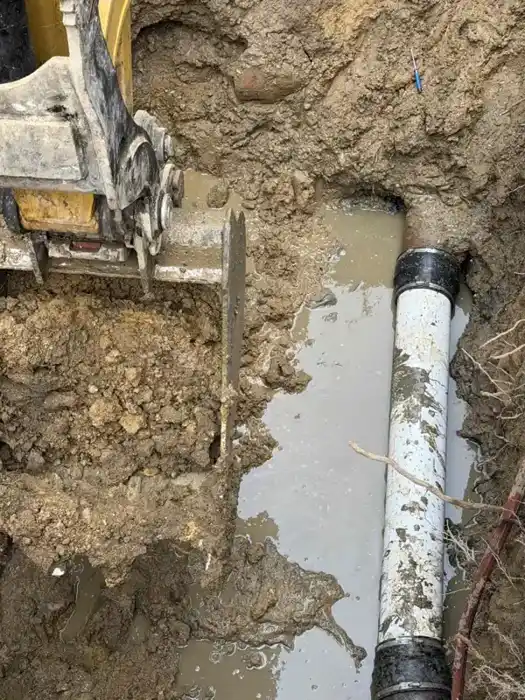
New sewer pipe sitting several feet below the lawn: this is what "normal depth" looks like in Grand Rapids. The white pipe is the new line, and the water at the bottom is groundwater that seeps in once you dig this far down.
What Decides How Deep Your Sewer Line Is?
Nobody picks a sewer depth out of the air. Three things set it, and they work together.
1. How deep the pipe leaves your house. If you have a basement with a floor drain, the line has to start below that drain so water can fall out of the house.
That alone often puts the pipe 4 or more feet below the yard right at the foundation wall. A slab or crawlspace home can start much shallower.
2. The slope the pipe needs. A sewer pipe has to fall a little bit every foot so waste keeps moving. The Michigan Plumbing Code (Table 704.1) requires at least 1/8 inch of drop per foot for the 3 to 6 inch pipe most houses use, and 1/4 inch per foot for smaller pipe.
Many plumbers aim for 1/4 inch on a house sewer because it moves solids more reliably. Over a 60 foot front yard, a quarter inch per foot adds up to more than a foot of extra depth by the time the pipe reaches the street.
3. How deep the city main is. Your line has to meet the city sewer at whatever depth the city built it. On older Grand Rapids streets, those mains can be deep, which is why the last stretch of your line near the sidewalk is often the deepest part of the whole dig.
Freezing matters too, and that is the next section. But in practice, slope and the city main usually push a Michigan sewer line deeper than the frost line requires anyway.
One more thing affects depth over time: the yard itself. Grading, a new driveway, a raised garden bed or a regraded lot can add or remove soil over an old pipe.
The pipe did not move, but the distance from your feet to the pipe did. That is one reason we never trust an old drawing or a neighbor's guess and always measure the actual line before quoting digging.
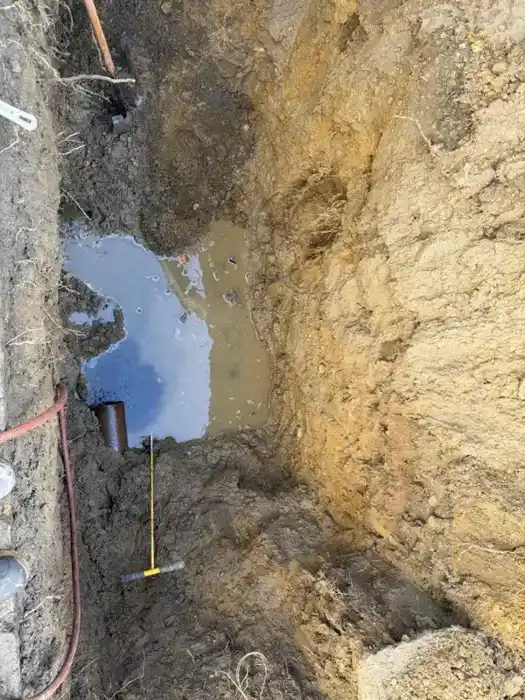
A tape measure dropped into the trench to confirm depth before the new pipe goes in. We measure the real depth on every dig because slope and depth decide how the replacement has to be built.
What Is the Frost Line in Michigan, and Why Does It Matter?
The frost line is how deep the ground freezes in a hard winter. Anything buried above it can freeze, and frozen soil also heaves and shifts, which can crack or pull apart buried pipe joints.
Michigan uses 42 inches (3.5 feet) as the standard frost depth for building. The state building rules require exterior footings to extend 42 inches below grade, and the City of Grand Rapids uses the same 42 inch figure in its residential deck guide.
For water lines, the Michigan Plumbing Code section 305.4 is specific: outdoor water supply pipe must sit at least 6 inches below the frost line and at least 12 inches below grade. That is why a new water service line we planned this summer was set to enter the house about 42 inches below grade.
A sewer line is different. It carries warm wastewater and is usually empty between uses, so the code does not tie it to frost depth the same way. In real life it ends up below 42 inches for most of its run anyway because of slope and the city connection.
Where frost does bite is at the shallow end. A sewer line that leaves a slab home just a foot or two down, or a line under a driveway where snow gets plowed off and frost drives deeper, can freeze in a hard cold snap.
A slow drip from a fixture can build ice in a shallow line. If drains back up in a deep freeze and thaw out later in the day, a shallow section is a likely suspect, and a camera will show it.
If you are worried about freezing pipes inside the house, our guide on how to tell if a pipe burst covers the warning signs, and we handle frozen pipe repair year round.
How Do You Find Your Sewer Line and How Deep It Is?
You can get a rough idea yourself, but only a locate gives you a real depth.
Start inside. Find where the sewer leaves your house. In most basements, that is a large pipe (usually 4 inches, cast iron in older homes, white or black plastic in newer ones) heading into the floor or through the front wall.
Many houses have a cleanout near it, which is a capped piece of pipe that lets a plumber into your line without digging. Whichever wall the pipe points toward is the direction it runs outside.
Look outside. Some homes have a cleanout cap sticking up in the yard. A straight line from the basement exit toward the street, ending near the city main, is the most common route, but older lines can bend around trees, porches and driveways.
Get it located. This is the step that matters. We run a camera with a small radio transmitter on its tip down the line. Someone above ground follows the signal with a receiver that shows both the pipe's location and its depth at each spot.
We mark it with paint or flags. It is the only way to know the real depth before anyone digs. You can read more about how that works on our camera inspection service page.
Call before you dig. In Michigan, anyone digging must contact MISS DIG 811 at least three business days ahead. The service is free. Utility locators then mark the gas, electric, water and communication lines they own.
Your private sewer line usually is not marked by those crews, because it belongs to you. That is why a plumber's camera locate and an 811 ticket go together.
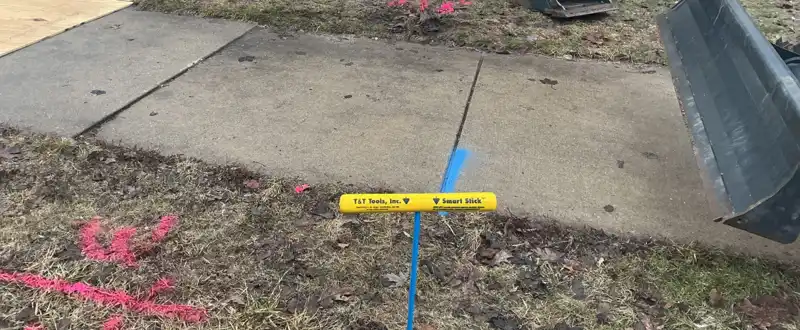
Paint and flags from a utility locate on a front lawn: this is what you want to see before anyone digs. The colors mark buried utilities so the crew knows exactly what is under the yard before the excavator comes in.
What Does Sewer Depth Mean for Repair or Replacement?
This is the question most people really care about. Depth changes how the job is done more than anything else.
A shallow line, roughly 4 feet or less, can usually be dug with a small excavator in a simple trench. It goes quickly, the hole is small, and the yard recovers fast.
A line from about 5 feet down needs protection for the crew. Federal trench safety rules (29 CFR 1926.652) require a protective system for trenches 5 feet or deeper unless the ground is solid rock.
In practice that means a trench box, a steel frame dropped into the hole so the walls cannot cave in on the plumber working at the bottom.
A line at 8 to 12 feet means a bigger hole, more soil to pile and haul, and often a wider dig to keep the walls safe.
Near the street, it can also mean working around the sidewalk and other utilities. This is the main reason two sewer repairs that look identical from the basement can be quoted very differently.
Depth also shapes the options. If only one short section is broken, a deep line still favors fixing just that spot over digging the whole yard. If the whole line is failing, a full replacement may be the right call, and our guide on sewer line replacement cost in Grand Rapids walks through what drives the price.
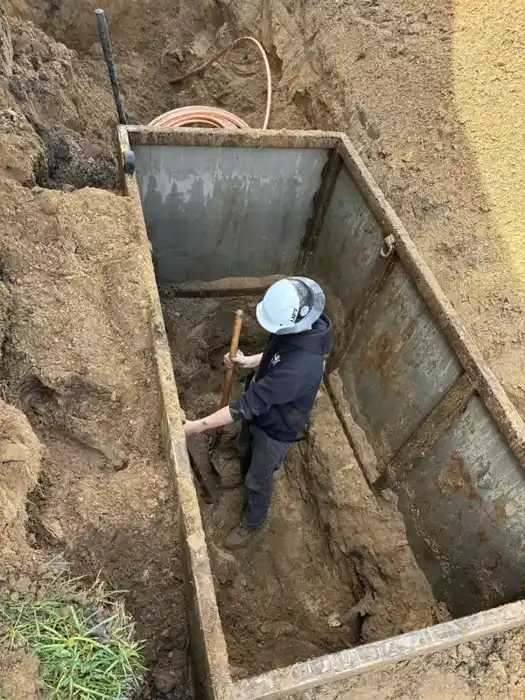
Steel trench box in a deep sewer dig: once a line is 5 feet down or more, this is how the crew works safely. If your quote mentions shoring or a trench box, this is what it is paying for.
Is a Deeper Sewer Line Better or Worse?
Neither, really. Depth comes with tradeoffs.
Deeper lines are better protected. They are well below the frost line, less likely to be crushed by vehicles, and less bothered by surface work like landscaping. A deep line is less likely to freeze in a Michigan winter.
Deeper lines are harder to reach. When something does go wrong, more digging is needed. That is the main downside, and it is why we always try to diagnose with a camera first and only dig where we have to.
Shallow lines are easier to repair but more exposed. Freezing at the shallow end, roots from shrubs, and damage from fence posts or tree planting are all more likely when the pipe is only a couple of feet down.
Roots are the problem that ignores depth. Tree roots go after the water and nutrients inside a sewer pipe and find their way in at joints, especially on older clay and cast iron lines.
We pull root masses out of lines at every depth. The worst we see come from big trees in the front yard sitting right on top of the pipe's route.
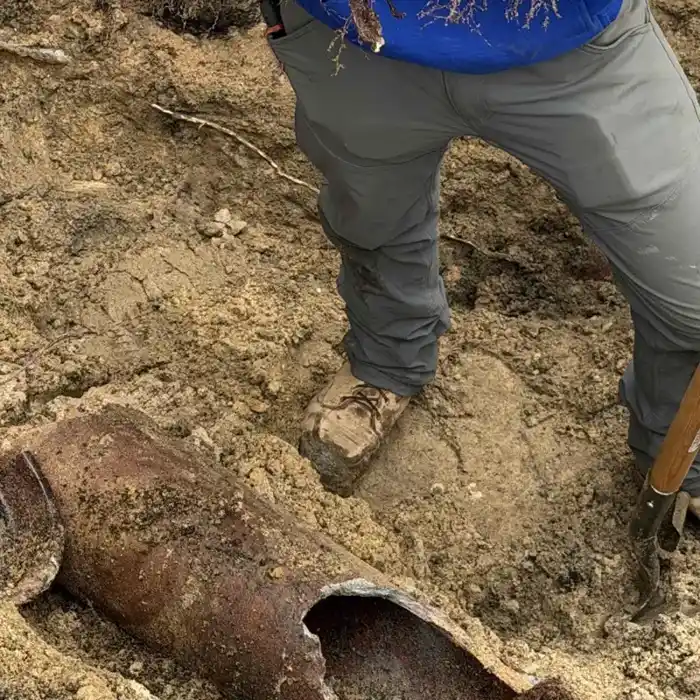
Old cast iron sewer pipe dug up beside a mass of roots pulled from it: this line was past saving and had to be replaced. Depth did not protect it, because the roots came from a tree standing right over the pipe.
If you just want the line cleared and checked, that is drain cleaning with a camera, not an excavation. Most backups never need a shovel.
What About Sewer Lines Under the House?
Not all of your sewer is in the yard. In a house with a basement, part of the drain system usually runs under the basement floor before it leaves through the wall. In slab homes, the drain lines run through the soil under the slab.
Under the house, depth is measured from the floor, not the yard. On one Grand Rapids job this spring, our crew cut the concrete in a kitchen area and found the main line roughly 5 feet below the floor.
On older homes we often open the basement floor along the front wall to replace the cast iron section under the house so it matches the new line outside.
Work under a floor follows the same rules as work outside: locate first, then open only what is needed. The concrete gets cut in a clean strip, the pipe is replaced and inspected, the trench is filled back in and the floor is poured again.
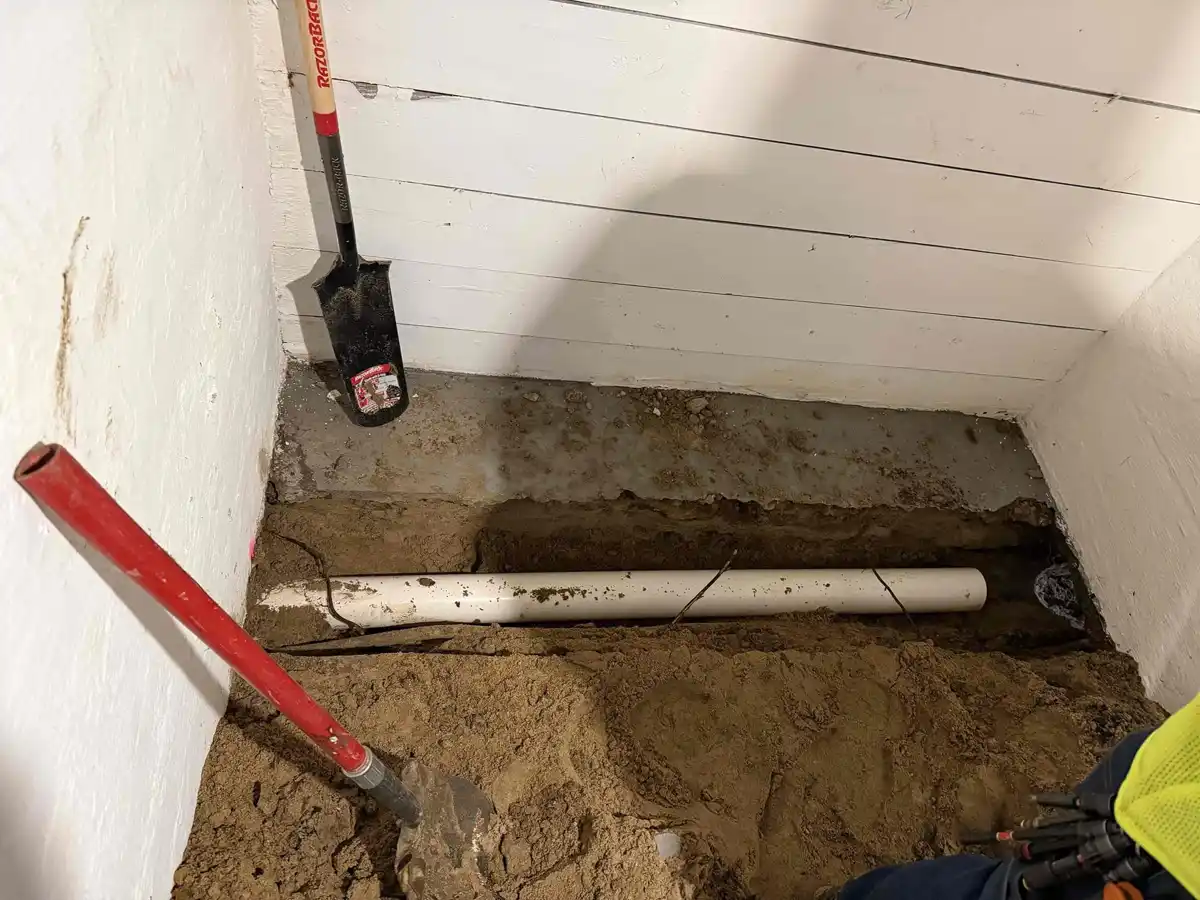
Basement floor opened along the wall to reach the sewer line underneath: this is how an under floor section gets replaced. The new white pipe runs at the same depth as the old one so it lines up with the line leaving the house.
If you are dealing with sewer smells in the house rather than a backup, the cause is often closer to the surface. Our guide on why your bathroom smells like sewage covers the common reasons, and our page on what a plumbing stack replacement is explains the vertical pipe that feeds into this line.
Who Owns the Sewer Line, and How Far Does That Go?
Depth matters most for the part of the line you are responsible for. In Grand Rapids and most West Michigan cities, the homeowner is responsible for the sewer pipe from the house out toward the street, up to the point where the city's responsibility starts.
Where that handoff happens varies by city and sometimes by street, so check with your city before assuming.
That matters because the deepest stretch of the line is often right near the handoff. On many of our jobs, the replacement runs from where the line leaves the house "to the city responsibility," and the deepest digging happens in that last stretch near the sidewalk.
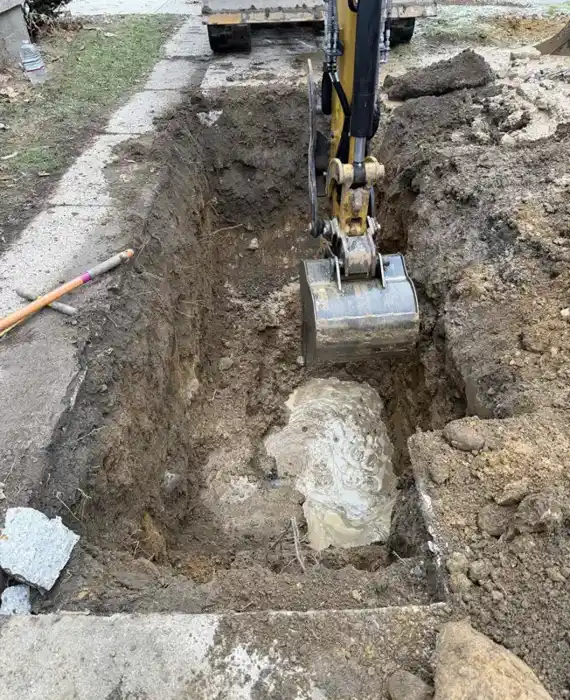
Trench running along the sidewalk toward the street: the closer the line gets to the city main, the deeper it usually goes. This is the stretch where depth most often climbs past 8 feet on older streets.
When we quote sewer work, we spell out exactly which section we are replacing and where it ends, so you know what you own, what we are fixing and what the city handles. If you already know your line is damaged, start with our sewer line repair and sewer line replacement pages.
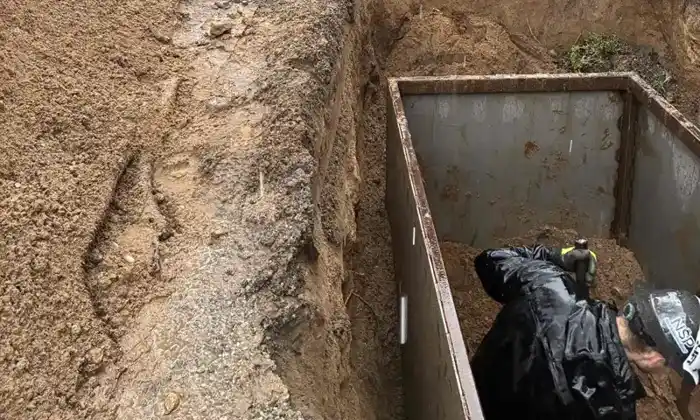
Trench box set near the street end of a sewer dig: this is the deepest and most involved part of most replacements. Planning for it up front is what keeps a deep job on schedule.
How deep are sewer lines buried in Michigan?
Most residential sewer lines in West Michigan sit between 4 and 8 feet deep for most of their run. They are shallower where they leave the house, sometimes only 1 to 3 feet on slab homes, and can reach 10 to 12 feet near the street on older city blocks.
Are sewer lines below the frost line?
Usually, yes. Michigan uses 42 inches as its frost depth for building, and most sewer lines end up deeper than that because of slope and the depth of the city main. The shallow end near the house is the part most likely to sit above it.
How deep are water lines buried in Michigan?
The Michigan Plumbing Code requires outdoor water supply pipe to be at least 6 inches below the frost line and at least 12 inches below grade. With a 42 inch frost depth, that puts most water service lines around 4 feet down.
Can I find my sewer line depth myself?
You can find the direction it runs by locating where it leaves the house and any cleanout caps in the yard. The real depth takes a camera with a locating transmitter, which a plumber runs down the line and reads from above ground.
Will MISS DIG 811 mark my sewer line?
MISS DIG notifies the utilities that own buried lines, and they mark gas, electric, water and communication lines. Your private sewer line usually is not included because you own it. A plumber's camera locate fills that gap.
Does a deeper sewer line mean a more expensive repair?
Often, yes. Lines 5 feet or deeper need a trench box or other shoring for crew safety, and deeper digs move more soil. That is why we locate and measure before quoting digging work.
Can tree roots reach a deep sewer line?
Yes. Roots go after the moisture inside the pipe and enter at joints at almost any depth, especially in older clay and cast iron lines. Large trees standing over the pipe's route are the most common cause we find.
Sewer Line Locating and Repair Around Grand Rapids from NSP Plumbing
NSP Plumbing is a licensed Michigan plumbing contractor (license #8004990) based in Wyoming, Michigan. We locate, inspect, repair and replace sewer lines at every depth, from shallow runs near the house to deep connections at the street, with our own excavation crews and trench boxes.
We work across Grand Rapids, Wyoming, Kentwood and the rest of West Michigan. If you are planning a dig, dealing with backups, or just want to know where your line runs before you build, start with a camera inspection or contact us.
Find out where your sewer line runs and how deep it is
A licensed NSP plumber runs a camera down your line, marks its path and depth on your yard, and shows you the footage. You get a clear answer on its condition and a written quote before any digging starts.