
Every fall the same thing happens across West Michigan. The garden hose stays clipped to the house a few weeks too long, the first hard freeze rolls in overnight, and nobody notices anything wrong until spring, when the faucet gets turned on and water pours into the basement. To winterize an outdoor faucet, take the hose off, shut the inside valve that feeds it, and open the outside faucet so the pipe drains. It takes about ten minutes.
How do you winterize an outdoor faucet?
The goal is simple: get the water out of the part of the pipe that runs through the cold wall, and stop new water from flowing back into it. Water expands when it freezes. If a few inches of pipe sit full of water inside a cold rim joist (the wooden band where the house sits on the foundation), that ice has nowhere to go but out through the side of the pipe.
Here is the order this guide follows:
- Figure out what kind of outdoor faucet you have.
- Find the shutoff valve inside the house that feeds it.
- Take the hose off.
- Close the inside valve.
- Open the outside faucet and let the line drain.
- Open the small drain cap on the inside valve, if it has one.
- Leave the outside faucet open for the winter and add a cover if you want extra protection.
Not every house needs every step. A newer frost free faucet (we explain those in the next section) usually only needs step 3. An older standard faucet needs all of them.
You do not need special tools. A flashlight, a bucket or towel for the drain cap, and maybe a pair of pliers if the hose is stuck will cover almost every home. If the shutoff valve inside will not turn, or it drips once you move it, stop there. Old valves sometimes start leaking the first time they are moved in years, and that is a quick fix for a plumber but not something to force.
The timing matters as much as the steps. Do this before the first night that drops into the twenties, not after you see frost on the windshield.
What kind of outdoor faucet do I have?
Plumbers call the outdoor faucet a hose bib or a sillcock. Same thing. There are two main kinds on West Michigan homes, and they need different care.
Here is a standard outdoor faucet. Look at how short it is and how close the handle sits to the siding.
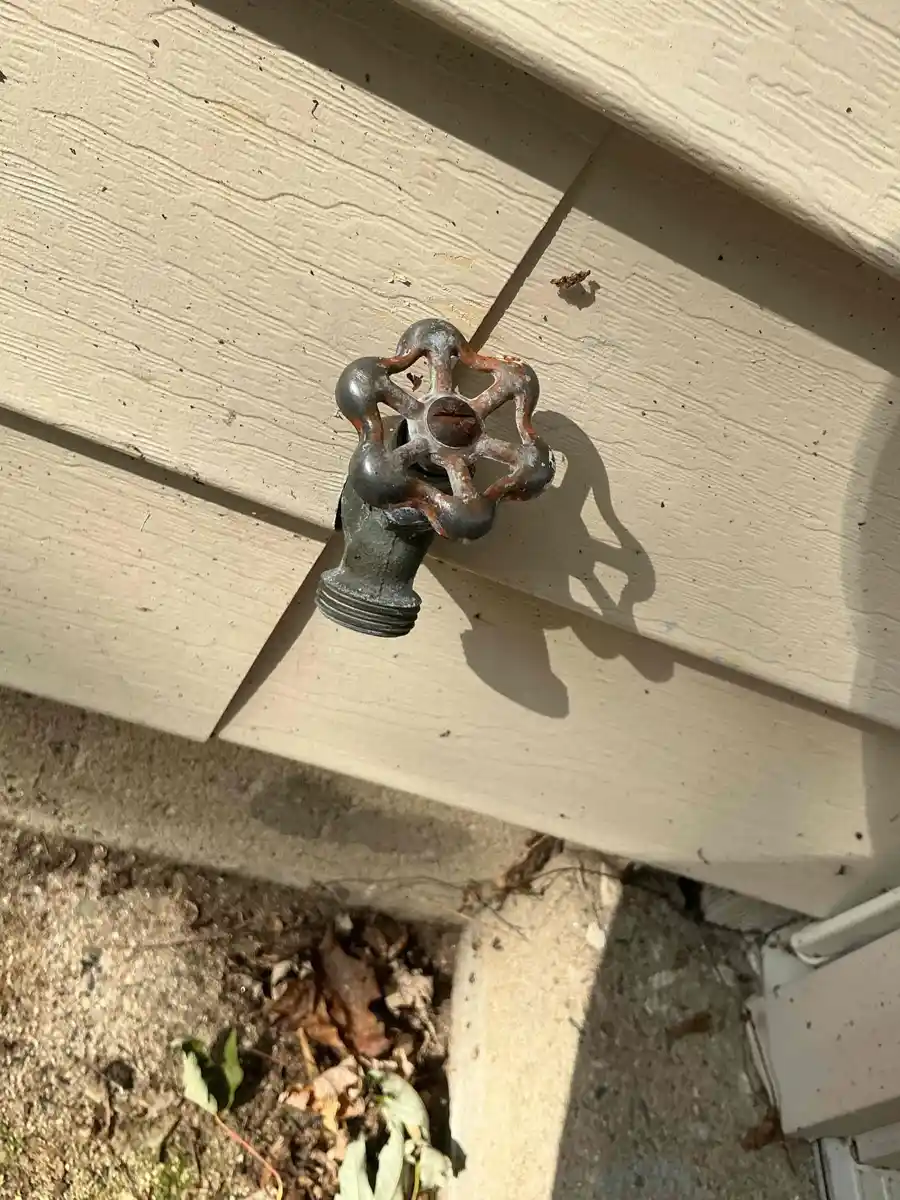
This is a standard outdoor faucet, and it needs the full winterizing routine. The valve that actually stops the water sits right at the handle, outside the wall, so the pipe behind it stays full of water all winter unless you shut it off and drain it from inside.
Now compare a frost free faucet. From the outside it looks similar, but it has a mounting flange screwed to the wall and usually a small cap on top. That cap covers a vacuum breaker, a small part that keeps hose water from being pulled back into your drinking water.
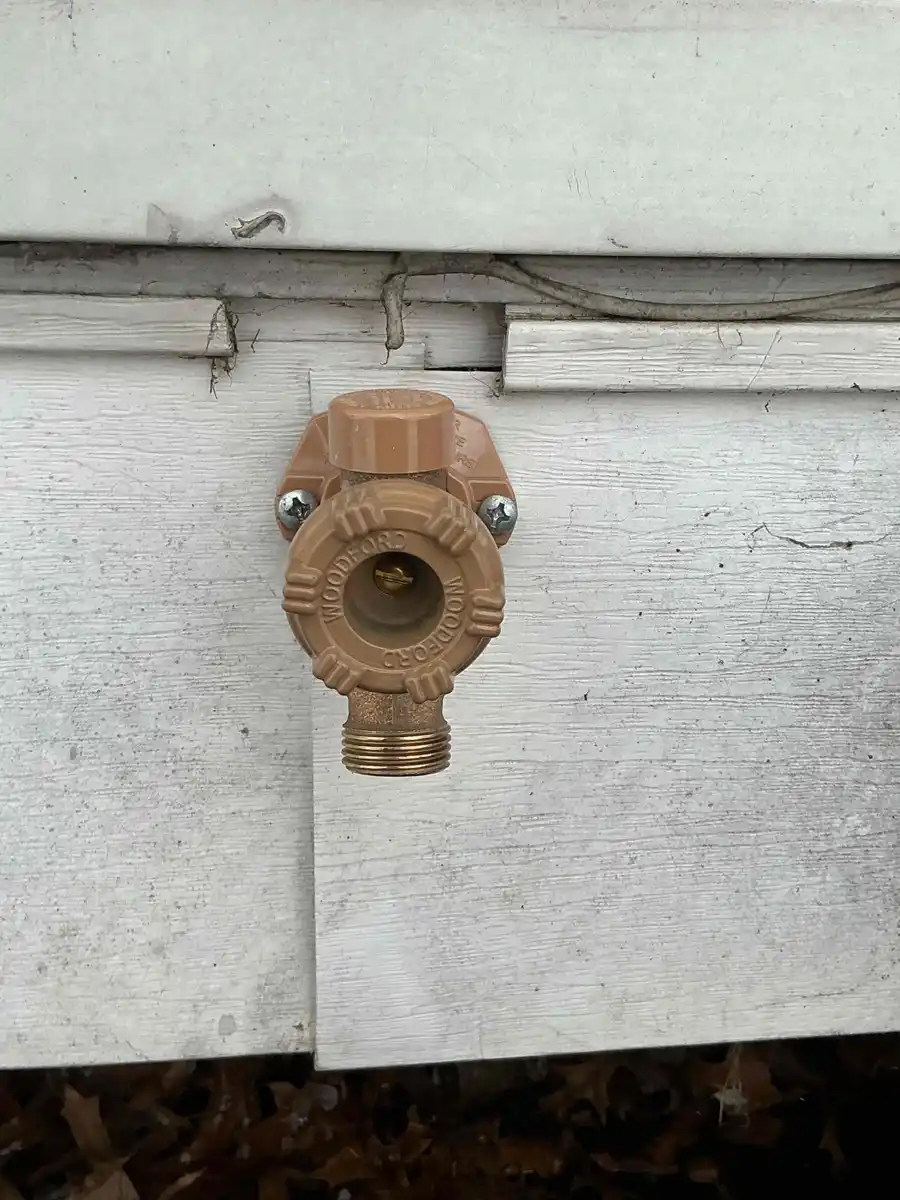
This is a frost free faucet. On most homes it only needs the hose removed. The real shutoff sits at the far end of a long tube, inside the heated part of the house, and the tube drains itself every time you turn the faucet off.
You can see that long tube when one comes out of the wall. The brass piece at the left end of this one is where the water actually stops, a foot or more inside the house.
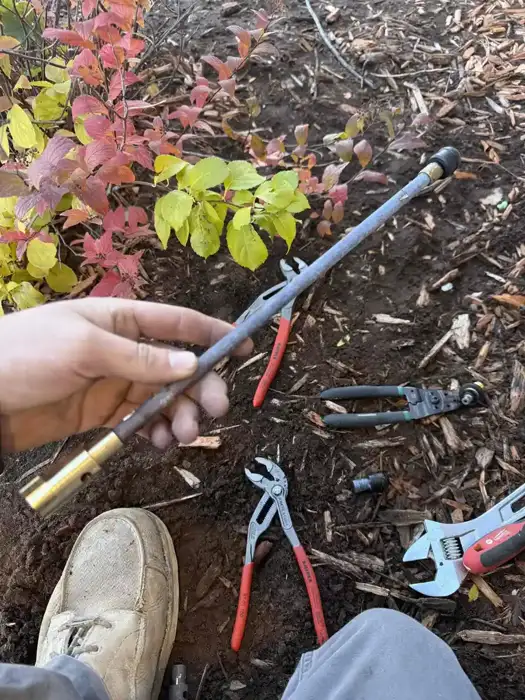
That long stem is why frost free faucets survive Michigan winters, as long as they are allowed to drain. If you are not sure which kind you have, look for the flange, the cap on top, or a handle that turns many times before the water fully stops.
Where is the shutoff valve for an outdoor faucet?
On a standard faucet, the shutoff is inside the house, on the pipe that runs to that wall. In a basement home, stand inside directly behind where the faucet sits outside, look up at the ceiling along the foundation wall, and follow the pipes. The valve is usually within a few feet of where the pipe goes through the wall.
Newer installs often have a ball valve, a valve with a lever handle that turns a quarter of a circle. Here is one our technicians installed on the line to an outdoor faucet.
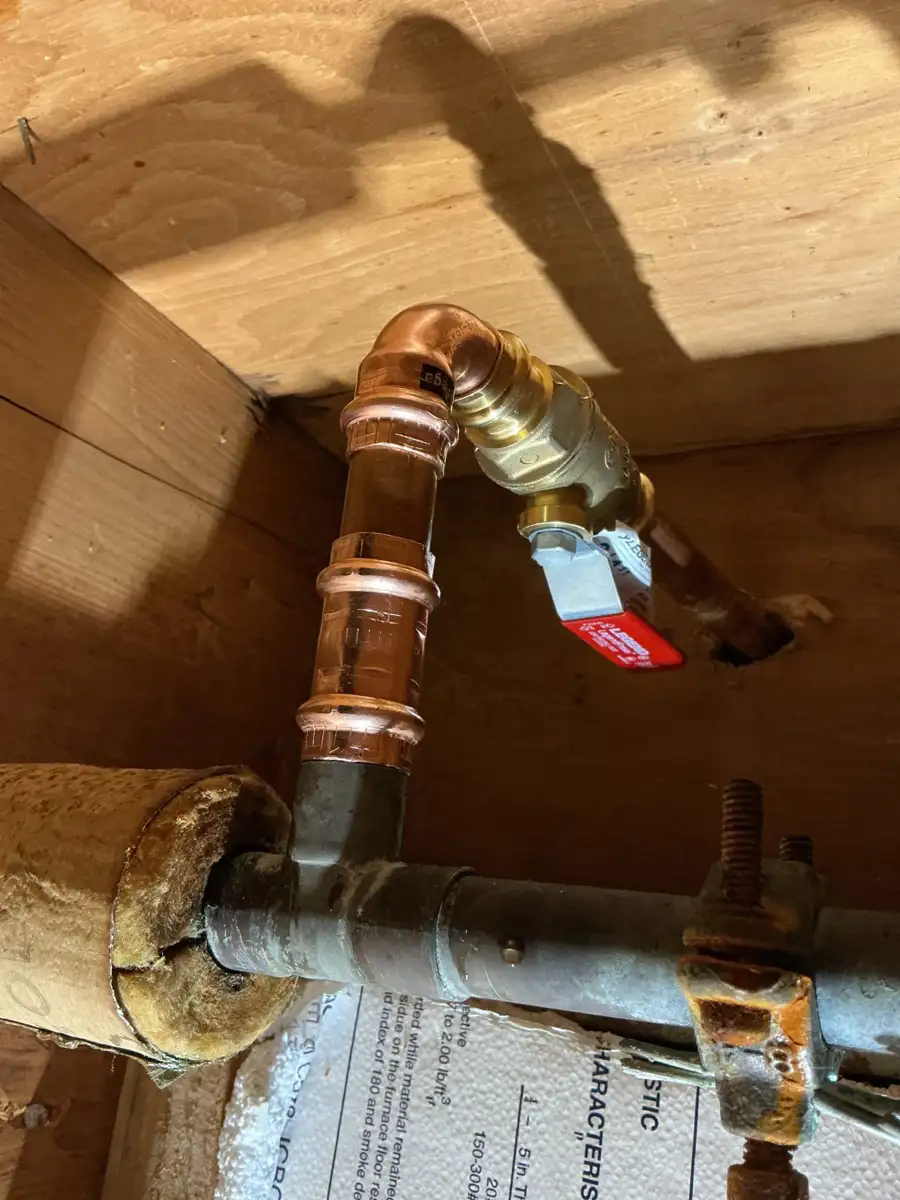
A lever handle running along the pipe means open. Turned across the pipe means closed. That is the easiest kind of valve to winterize with, and the one we install when we replace an outdoor faucet line.
Older homes usually have a valve with a round wheel handle instead. Those turn clockwise to close, the same direction as tightening a jar lid.
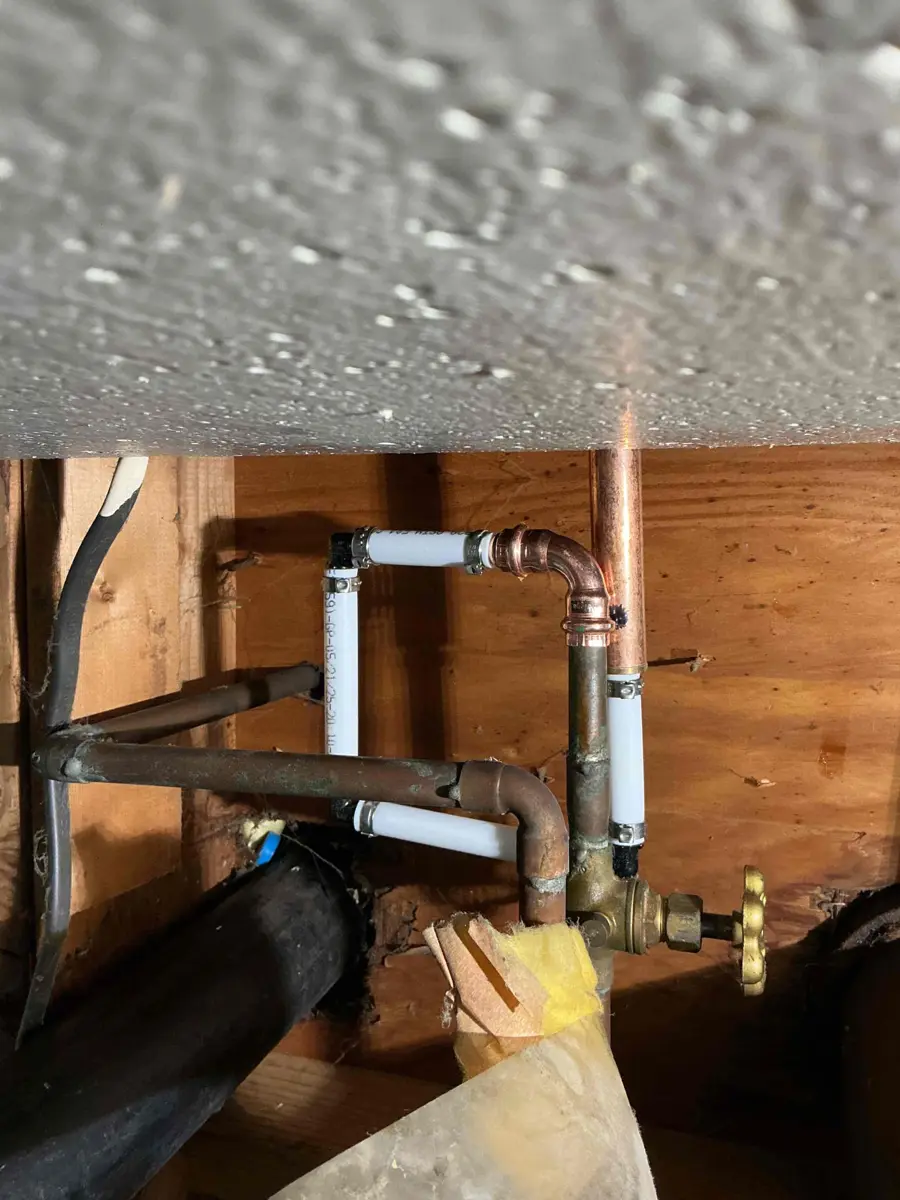
A round wheel handle like this one closes clockwise, and it may take several full turns. Go slowly. If it is stiff, do not use a wrench to crank it, because old valves can snap at the stem.
If you cannot find a dedicated valve, the outdoor faucet may only be controlled by the main shutoff for the whole house. Our guide to finding your main water shutoff valve walks through that. A home with no separate valve is a good candidate for adding one, which is a small job.
In homes with finished basements, the valve is often hidden behind a ceiling tile or an access panel. One homeowner we helped last December tried to shut off the outdoor faucet and closed the valve that fed the upstairs instead. If the valves are not labeled, it is worth tagging them once you find the right one.
Step by step: how to shut off and drain an outdoor faucet
This is the full routine for a standard faucet. If you have a frost free faucet, Step 1 is usually all you need, but read Step 4 for how to check that it drains.
Step 1: Take the hose off. This is the single most important step, for both kinds of faucet. A hose left on traps water in the faucet and keeps a frost free faucet from draining. Here is what that looked like on a call we ran last December.
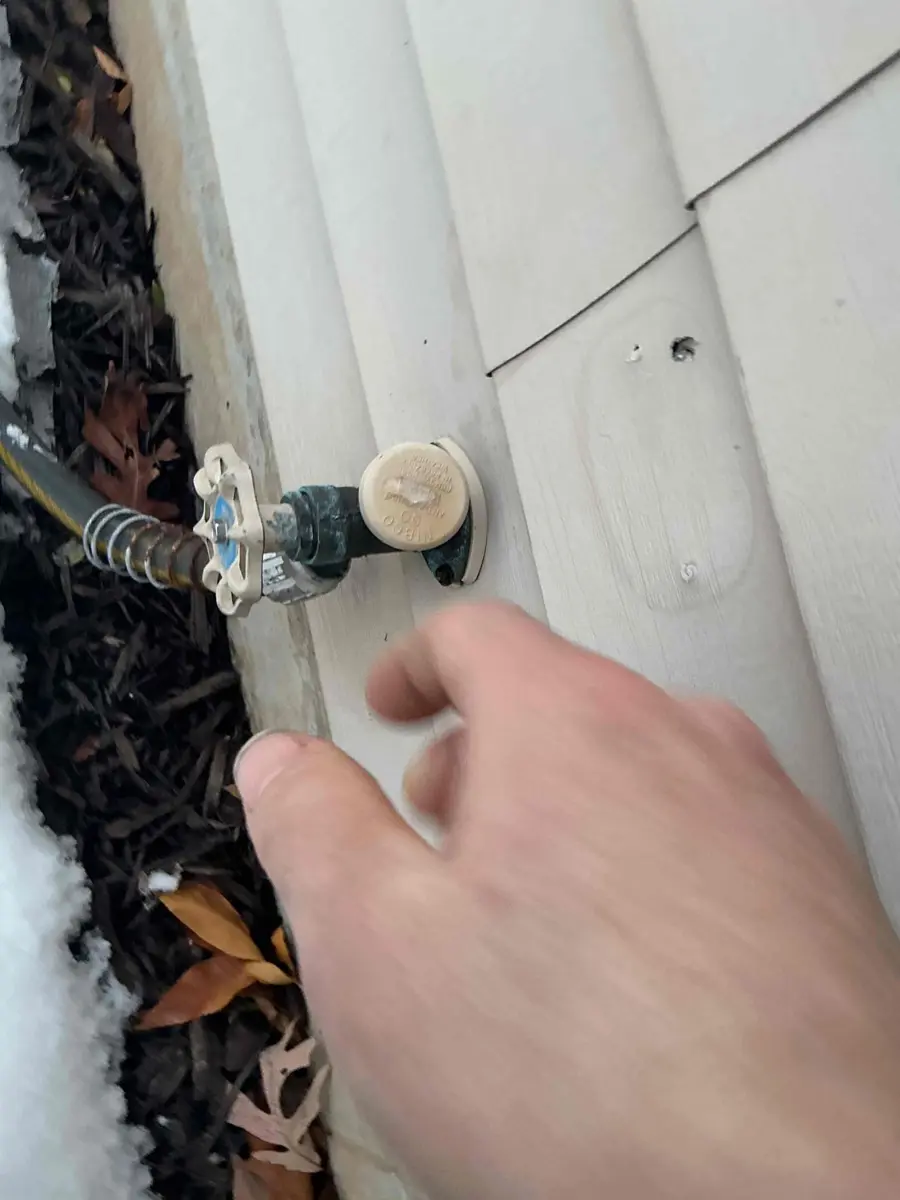
A hose still connected in the snow means the faucet behind it may already be damaged. Unscrew it, drain it, and store it in the garage. Splitters, timers and quick connect fittings need to come off too.
Step 2: Close the inside shutoff valve. Turn the lever across the pipe, or turn the wheel clockwise until it stops. Do not force it. If it drips from the handle after you move it, put a towel under it and call. A slow drip from a valve packing nut is common and simple to fix.
Step 3: Open the outside faucet all the way. Water already in the pipe will run out. On a short line it is a cup or two. On a longer line it can run for a while.
Step 4: Watch it drain. When the flow trails off to nothing, the line is empty up to the inside valve. This is also how you check a frost free faucet: turn it on and off once with the hose removed, and you should see a short rush of water as the tube empties.
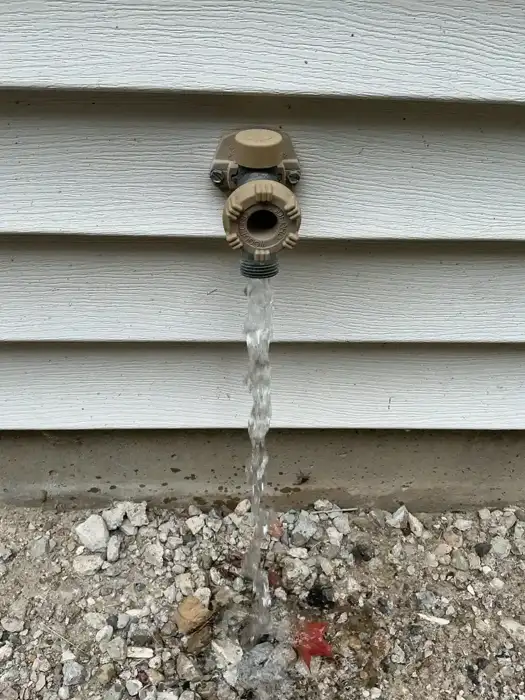
A steady stream that trails off to nothing means the line is draining the way it should. If water keeps running at full strength after the inside valve is closed, that valve is not sealing, and the pipe will refill.
Step 5: Open the drain cap on the inside valve. Many shutoff valves on outdoor faucet lines have a tiny cap on the side, sometimes called a bleeder. Hold a cup under it and unscrew it. A little water and air will come out, which lets the last bit of pipe empty. Put the cap back on loosely so it does not get lost.
Step 6: Leave the outside faucet open for the winter. An open faucet lets any water that seeps past the inside valve drain out instead of freezing in the pipe. If you want extra insurance, add a foam faucet cover over the outside.
We do not have a clear job photo of the drain cap step or a foam cover yet, so those two steps are described in words only.
Why do frost free outdoor faucets still freeze and burst?
Frost free faucets are excellent, and they still break every winter. In almost every case we see, the cause is the same: a hose was left attached. The faucet is designed to drain toward the outside after you shut it off. A hose screwed onto the end blocks that, so water stays in the tube inside the cold wall.
This is the faucet from the same December call as the snow photo above, after our technician pulled it out of the wall.
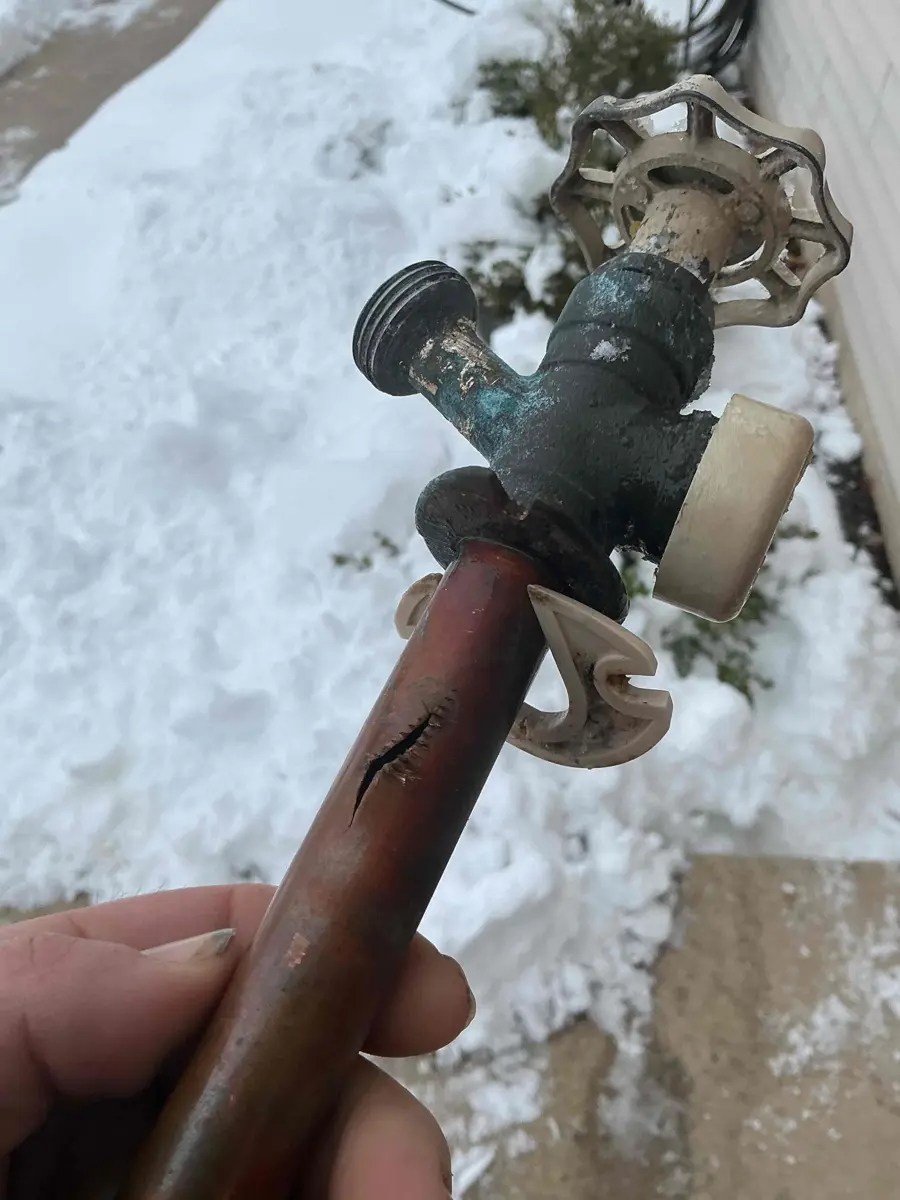
That lengthwise split in the copper is a freeze break, and this faucet had to be replaced. The crack sits inside the wall, which is why these often go unnoticed until someone turns the water on in spring and it runs into the basement instead of out the faucet.
That timing shows up clearly in our own work. Outdoor faucet repair calls stay steady through the winter, then jump sharply from April through June, when people turn the water back on for the first time and find out what froze. Many of those spring leaks trace back to a hose or a valve left the wrong way the fall before.
Here is the inside end of a frost free faucet from a January call where water was leaking into a basement ceiling.
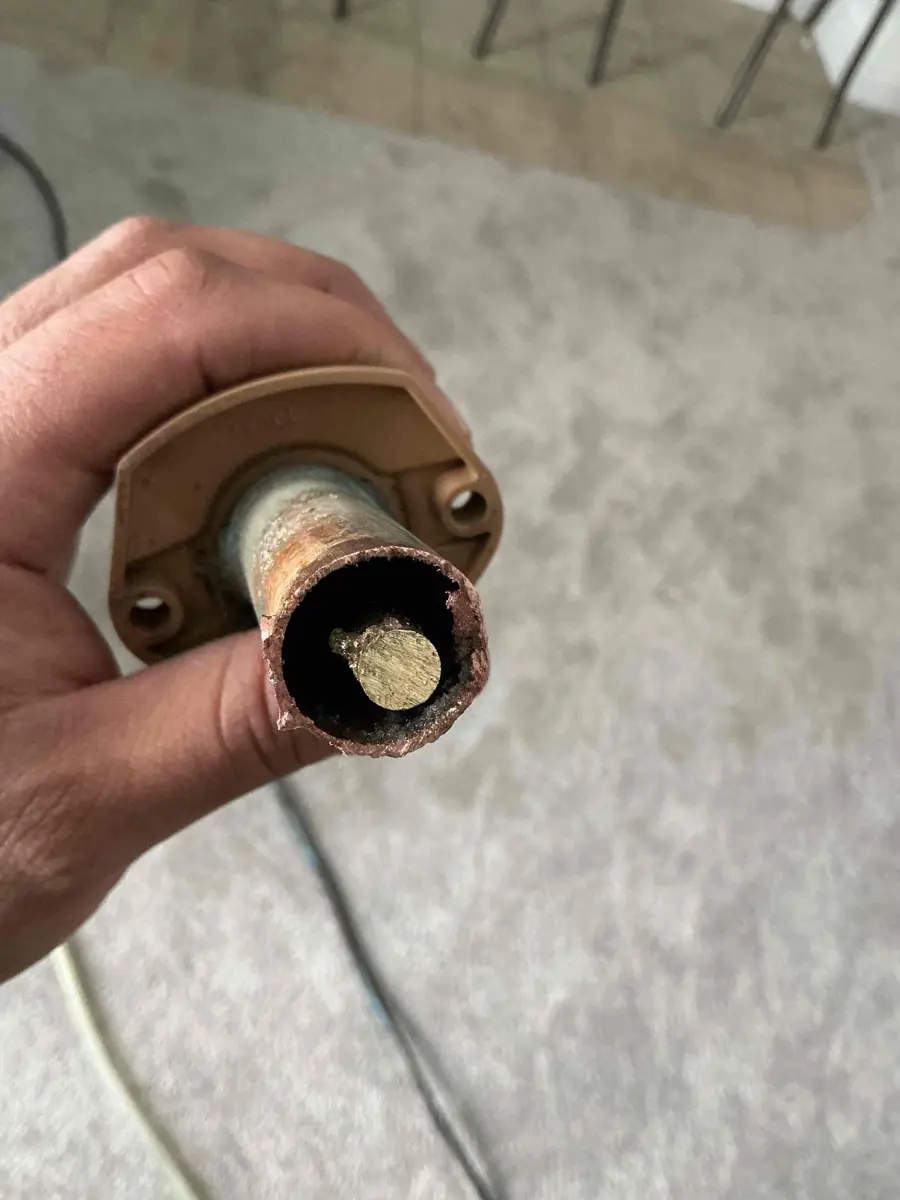
When a frost free faucet fails inside the wall, the repair usually means opening the ceiling or wall to reach it. That is why taking the hose off is worth the thirty seconds.
Other reasons a frost free faucet freezes: it was installed tilted back toward the house so it cannot drain, the tube is too short to reach heated space, or the inside of the wall where it passes through has no insulation and lots of cold air leaking in. If yours has frozen once, one of those is likely the cause, and replacing it with the same part in the same way will not fix it.
How do you winterize a sprinkler line and backflow device?
If your home has an underground lawn sprinkler system, it usually connects to the house water through a backflow preventer, a valve assembly that stops lawn water from flowing back into your drinking water. On many West Michigan homes it is mounted on the outside wall, like this one.
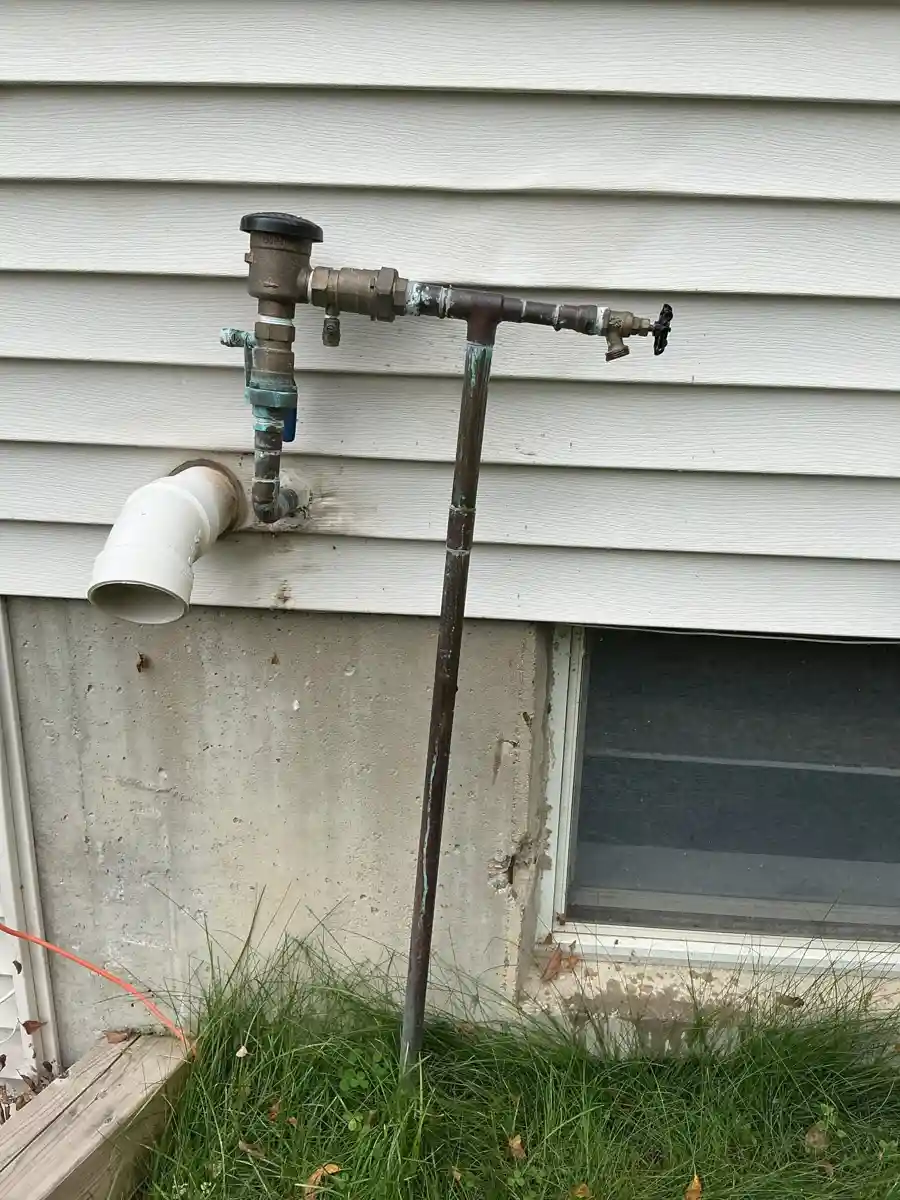
A backflow device mounted outside like this one has to be shut off and drained before the first freeze, or its brass body can crack. The valve that feeds it is inside the house, usually close to where the line passes through the wall.
The basic steps are the same as for a faucet. Close the inside valve, then open the small test cocks on the device so it drains. The sprinkler lines in the yard are a separate job. Most irrigation companies blow them out with compressed air in October, and it makes sense to time the house side for the same week.
A common mix up we see: someone winterizes the sprinkler system and shuts off the wrong inside valve, or a contractor closes more than the sprinkler line. One customer last fall found that the company that winterized their sprinklers had also shut off water to part of the house. If you hire someone, ask them to show you which valve they closed.
Michigan's plumbing code requires lawn irrigation systems and hose connections to have backflow protection (see Chapter 6 of the Michigan plumbing code on UpCodes). Some communities also require yearly testing of sprinkler backflow devices. Our backflow testing service handles both the test and the paperwork.
For more on watering efficiently once spring comes back, the EPA WaterSense outdoor water use page is a good neutral resource.
When should you winterize outdoor faucets in Michigan?
Do it before the first hard freeze, not after. In Grand Rapids, the average first night at or below freezing lands in the second half of October, and a hard freeze in the mid twenties usually follows by early November. You can check the long term numbers and current forecasts on the National Weather Service Grand Rapids climate page.
A single cold night will not always burst a pipe. What does the damage is a hard freeze several nights in a row, or a very cold night with wind blowing against that side of the house.
A practical rule for West Michigan: winterize outdoor faucets the same weekend you put the garden hose and patio furniture away, which for most households is mid October. If a cold snap is in the forecast earlier than that, do it then. There is no downside to doing it early. You can always open the inside valve back up for one last car wash.
The National Weather Service winter safety page and the Red Cross winter storm guide both list outdoor faucets as part of getting a home ready for winter.
If your home will sit empty for weeks over the winter, outdoor faucets are only part of the job. Our guide on how to winterize plumbing for vacation covers the rest of the house, and how to prevent frozen pipes covers the pipes inside the walls.
What should you do if an outdoor faucet already froze?
First, find out whether it is just frozen or actually broken. Close the inside valve that feeds it, if you have not already. That stops more water from getting to a cracked pipe.
Signs it is frozen but probably not broken: no water comes out of the faucet on a cold day, and nothing is dripping inside. Leave the inside valve closed, leave the outside faucet open, and let it thaw on its own as the weather warms. Our guide on how to unfreeze pipes explains safe ways to warm a pipe if you need water sooner. Never use an open flame.
Signs it is broken: water on the basement floor or ceiling near that wall, a stain spreading on drywall, a faucet that runs at full force inside the wall when you open it, or a water bill that jumped. One customer last winter found out from the city that their water use had spiked, and the outdoor faucet was the suspect.
If it is broken:
- Close the inside valve, or the main shutoff if there is no separate valve.
- Move belongings away from the wet area and take photos for insurance.
- Call a plumber. A leak inside a wall or ceiling can keep spreading even after the visible drip stops.
For a basement that is actively flooding, our emergency plumbing team answers around the clock. For a leak you cannot find, leak detection can pinpoint it before anything gets opened up.
When we replace a frozen standard faucet, we usually recommend switching to a frost free model long enough to reach heated space, plus a ball valve inside for easy shutoff. On one February call, that meant a 14 inch frost free faucet so the shutoff end sat well inside the warm basement.
Do I need to shut off outdoor faucets in winter in Michigan?
Yes for a standard outdoor faucet. Close the inside valve and open the outside faucet so the pipe drains. A frost free faucet usually only needs the hose removed, because its shutoff sits inside the heated part of the house.
Do frost free outdoor faucets need to be winterized?
They need one step: take the hose off. A hose left attached traps water in the tube inside the wall, and that water can freeze and split the pipe even on a frost free faucet. Shutting the inside valve too is extra protection, not a requirement.
Should I leave my outdoor faucet open or closed in winter?
For a standard faucet, close the valve inside the house and leave the outside faucet open. That way any water that seeps past the inside valve drains out instead of freezing in the pipe. For a frost free faucet, turn it off normally.
How do I know if my outdoor faucet is frost free?
Look for a flat mounting flange screwed to the wall, a small cap on top of the faucet, and a handle that turns several times before the water stops. A short faucet with a wheel handle sitting right against the siding is usually a standard faucet.
Do outdoor faucet covers work?
A foam cover adds some protection by trapping a little heat from the house around the faucet. It helps, but it does not replace shutting the inside valve and draining a standard faucet. On a frost free faucet with the hose removed, a cover is optional.
When should I winterize outdoor faucets in Grand Rapids?
By mid October, and always before the first night forecast in the twenties. The average first freeze in Grand Rapids lands in the second half of October, and a hard freeze usually follows within a couple of weeks.
How do I know if my outdoor faucet pipe burst?
Turn the faucet on in spring and check inside the house at the same time. Water in the basement, a wet ceiling or wall near the faucet, or weak flow outside while water runs somewhere else all point to a split pipe inside the wall. Close the inside valve and call a plumber.
Outdoor faucet help from NSP Plumbing
NSP Plumbing is a licensed Michigan plumbing contractor (license #8004990) based in Wyoming, Michigan. Our technicians replace frozen outdoor faucets, add shutoff valves and install frost free faucets across Grand Rapids, Wyoming, Kentwood, Grandville, Jenison, Byron Center, Hudsonville, Caledonia and the rest of West Michigan.
If your outdoor faucet already froze, our frozen pipe repair team can find the break and replace it. If you want a stuck valve fixed or a frost free faucet installed before winter, that is everyday plumbing repair for us. You can read what customers say on our reviews page.
Outdoor faucet leaking or valve stuck?
A licensed NSP plumber will check the faucet and the valve inside, fix what is broken, and show you how to shut it off next fall. Pick a time that works for you and we will confirm by text.