Commercial Services
Commercial Hydro Jetting in Grand Rapids
Grease trap backing up? Sewer lateral choked with roots? Recurring blockages your snake won't hold? Our commercial hydro jetters use up to 4,000 PSI of water to clean pipe walls down to the original diameter — built for restaurants, multi-family buildings, manufacturing facilities, and any commercial drain a snake can't keep ahead of.
Quick Answer
NSP Plumbing provides commercial hydro jetting in Grand Rapids, MI, using up to 4,000 PSI of water to scour grease, scale, and tree roots from commercial drain lines that snaking can't keep clear.
- Built for restaurants, multi-family buildings, hotels, medical offices, manufacturing plants, and other commercial properties with recurring drain backups.
- Commercial hydro jetting typically runs $400-$1,200+ per visit, and camera inspection before and/or after jetting is included with the job.
- Unlike snaking, jetting cleans the full pipe diameter back to original flow, so the next clog is months or years out instead of weeks.
- Same-day dispatch for active backups, with overnight and weekend service available for restaurants, retail, and hospitality customers.
Why Does Professional Commercial Hydro Jetting Matter?
Commercial drain lines fail differently than residential. Restaurants, multi-family, healthcare, and manufacturing facilities push grease, soap, scale, hair, food solids, and chemical residue through the same lines day after day. Snaking opens a path through the blockage, but the pipe walls are still coated — so the line backs up again in weeks.
Hydro jetting at the right pressure scours the pipe back to its original diameter, restoring full flow and dramatically extending the time between service calls. For grease lines, it's the only method that actually solves the problem instead of postponing it. For multi-family buildings with chronic root intrusion or scale, it's how you eliminate the recurring emergency. Properties on a regular jetting schedule typically see emergency drain call volume drop by half or more — and that pays for the maintenance contract many times over in avoided lost-revenue closures.
Which Industries Does NSP's Commercial Hydro Jetting Service Serve?
- Restaurants and food service facilities
- Commercial kitchens, catering, and ghost kitchens
- Hotels and hospitality
- Medical and dental offices
- Veterinary clinics
- Manufacturing plants and industrial sites
- Multi-family buildings and apartment complexes
- Schools and educational facilities
- Municipal systems
- Shopping centers, retail, and grocery
- Office buildings and mixed-use developments
How Much Does Commercial Hydro Jetting Cost?
Commercial hydro jetting typically runs $400-$1,200+ per visit depending on line size, length, blockage severity, and facility access. Restaurant grease lines on a quarterly maintenance schedule are often priced lower per visit than one-off emergency jetting. Camera inspection before and/or after jetting is included with the job at no extra charge. If you want the line scoped on its own first, a standalone commercial camera inspection is $250, and we take that $250 off the job if you book the work with us afterward. For multi-line buildings and portfolio property managers, we offer volume pricing and annual contracts. Every job is quoted flat-rate upfront — no hourly meter, no surprise fees.
How Long Does Commercial Hydro Jetting Take?
Most commercial jetting takes 2-4 hours depending on system size and severity. Single-line restaurant grease jobs are usually 1-2 hours. Multi-line buildings or full main-line jetting with camera verification can be 3-5 hours. We dispatch same-day for active backups and schedule routine maintenance around your operating hours — overnight and weekend service is standard for restaurants, retail, and hospitality customers who can't pause during the day. Emergency response in metro Grand Rapids is typically 1-2 hours from your call.
What Should You Expect?
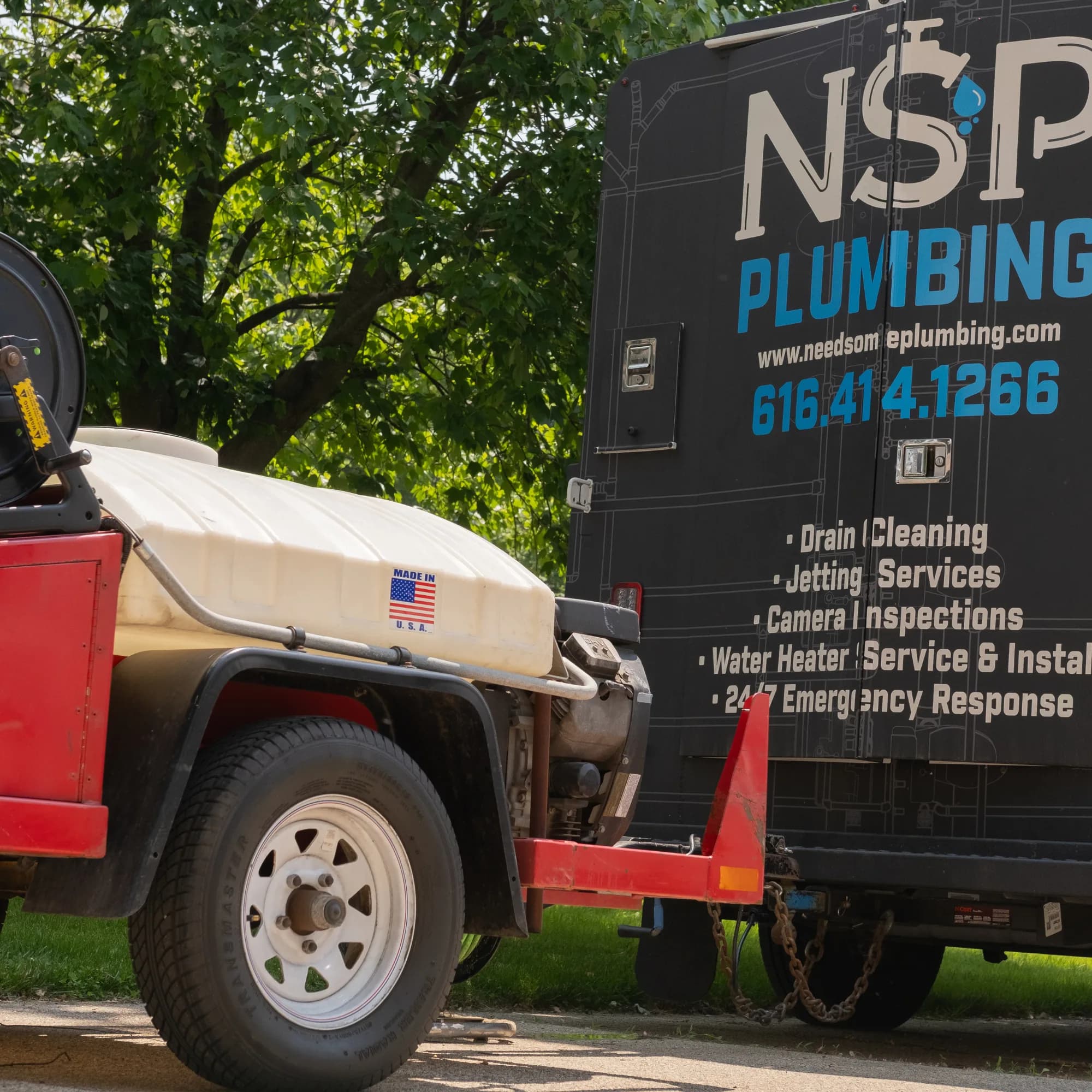
Our technician arrives with a commercial-grade hydro jetter, camera reel, and the right nozzle set for the line we're servicing. We camera-inspect first when the line history is unclear, then jet at the appropriate pressure — different lines need different PSI, and matching the equipment to the pipe is what separates safe jetting from damaging it. After jetting we verify flow, optionally re-camera to document the cleaned pipe, and walk you through the findings.
If we identify structural problems (root entry, broken section, belly), we'll show you the footage and recommend the right repair — without pressure. You get a written invoice and any inspection records for facility files. For maintenance customers we keep visit history on file so the next technician shows up already knowing your system.
Frequently Asked Questions
Quick answers to common questions about our commercial plumbing services.
Hydro jetting uses a high-pressure water stream — typically up to 4,000 PSI on commercial work — delivered through a specialized nozzle to scour pipe walls clean. Unlike a snake, which punches a hole through a blockage, jetting cleans the full pipe diameter, removing grease, soap scale, sludge, mineral buildup, and tree roots. It's the standard method for commercial grease lines, restaurant kitchens, and any line with recurring clog problems.
It's safe for most commercial plumbing in good condition. Modern PVC, ABS, cast iron, clay tile, and Orangeburg in serviceable condition all handle jetting at the right pressure. We camera-inspect first when the line history is unclear or pipe age is in question — if we find badly deteriorated cast iron, severely cracked clay, or compromised joints, we adjust pressure or recommend a different approach. A licensed technician matches PSI and nozzle to the line, which is why DIY jetters or undertrained operators sometimes cause damage that we then have to repair.
Snaking punches a hole through the blockage and is fast and inexpensive — great for one-time clogs. But the pipe walls are still coated with whatever caused the clog, so the same line tends to backup again in weeks or months. Jetting strips the pipe back to its original diameter, which means the next clog is months or years out instead of next week. For commercial grease lines, restaurants, and multi-family buildings with recurring backups, jetting is almost always the better total-cost option.
Restaurant grease lines often benefit from quarterly or semi-annual jetting. Multi-family building mains usually do well on an annual cycle. Manufacturing facilities with process discharge vary widely based on what they discharge. We recommend a schedule after the first inspection — and most maintenance-plan customers see their emergency call rate drop dramatically once the lines are on a regular jetting interval.
Jetting cuts through and removes the roots inside the pipe, but it doesn't kill the source tree above ground — roots can regrow. For lines with chronic root intrusion, we often combine jetting with a follow-up camera inspection to identify entry points (joint offsets, cracked sections) and recommend spot repair or trenchless lining to eliminate the entry path.
Yes — and it's recommended for any commercial line we haven't seen before. We camera-inspect first to assess pipe condition, confirm jetting is appropriate, and identify the blockage type. After jetting we can verify the line is clear and document the result. The combined service is the gold standard for recurring commercial drain issues.
Protect uptime with proactive plumbing support
Schedule service with NSP Plumbing to keep your facility running smoothly.
Service Areas Near Grand Rapids, MI
NSP Plumbing provides commercial plumbing service for businesses throughout Grand Rapids, MI and the surrounding West Michigan communities.
Ada, MI
Byron Center, MI
Caledonia, MI
East Grand Rapids, MI
Grand Rapids, MI
Grandville, MI
Jenison, MI
Middleville, MI
Walker, MI
Wyoming, MI
Kentwood, MI
Cascade, MI
Rockford, MI
Hudsonville, MI
Lowell, MI
Need something not listed here? See every commercial plumbing service we offer, or browse all of our service areas.
Related Plumbing Services
Other commercial plumbing services NSP Plumbing offers across West Michigan.
See How NSP Plumbing Can Transform Your Business
Connect with our team to discover custom plumbing solutions designed for your business. We'll ensure your operations stay efficient and problem-free.